May 27, 2012

Pentecost at St. David’s

Sign at St. David’s
St. David’s sign. The old church can be seen at the right.
Episcopal Church services returned to St. David’s in Peters Township on this day of Pentecost. (See “Changes Coming to Pittsburgh Diocese.”) The Rev. Kris McInnes, associate rector of my own parish, St. Paul’s, Mt. Lebanon, conducted services at 8 o’clock and at 10:30. He also presided over an informational meeting between the services.

Although the word had been put out in various media about what was to happen today, it was unclear just how many people would show up at St. David’s. (Among other things, Kris and St. Paul’s’ rector, the Rev. Lou Hays, had sent a letter to people who have been worshiping at the church.)

When I arrived at the East McMurray Road property, I was delighted to find that the signage now declared the church an Episcopal, not an “Anglican,” facility. I was also happy to see that the electronic portion of the sign had been reprogrammed, not only welcoming worshipers to an Episcopal church but also giving the times of services and of the parish meeting.

I had not visited St. David’s since the 2002 diocesan convention at which then Bishop Robert Duncan’s take-no-prisioners march to the right became painfully evident. I had forgotten what an impressive facility St. David’s is. The parking lot is enormous, there is a rectory on the property, and there is a good deal of undeveloped land behind the church. In 2001, the congregation built a completely new worship space that, unfortunately, never seems to have attracted sufficient worshipers either to fill it or pay for it. The new church is of a pleasing contemporary design and is well-equipped to support worship in a variety of styles.

St. David’s Episcopal Church
St. David’s. The new church is at the right.
As I was taking pictures outdoors, Elaine Coleman drove up and said hello. She is a former St. David’s parishioner who has been worshiping at All Saints’, Bridgeville, and wanted to see what was happening at her former parish. She was one of a number of people who had once worshiped at the Peters Township church who showed up this morning, though most such people came only for the 10:30 service.

When we entered the building, we were greeted with a table containing sign-up sheets—more on that later—and a table containing a variety of breakfast foods and a cake. Juice was plentiful, but coffee was in short supply. (This is a problem that needs to be fixed by next Sunday!) The people who had attended the early service were milling around and talking.

I was able to have a brief conversation with Kris, who was making more coffee in a painfully small coffeemaker. He told me that there were 10 people at the early service. Kris grew up at St. David’s, and I asked him how it felt to be coming home. He indicated that it did not feel quite as strange as it might have. He had left for college before the new church was built, so, although he was, in a sense, returning to his roots, he would be leading services in a place where he personally had never worshiped regularly. Obviously, however, he knew most of the people who would attend St. David’s this morning, and his mother and sister were prominent among the St. David’s people returning to the Episcopal Church fold.

Only 10 people attended the informational meeting. Kris did a fine job of describing the provisions that have been made for St. David’s, including financial ones. The diocese has committed to making up any deficits for a year, and it will do so for at least another year if all goes well. The priests from St. Paul’s, Kris and Lou, are committed to staying as long as necessary. Rental income, he suggested, will help the financial situation a lot. (There is a preschool at St. David’s. I don’t know what other sources of rental there might be, though the rectory could perhaps be rented.)

Kris explained that services had been scheduled at 8 and 10:30 because those are the times at which services have been scheduled at the church, but he suggested that the two services might soon be consolidated into one. He asked if anyone would be upset if only a Rite II Holy Eucharist were offered on Sunday morning. No objections were registered.

There is an urgent need, Kris said, for a treasurer. People from St. Paul’s are available to help a new treasurer get up to speed. (Only the ability to balance a checkbook is required, we were told.) Additionally, there will need to be volunteers to be on altar guild and vestry, and other volunteers to serve as ushers, chalice bearers, and the like. He invited people to put their names on the sign-up sheets I mentioned earlier to begin building a list of parishioners and possible volunteers. We want to be transparent, he said, and not cut corners. Some changes will need to be made to parish bylaws, allowing for a vestry smaller than the currently required 12, for example.

Inevitably, I suppose, someone asked if the things that had been said about The Episcopal Church during St. David’s’ “Anglican” days were true. (The person who asked the question referred to a “packet of materials” that had been promoted at the church. I presume the “packet” was the scurrilous document from the American Anglican Council, “The Episcopal Church: Tearing the Fabric of the Communion to Shreds.”) Kris pointed out that only a few church leaders were quoted in the material in question and that the church’s theology is determined by its prayer book, not by its leaders. He suggested that bishop-elect Dorsey McConnell is quite orthodox in his beliefs and will work to bring us together. The focus at St. David’s will not be on church politics, he added, but on love, charity, and grace. I added that The Episcopal Church has both liberal and conservative bishops and that Anglicanism, historically, has been characterized by its theological diversity.

The meeting was, in fact, rather brief, and we were soon back in the narthex discussing St. David’s, enjoying the refreshments, and greeting new people as they arrived. Of greatest concern to those with a longstanding connection to St. David’s was the disappearance of some stained glass. Apparently, the departing congregation agreed not to take the stained glass but did so anyway. (One hopes there was a misunderstanding, and the property will soon be returned.)

By the time we were ready to begin the second service, there were roughly 40 people in the church, including a handful of children. I'm not sure how many were in what category, but the congregation included people who had remained at St. David’s after the 2008 schism, recent and not-so-recent former parishioners, and well-wishers.

Worshipers were provided with a service leaflet that contained the entire service, so neither prayer book nor hymnal was required. The service itself was fairly traditional. There was no choir, of course, but hymns from Hymnal 1982 accompanied by electronic organ represented about half the music used in the service. The rest of the music was provided by a small praise band, which included Kris on guitar. (Apparently, about half the instrumentalists who had been playing at St. David’s stayed and half left.)

Communion at St. David’s
Kris begins distributing the elements of communion.
Kris delivered a fine sermon based on the reading from John’s gospel. He emphasized that St. David’s will be a church of love, charity, and grace, a place where love and peace will be offered where there has so often been discord and hate. He pointed out that apostles Matthew, a tax collector for the Romans, and Simon the Zealot were poles apart yet were brought together by Jesus. If those two could get along, he said, we can all come together at the same table.

At the announcements, Kris repeated some of what he had said at the earlier meeting, and again encouraged sign-ups and volunteers. He also read a letter from Bishop Price. The bishop wrote that there is no more appropriate day than Pentecost for a congregation to begin a new life together. Jon Delano, a layperson from St. Paul’s who is chair of District III and a member of the Standing Committee, said a few words as well that might best be characterized as a welcome and a pep talk.

The rest of the service proceeded uneventfully, and worshipers greeted the preacher, partook of the refreshments, conversed, and, eventually, said their goodbyes.

It was, I think, a good beginning for a St. David’s returned to its former status in the Episcopal Diocese of Pittsburgh. Lou will preach next week. I hope that no one will be disappointed that he doesn’t play guitar.

May 24, 2012

What’s Wrong with My Oxalis?

My Oxalis—see picture below—seems to be sick. In many ways, the plant seems fine, but the leaflets have developed white spots. Can anyone suggest what the problem might be and what I should do about it?

Sick Oxalis
Sick Oxalis
Click for larger picture.

What to Do about Pakistan?

An interesting thought occurred to me yesterday.

What sparked the idea was the news story that Pakistani doctor Shakeel Afrid had been convicted of treason for his assistance to the CIA in finding Osama bin Laden and sentenced to 33 years in prison. This was just the latest indication that Pakistan, ostensibly an ally, is substantially hostile to U.S. interests and coöperates with the U.S. only insofar as it is necessary to collect billions of dollars in foreign aid and other compensatory payments. Pakistan–U.S. relations are most problematic with respect to our operations in Pakistan’s Tribal Areas, where, it seems, we operate drones with impunity to kill members of the Taliban. That the Tribal Areas provide safe haven—relatively safe haven, anyway—for the Taliban is one reason the war in Afghanistan has dragged on so long.

My thought may be half-baked, as I haven’t considered all possible implications, particularly, but not limited to, the fact that Pakistan is a nation possessing nuclear weapons. Anyway, here is my idea: Why not just declare war on Pakistan and fight a real war in the Tribal Areas?

May 15, 2012

PEP Meets with Bishop-Elect

Pittsburgh’s bishop-elect was in town yesterday for a brief visit, and Progressive Episcopalians of Pittsburgh (PEP) took the opportunity to have a conversation with him.

PEP logo

About 35 PEP members brought food for a potluck supper to Church of the Redeemer, Squirrel Hill. They were joined for dinner by Dorsey McConnell, who listened to a brief history of PEP given by PEP president Joan Gundersen, followed by a lively dialogue between PEP members and the next Bishop of Pittsburgh.

Although some questions probed McConnell’s views and intentions, a majority of remarks from those gathered around the table were aimed at explaining the state of the diocese and the path by which it arrived where it is. Much hurt and frustration were in evidence. Many stories told were set in the Duncan era, but it was clear that Pittsburgh Episcopalians believe that blame for the 2008 schism must be shared with Trinity School for Ministry, with Pittsburgh clergy, and with prior Pittsburgh bishops.

The bishop-elect’s least well received response was elicited by a question about same-sex blessings: If, as expected, the General Convention approves trial use of a liturgy for blessing same-sex unions, would a Bishop McConnell allow that liturgy to be used in Pittsburgh? McConnell repeated the noncommittal response he gave at the March walkabouts—see “Walkabout Reflections”—namely, that discussion and consensus would be needed before same-sex unions could be blessed in Pittsburgh.

Although I doubt that McConnell’s answer satisfied anyone in the room, he segued into comments about the episcopate in our church, which were more reassuring. He called the church’s model of episcopal ministry “less than collaborative,” and, although it is largely shaped by canon, he said, “My own sense is that model is almost gone.” It is, he asserted, on the wrong side of both mission and economics.

In actuality, McConnell did more listening than talking—probably not a bad strategy—and he did say some things people seemed happy to hear. For example, he expressed the hope that the diocese would become more proactive in getting out its own message and not simply trying to counter statements from the Anglican Diocese of Pittsburgh.

In response to a question about engaging youth, McConnell suggested that evangelicals have concentrated on the faith of individuals and progressives have focused on society. The two concerns “have gotten pulled apart,” he said, but young people are looking for a faith that is both “spiritually vital and socially engaged.”

Thoughts on the Meeting


Last night’s discussion was cordial, and I suspect that many left Redeemer in a hopeful frame of mind, anticipating a more coöperative, less imperial Pittsburgh episcopate. PEP will be watching, not without some anxiety.

In particular, if a trial liturgy is approved for same-sex blessings and Pittsburgh parishes are not allowed to use it, I believe the prohibition will be taken as a sign that the new bishop is intent on returning the diocese to the bad ol’ days from which we thought we had been delivered. I sincerely hope that no one wants that.

In any case, the role of PEP was articulated in a new statement of purpose handed out at the meeting. You can read it here. No further comment seems necessary.

Changes Coming to Pittsburgh Diocese

Calvary Rector to Retire


The Rev. Canon Dr. Harold T. Lewis has announced that he will be retiring from his current position as rector of Pittsburgh’s Calvary Church. He plans to devote his time to writing. Lewis is the author of several books and numerous hymns. He will perhaps remain best known in Pittsburgh for the lawsuit he initiated against then bishop Robert Duncan and other diocesan leaders in 2003. The litigation resulted in the parties signing a stipulation two years later. That agreement was responsible for the court’s awarding diocesan property to the Episcopal Diocese of Pittsburgh after Duncan supporters voted to leave The Episcopal Church in 2008.

St. David’s to Return as Episcopal Parish


I noted on March 26, 2012, that the parish property of St. David’s, in Peters Township, is to be returned to the Episcopal Diocese of Pittsburgh later this month by the congregation—part of the Anglican Diocese of Pittsburgh—currently occupying the building. There has been much speculation as to the future of the property, on which there is a substantial mortgage.

As it happens, not everyone will be leaving Peters Township to begin worshiping in an unused Roman Catholic church in Canonsburg on May 27. Some people will be staying behind to become the congregation of a restored St. David’s Episcopal Church. Initially, the congregation is expected to number somewhere in the 30s, but it is likely that former parishioners who have stayed away from St. David’s during its “Anglican” period will return. Others may be drawn to a more mainstream Episcopal church from the residential neighborhoods surrounding the East McMurray Road property.

St. David’s, for the time being at least, will not have its own priest. Instead, two priests from my own parish, St. Paul’s, Mt. Lebanon, will conduct services at St. David’s. Rector Lou Hays and associate rector Kris McInnes (who grew up at St. David’s) will alternate performing duties at the nearby church. This is made practical by the addition of Michelle Boomgaard to the St. Paul’s staff as associate rector. The recently ordained Boomgaard has been serving as an assistant at Church of the Redeemer, in Squirrel Hill. A grant from the diocese is allowing St. Paul’s to replace Mabel Fanguy, a part-time priest who left St. Paul’s recently, with the full-time Boomgaard.

Episcopal services return to St. David’s on Pentecost, May 27.

Update, 5/15/2012: A letter to “My sisters and brothers in Christ” from Harold Lewis arrived in the mail this morning announcing the upcoming retirement of Calvary’s rector after sixteen years. According to the letter, Lewis’s resignation takes effect February 28, 2013, but his last Sunday will be November 25, 2012. He and his wife Claudette plan to remain in Pittsburgh after his retirement.

May 13, 2012

Three Silly Poems

Every now and then, my inner Ogden Nash comes to the fore and I begin thinking of poems lacking, well, gravity. Having written no poetry since Labor Day—I think that effort was pretty good, however—perhaps offering a few silly poems is better than letting yet another month pass without writing any poems at all.

So, here are three poems offered just for fun, rather than for inspiring sober reflection.

Casket


The element you’re prone to meet when you’re dead
Is lead.

Excess


To that stack of porno prints, might there be a link
To your printer’s being out of ink?
Ya think?

Persistence


Alchemists of old, I’m told,
Were keen on turning lead to gold.
That failure rates were very high
Did not convince them not to try.


Periodic Table entry for gold
You may have noticed that two atomic elements feature prominently in these poems. I was so pleased with my poem “Mercury” that I’ve long thought of writing a series of poems about each of the atomic elements. It’s easy to understand why no one has done this before, however. Rhyming words like “molybdenum” and “praseodymium” would have taxed even the talents of the real Ogden Nash. Anyway, thoughts of the Periodic Table were, in part, responsible for two of the three efforts.

May 8, 2012

Is It Possible to Reject the Anglican Covenant?

In its upcoming General Convention in July, The Episcopal Church will have to decide how it will deal with the Anglican Covenant. Although we know of two resolutions—both sponsored by bishops—that would put The Episcopal Church on a clear path to adopting the Covenant, it is widely believed that the 2012 General Convention will not go in that direction.

If The Episcopal Church neither adopts the Covenant nor commits to doing so, what are the alternatives? Four basic approaches have been suggested: (1) ignore the Covenant, (2) defer a decision on the pact, (3) gently say no, or (4) reject the Covenant definitively.

OptionsAny resolution likely to be passed in Indianapolis, irrespective of its overall thrust, will assuredly emphasize the desire of our church to remain in the Anglican Communion, even if it is somewhat vague about what that means. One proposed strategy for General Convention is for the church only to affirm our commitment to the Anglican Communion, saying nothing at all about the Anglican Covenant.

The obvious drawback to this strategy is that it will be interpreted by our sister churches for what it is—passive-aggressive. It is well-known that only the General Convention can decide on the Covenant on behalf of The Episcopal Church, and it is equally well-known that the Covenant has been extensively studied. All the Anglican churches have been asked to consider the Covenant. To fail to do so will be seen as arrogant.

Likewise, deliberately postponing a decision will be seen as insincere or irresponsible. The General Convention went along with the Windsor Report in 2006 and agreed (sort of) not to consecrate any partnered gay bishops. In 2009, it accepted the Covenant design project without objection. The expectation is that it is now time for the General Convention to make a decision, not simply kick the can down the road yet again in the hope that we can forever avoid acting like adults.

Then there are the resolutions that say no thanks to the Covenant but don’t quite slam the door. Resolution A126, from Executive Council, is in this category. This resolution begins by expressing “profound gratitude” to those who labored on the Covenant. It then offers the obligatory commitment to the Communion before it pledges the church to “recommit itself to dialogue with the several provinces when adopting innovations that may be seen as threatening to the unity of the Communion. It declares that the church is “unable to adopt the Anglican Covenant in its present form.” In other words, the resolution first accepts an obligation that is one of the most objectionable features of the Covenant, after which it implies that the church might be able to accept a covenant in a somewhat different form.

All of the aforementioned approaches seem designed to keep The Episcopal Church “still in the process of adoption.” In particular, §4.2.8 of the Covenant text reads
Participation in the decision making of the Standing Committee or of the Instruments of Communion in respect to section 4.2 [The Maintenance of the Covenant and Dispute Resolution] shall be limited to those members of the Instruments of Communion who are representatives of those churches who have adopted the Covenant, or who are still in the process of adoption.
One has to ask, however, why we even want Episcopalians to participate in the disciplinary process of §4.2, a process that I, for one, find to be un-Anglican and an invitation to mischief. (Note that rejection of the Covenant, per se, does not remove a church from the Communion nor its members from the Instruments.) Some have argued that, by being at the table, our representatives can vote against applying sanctions. But participating in the process lends it legitimacy I believe we do not want to grant. Further, it seems cynical to put ourselves in a position where The Episcopal Church cannot be disciplined but can participate in the disciplining of other churches.

This brings us to the final approach, which attempts to say a definitive no to the Covenant. I place the model resolution from the No Anglican Covenant Coalition in this category. This resolution avoids expressing gratitude for that for which we are conspicuously not grateful, declares allegiance to the kind of Communion we actually want, suggests that we find ways of strengthening that Communion, and declares that we “decline to adopt” the Covenant for good and sufficient reasons.

In the end, however, we have to ask if it is actually possible to reject the Covenant. Before Church of England dioceses determined that Covenant adoption would not return to the current General Synod, I speculated whether, in such a situation would nevertheless leave the Church of England “still in the process of adoption.” (See “What If the Church of England Votes Against the Covenant?”)

Like so many other concepts, the Anglican Covenant fails to define what it means to be “still in the process of adoption.” This really indicates a lack of imagination on the part of the Covenant drafters, who clearly believed, contrary to all reason, that all Communion churches would quickly adopt the Covenant simply because the Archbishop of Canterbury asked them to do so.

Is the Church of England “still in the process of adoption”? I don’t know. In principal, the Church of England could reconsider the matter when a new General Synod is seated in 2015.  Even if General Convention 2012 resolves, in the words of the No Anglican Covenant Coalition resolution, to “decline to adopt” the Covenant, it might still be “in the process of adoption.” After all, with no time limits on Covenant adoption, the 2015 General Convention could, in principle, revisit Covenant adoption. In fact, the 2012 General Convention cannot bind future General Conventions to not take up Covenant adoption. Therefore, I suggest that it is probably impossible to remove our church from being “still in the process of adoption.”

The reality is that the Anglican Covenant has the potential to haunt the Anglican Communion forever. The only way to escape its malevolent influence is to encourage churches to reject it and to encourage the churches that have adopted it to withdraw, as provided for in  §4.3.1:
Any covenanting Church may decide to withdraw from the Covenant. Although such withdrawal does not imply an automatic withdrawal from the Instruments of Communion or a repudiation of its Anglican character, it may raise a question relating to the meaning of the Covenant, and of compatibility with the principles incorporated within it, and trigger the provisions set out in section 4.2 above.
Ironically, even withdrawal from the Covenant seems as though it might trigger repercussions.

May 4, 2012

The Pope and the Saints

I am listening to a discussion on NPR about the bounties offered to New Orleans Saints defensive players to take out opposing players and about the penalties imposed by the National Football League for the incentive system to injure opponents. To date, I have neither read nor heard any defense of the Saints’ program. There is, of course, some irony in the name of the team caught in what is generally considered unethical—perhaps even sinful—behavior.

To add further irony to the day, while listening to Tell Me More, I encountered a link to a story on the Mail Online Web site. The story is titled “Pope Benedict XVI makes £150,000 donation to ‘disaffected’ Anglican church so it can convert to Catholicism.” Anglican readers, without my help, can figure out the content of the story.

Question for the day: How is what Pope Benedict XVI did any different from what the Saints did?

Extra Credit Question: Who imposes penalties on the Pope for unsportsmanlike conduct?

April 30, 2012

Making Commenting Easier

I made some changes to Lionel Deimel’s Web Log today that should make commenting easier. I had received a number of complaints from people who had had a hard time leaving a comment or who had been unable to leave a comment at all.

Hands typingFirst, I eliminated the need to deal with a CAPTCHA, the challenge-response puzzle that sometimes drove people—I include myself here—crazy.

Second, I reconfigured the blog to put comments on the same page as the corresponding post. I think the new system will be easier to use. The post itself will remain readily available to commenters. Note that, if you don’t see a place to enter a comment, click on the # Comments link, where # is a number, possibly 0.

Third, I changed the way images are displayed when you click on them. This actually has nothing to do with comments, and most readers will not notice a change.

I hope the changes will make reading and interacting with Lionel Deimel’s Web Log a more pleasurable experience.

Let the Confessing Anglicans Confess—Somewhere Else

Paul Bagshaw has been reading the FoCA tea leaves over on his blog Not the same stream. FoCA, of course, is the Fellowship of Confessing Anglicans, which has just finished meeting in London. The FoCA folks are the Calvinist fringe of the Anglican Communion, who mistakenly believe that they represent authentic (“orthodox”) Anglicanism.

Paul’s analysis is quite helpful, as it provides a flavor of what the FoCA crowd is up to, thereby saving you the painful task of reading the tiresome, repetitive drivel they turn out.

I was struck by this depressing observation:
Therefore there will be no schism in the sense of one organization separating itself out from another on a certain day, followed immediately by either or both bodies setting up new structures and legal identities.

Instead there will be a steady continued tearing of the fabric as distinct ecclesial units (parishes, dioceses and provinces as well as individuals) align themselves explicitly with the FoCA. The legalities will depend on the law of each country (property and pensions being governed by secular law) and on the ecclesiastical structure of each Church.
One can quibble about what is and is not schism. And one can speculate as to whether a formal break of FoCA from the Anglican Communion wouldn’t be good for all concerned. I suspect that FoCA sees some drawbacks to a clean break from the Communion. It would be easy for a Nigeria or Uganda to abandon the Communion, but what about a Diocese of Sydney? And what about individual parishes? Like the Anglican Church in North America, FoCA is parasitic and is trying to rustle as many sheep as it can wherever they can be found.

Nonetheless, people have been asking for quite a while whether some churches of the Anglican Communion will actually leave the Communion or whether, for all practical purposes, they already have.

I am inclined to view the Communion as having already split, and believe that it might be time to recognize the new reality. The Anglican Communion is not, in fact, the group of churches in communion with the Archbishop of Canterbury (or, for that matter, the Church of England). England has communion agreements with other churches that have never been considered either Anglican or part of the Anglican Communion. But does it, in fact, make sense to have an Anglican Communion in which it is not the case that every church in it is in communion with every other church?

I don’t know that The Episcopal Church has ever declared broken communion with another church. We did not even do so when Southerners broke away from The Episcopal Church during the Civil War. But the situation is different with, say, the Church of the Province of Uganda, which claims no longer to be in communion with The Episcopal Church. Is The Episcopal Church in communion with the Church of the Province of Uganda nonetheless? Of course not. Being in communion is a symmetric relation. A in communion with B implies that B must also be in communion with A. The Episcopal Church cannot impose communion on its Ugandan counterpart. This is like friendship. I cannot legitimately claim I am Joe’s friend if Joe has publicly declared that I am not his friend and has acted accordingly.

The Episcopal Church should acknowledge the obvious: we are not in communion with Anglican Communion churches that have broken off communion with us. Moreover, an Archbishop of Canterbury who was interested in real, rather than faux, unity of the Anglican Communion would make it clear that a church cannot be in the Anglican Communion if it is not in communion with all the sister churches of the fellowship.

Let’s get on with the Anglican divorce, so we can get beyond the bickering with which the Calvinists have tied the Communion in knots in the past decade or so.

Does Congress Need a More Anglican Approach?

Even Worse Than It Looks
Morning Edition interviewed Norman Ornstein, a resident scholar at the American Enterprise Institute, today. Ornstein, along with Thomas Mann, a senior fellow of the Brookings Institution, has written It's Even Worse Than It Looks, a book arguing that American democracy is threatened by the extremism of the Republican Party.

In their book, the authors declare
One of the two major parties, the Republican Party, has become an insurgent outlier—ideologically extreme; contemptuous of the inherited social and economic policy regime; scornful of compromise; unpersuaded by conventional understanding of facts, evidence, and science; and dismissive of the legitimacy of its political opposition.
In the interview, Ornstein described the Republicans as “pretending the last hundred years of history didn’t happen.” He also said
I don’t believe in a golden mean; I don’t believe you find policy wisdom between two polar points. I don’t dismiss that possibility, but I look at the platform that’s so ideologically based, that’s so dismissive of facts, of evidence, of science, and it’s frankly hard to take seriously.

We’re not against conservatives. Some of our heroes are very, very strong conservatives here. We're not against strong liberals, either. … The problem is not one that is resolved by just turning it over to one side to do simplistic solutions that are based on more wishful thinking than reality. It's finding that hard reality.
Perhaps we need more Episcopalians in Congress. (We once had many more Episcopalians in Congress.) An Anglican approach, after all, seems to be what Ornstein and Mann are calling for.

Congress is properly guided by scripture, tradition, and reason. For the United States, “scripture” is the U.S. Constitution, which, for better or worse, is as subject to interpretation as the Bible. Tradition requires that we do pay attention to the last hundred years and do not, as Ornstein suggested the Republicans want to do, return to the Gilded Age. And reason requires that we use real facts, not made-up ones, and have respect for the conclusions of science. And, of course, Anglicans do not believe in the golden mean, either. The Anglican via media tradition adopts the best from disparate positions.

So, when you cast your vote for Senators and Representatives this November, whenever you can, vote for the Episcopalian.

April 27, 2012

No Anglican Covenant Coalition Offers Model Covenant Resolution for General Convention

The No Anglican Covenant Coalition, of which I am the Episcopal Church convenor, has released a model resolution for the 2012 General Convention on the subject of the Anglican Covenant. The resolution has been posted on the Coalition’s blog. To facilitate deputies’ ability to sponsor this or similar resolutions, the text is also available both as a Microsoft Word file and a PDF file.

The model resolution is the following:

Title: Relation to the Anglican Communion

Resolved, the House of _______ concurring, That the 77th General Convention give thanks to all who have worked to increase understanding and strengthen relationships among the churches of the Anglican Communion, and be it further

Resolved, That the General Convention reaffirm the commitment of this church to the fellowship of autonomous national and regional churches that is the Anglican Communion; and be it further

Resolved, That the General Convention believe that sister churches of the Anglican Communion are properly drawn together by bonds of affection, by participation in the common mission of the gospel, and by consultation without coercion or intimidation; and be it further

Resolved, That the General Convention, having prayerfully considered the merits of the Anglican Communion Covenant and believing said agreement to be contrary to Anglican ecclesiology and tradition and to the best interests of the Anglican Communion, respectfully decline to adopt the same; and be it further

Resolved, That the General Convention call upon the leaders of The Episcopal Church at every level to seek opportunities to reach out to strengthen and restore relationships between this church and sister churches of the Communion.
______

Explanation: Churches of the Anglican Communion have been asked to adopt the so-called Anglican Communion Covenant. The suggestion for such an agreement was made in the 2004 Windsor Report, which proposed “the adoption by the churches of the Communion of a common Anglican Covenant which would make explicit and forceful the loyalty and bonds of affection which govern the relationships between the churches of the Communion.”

The Windsor Report was produced at the request of Primates upset with the impending consecration of Gene Robinson as Bishop of New Hampshire and the promulgation of a liturgy for the blessing of same-sex unions by the Diocese of New Westminster in the Anglican Church of Canada.

Archbishop Drexel Gomez, of the Anglican Province of the West Indies, was entrusted with leading the development of the first draft of a covenant. This same Archbishop Gomez was one of the editors of To Mend the Net, a collection of essays dating from 2001 and advocating enhancing the power of the Anglican Primates to deter, inter alia, the ordination of women and “active homosexuals,” as well as the blessing of same-sex unions. Archbishop Gomez’s punitive agenda remains evident in the final draft of the proposed Covenant.

Despite protestations to the contrary, the Anglican Communion Covenant attempts to create a centralized authority that would constrain the self-governance of The Episcopal Church and other churches of the Communion. This unacceptably inhibits Communion churches from pursuing the gospel mission as they discern it.

The Church of England has already declined to adopt the Anglican Communion Covenant. The House of Bishops of the Episcopal Church in the Philippines has indicated that they will not support the Covenant, and the rejection of the Covenant by the Tikanga Maori of the Anglican Church in Aotearoa, New Zealand and Polynesia renders it virtually certain that those churches will also reject the Covenant. A number of Global South churches have indicated that they will decline to adopt the Covenant.

The deficiencies of the Covenant are legion, and the Anglican Communion faces the prospect of becoming a fellowship not united but divided by the Covenant. It is essential to reject the Anglican Communion Covenant in order to avoid the Communion’s permanent, institutionalized division.

To date, three resolutions on the Anglican Covenant have been proposed, none of which is completely satisfactory. (Although colleagues in the Coalition will agree with much of what I say in this post, the opinions expressed should be considered my own and not that of the Coalition.) This, of course, is why the Coalition is offering its own resolution.

It is important to reject the Covenant categorically. It is difficult to say with confidence that no conceivable covenant would be acceptable, since the notion of a covenant is itself flexible. (I even proposed provisions for a covenant in my essay “The Covenant We Do Need.”) But I believe it is necessary to make it as clear as possible that the covenant currently on offer is simply unacceptable, now and forever. There will be, I fear, a movement among bishops to somehow preserve the fiction that we are “still in the process of adoption,” a state which the Covenant, like so many other concepts, fails to define with any usable precision. Any suggestion that we still might adopt the Covenant will only prolong the agony to which the covenant process has subjected the Communion. What might we have accomplished had we actually talked to one another about the issues that divide our churches, rather than performing an elaborate kabuki dance, pretending that it would lead to a framework that would magically unite us?

One can only hope that a definitive rejection of the Covenant will be an inspiration to other churches to admit publicly that the Covenant emperor has no clothes. Our churches are already divided into three classes—arguably more when one considers the action of South East Asia, for example—covenanted, non-covenanted, and still-in-the-process-of adoption. This situation, which can only get worse, demands that we put the Covenant behind us. I had originally proposed that the final paragraph of the resolution call upon church to reject the Covenant if they have not acted on adoption and, if they have, to resign from the class of covenanted churches. Lest The Episcopal Church seem overbearing, however, we substituted the milder fifth provision seen above.

General Convention resolutions often begin by thanking someone for something, even if the church is going to reject whatever it is they were responsible for. This passes for politeness, but, in many cases, is really disingenuousness. The resolution offered by Executive Council, for example, resolves “That this 77th General Convention express its profound gratitude to those who so faithfully worked at producing the Anglican Covenant.” This is a bit like thanking the Queen at whose behest your head is about to be cut off. The model resolution preserves the conventional form but is rather nonspecific about the object of the church’s gratitude. (Hint: It is neither Rowan Williams nor Drexel Gomez.)

The second and third paragraphs of the resolution reaffirm the commitment of The Episcopal Church to the Anglican Communion. They also declare the nature of the Communion to which we are pledging our allegiance. It remains to be seen whether such an Anglican Communion is gone forever. If it is, we may not want to be a part of it. The important relationships of the Communion are bilateral ones between churches, dioceses, or individual parishes. Such relationships do not need a Lambeth Conference, Anglican Consultative Council, Primates’ Meeting, or, for that matter, an Archbishop of Canterbury.

Although the purpose of the resolution is to decline to adopt the Anglican Covenant, the explanation for the resolution says little about its actual provisions. In part, this is because it is reasonable to assume that the people who will vote on the resolution understand its general outlines. This may not be universally true, but one can hardly make the full case against the pact in a paragraph or two. Instead, the explanation tries to make the case that the true intent of the Covenant, at least in the minds of its early advocates, is less than benign.

The reference to the slim volume To Mend the Net, then, is very significant. The book sets out clearly the militant Evangelical view of the sickness besetting Anglicanism, and it proposes a cure that looks much like the Anglican Covenant presently up for adoption. Gomez, et al., wanted to put the power to punish in the hands of the primates. The first draft of the covenant did exactly that, but too many Anglicans found that unacceptable. Equivalent power was instead invested by the Covenant in the Standing Committee. Nonetheless, if you want to learn what “relational consequences” would look like, read To Mend the Net.

A brief excerpt from To Mend the Net will suggest why the “crisis” in the Anglican Communion had only incidentally to do with Gene Robinson. The “orthodox” plan to seize power in the Communion was in place years earlier. This seems a good place to end this essay. Here is Section 1.6 of To Mend the Net:
1.6 The gap that exists between the search for relevance in the North and physical survival in the South has a particular bearing upon two of the controversies that have threatened and are threatening to divide the Communion. The ordination of women may be seen as implicit in the Gospel of Christ or alien to it; something which in itself represents a serious dilemma. This ordination, though, becomes an intolerable problem for the Communion if it is imposed against conscience. Adoption of a new sexual ethic that places great emphasis on pleasure and individual fulfillment creates a crisis of conscience in the Communion whether this novelty is universally imposed or not. The new understanding of sexual ethics and the consequent practices of easy re-marriage and the ordination of active homosexuals and blessing of their partnerships have of course been promoted by the most influential section of the wealthiest of our member Churches. In particular, the ordination of active homosexuals and the blessing of their partnerships is opposed by Provinces with a less powerful voice and for whom the repercussions of such western trends add one more difficulty to witness in regions hostile to the Christian Faith. There has been some consultation about these matters at international level, some mutual concern, but as yet no way has appeared of halting these novel and unauthorized ordinations and blessings. This is the case even though such experiment is devoid of Scriptural or historic precedent, lacking in majority support in the Communion and with totally unforeseen consequences not least for those it is intended to benefit.

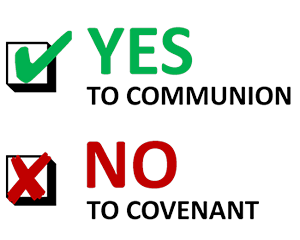
Yes to Communion; No to Covenant

April 25, 2012

Bumper Sticker Riposte

While driving home today, I saw a bumper sticker I had not seen before. It’s too bad I couldn’t put the obvious sign below it. Here is the bumper sticker and the sign I wanted to put below it:


You Can’t Be Catholic & Pro-Abortion bumper sticker


The Episcopal Church Welcomes You sign

April 22, 2012

Snatching Defeat from the Jaws of Victory: How Not to Elect a Bishop

As I’m sure most readers who care about the Episcopal Diocese of Pittsburgh know by now, Dorsey McConnell of Chestnut Hill, Massachusetts, was elected eighth Bishop of Pittsburgh yesterday at Trinity Cathedral. I apologize if anyone was expecting either real-time commentary from me during the election or an immediate analysis once it was over. The former seemed unnecessary, since the diocese was posting vote totals on-line as soon as they became available, and the latter was impossible because I went out for a martini after the election instead.

It was, I think, the consensus view that the search process had run smoothly prior to this weekend. The nomination of Scott Quinn by petition was a bit of a hiccup, but the petition process seemed necessary to assuring fairness.

Going into the final two events of the selection process, the discussion on Friday and the election on Saturday, It was clear that the clergy were largely partial to Dorsey McConnell, with some significant favorite-son support for Scott Quinn. The strongest lay support seemed to be for Stan Runnels. There was significant sympathy for Ruth Woodliff-Stanley, but it was accompanied by a skepticism that Pittsburgh could elect a woman, particularly an avowed liberal who might serve for more than two decades.

I believe that what had appeared to be a well-designed, well-run process, ran off the rails Friday night and Saturday. I have already reported on the Friday gathering. (See “‘Discussing’ the Candidates.”) Before I try to support my thesis, let me report on the voting that took place yesterday.

The voting began with 42 eligible clergy and 86 lay deputies present. Since election required a simultaneous majority in both the clergy and lay orders, 22 clergy votes and 44 lay votes were required to elect a bishop. The balloting is tabulated below:

CLERGY Ballot 1 Ballot 2 Ballot 3 Ballot 4 Ballot 5 Ballot 6
McConnell 16 22 25 29 30 31
Runnels 9 12 14 13 11 10
Quinn 11 6 3
Ambler 2 0 0 0 0 0
Woodliff-Stanley 4 2 0

LAY Ballot 1 Ballot 2 Ballot 3 Ballot 4 Ballot 5 Ballot 6
McConnell 19 24 34 37 42 47
Runnels 33 45 46 48 43 35
Quinn 18 10 3
Ambler 4 0 0 0 0 1
Woodliff-Stanley 12 7 3

To understand what happened, you need knowledge of the candidates, of the diocese, and of the procedures that were used.

Woodliff-Stanley was clearly the most liberal candidate, and McConnell was generally considered the most conservative of the candidates put forward by the Nominating Committee. Quinn was seen as conservative, tolerant of diversity but tainted by prejudices, both positive and negative, for his actions and inactions in the diocese over the years. (I set out the arguments against an internal candidate, in general, and against Quinn, in particular, in “Pittsburghers Nominate Episcopal Candidate by Petition,” “Additional Thoughts on an Internal Candidate for Pittsburgh,” and “Musings on the Candidacy of the Rev. Canon Scott Quinn.”) Michael Ambler and Stan Runnels fell somewhere in the middle, with Runnels to the left of Ambler.

Southwestern Pennsylvania is a conservative region. Under now-deposed bishop Bob Duncan, conservative clergy greatly outnumbered liberal clergy, though a strong moderate-to-liberal combination of clergy and laypeople saved Pittsburgh from at least some of the troubles of San Joaquin, Fort Worth, and Quincy following diocesan schisms. Because opponents of the Duncan program came together months before a split was effected, a larger fraction of the diocese remained with The Episcopal Church, but, unlike the other dioceses experiencing similar trauma, Pittsburgh did not become substantially more liberal thereby. Nonetheless, lay Pittsburgh Episcopalians are, as a group, more progressive than their clergy, many of whom are retired, part-time priests whose prime working years were in a different sort of Episcopal Church.

I will have more to say about procedures presently.  I now want to look at the voting record.

The first ballot offered few surprises. Ambler’s poor showing was prefigured by his lack of apparent support the night before. The minimal support for Woodliff-Stanley was a bit of a surprise, but, as it turned out, those who said we could not elect a women may have been right.

The second ballot made it clear that Ambler’s candidacy was going nowhere, and Woodliff-Stanley’s star likewise appeared to be setting. Unsurprisingly, Quinn’s support declined. Among the clergy, most of the changed votes went to McConnell. On the lay side, votes gravitated predominantly toward Runnels. On this and subsequent ballots, a candidate in each order had sufficient votes for election, though the candidates were different until ballot 6. No one could figure out why Ambler did not drop out of the race, since he received no votes at all. His failure to bow out gracefully became increasingly perplexing.

On the third ballot, whose results were announced after lunch, support for both Quinn and Woodliff-Stanley declined, causing both candidates to drop out before the fourth vote. The clergy vote did not change very much, but Runnels’ support among the clergy reached its apogee. McConnell’s vote total enjoyed its biggest bump among the laity on the third ballot, gaining most of those votes at the expense of Quinn. It was pretty obvious at this point—arguably, it was obvious after the first ballot—that the contest was between the clergy favorite, McConnell, and the lay favorite, Runnels.

On the fourth ballot, the contest was literally between McConnell and Runnels. The lay vote for Runnels reached its high point, 48, on this round, but Runnels actually lost a vote in the clergy balloting. One layperson left the convention before the fourth ballot, so only 43 lay votes were needed to elect a bishop.The clergy preference for McConnell was stronger (69%) than the lay preference for Runnels (56%), but it was clear that without an explicit compromise or one side’s giving in, a consensus candidate could not be selected. The history of clergy voting suggested that the clergy were not likely to throw in the towel. Besides, at this point, it was clear that clergy had been lobbying their colleagues in favor of McConnell.

I considered proposing (or getting someone else to propose) that we have a general discussion about the situation in which we found ourselves, but I did not do so. The next ballot made it clear that electing a reasonably liberal bishop—something I though that those of us who had worked so hard to save the diocese from disaster deserved—was a lost cause. Five lay deputies, presumably watching the clock and wanting to get the matter over with, switched their votes to McConnell. Now, the switching of a single lay vote would elect McConnell. (Only 41 clergy votes were cast on the fifth and sixth ballots.)

On ballot 6, McConnell picked up one redundant clergy vote. Runnels lost 8 votes. Five went to McConnell, assuring his victory; one, oddly, went to Ambler; and 2 simply vanished.

What happened? A liberal-conservative split clearly remains in the diocese, and it is, in part, a lay-clergy split. The laity, in any case, whether out of boredom, impatience, or naïveté, threw in the towel. Not only was I severely disappointed by this, but it made me think that the candidate we really needed was Ruth Woodliff-Stanley, who had the strongest skills and record of bringing divided communities together.

The sad reality is that Bishop Price, perhaps inadvertently, but surely with the complicity of others in charge of the search process, threw the laity under the bus. We were offered the poisoned Kool-Aid of Anglican niceness. Our bishop constantly asserted that an episcopal election is not a “political” process. We were implored to call the five priests standing for the election “nominees,” rather than “candidates.” We were told not to say anything “negative” about any of the “nominees.”

Of course an episcopal election is political! Any process by which a body of people selects a leader is, by definition, political. That the electors are Christians does not make it something other than political. The process can only be more or less successful in reflecting the will of the electoral body. If one believes in the democratic process—the election of bishops, perhaps more than any other element of our polity, distinguishes The Episcopal Church from most of its Anglican sisters—one should be interested in making that process as effective as possible. Among other things, electors should have as much information as possible and be able to exchange that information freely.

On March 27, 2012, I wrote this in my post “Episcopal Election Procedures for Pittsburgh”:
First, in response to the question “Do Clergy and Lay Deputies have a chance to discuss the merits of nominees with each other?” we find this sentence: “There will be NO such open discussion period at the special convention on Saturday.” I argued unsuccessfully against this policy, which encourages cliques to act in concert while preventing the body as a whole from doing so. The convention is a deliberative body, and preventing it from deliberating or allowing deliberation to be conducted only secretly in small groups hardly seems conducive to helping the Holy Spirit in our discernment. Among other things, such a policy gives more power to the clergy, who know one another well, making it easy for them to strategize, whereas lay deputies, who seldom meet, mostly do not know one another and would therefore have a more difficult time doing so.
Need I say that my worst fear was realized? Had it been allowed, I would have wanted to tell lay deputies to stay the course and to prevail upon the clergy to consider the will of their flocks, particularly since many of them would have to live with the decision made at the convention long after many of the clergy voters would be long dead.

Rather than beginning the convention with a brief version of Morning Prayer and ending with a Holy Eucharist at the end of the day, business was conducted in the middle of a Eucharist service, something I have always found manipulative, a way to encourage Episcopalians to do exactly what we often say our church does not demand, namely, checking one’s brain at the door. Moreover, it took valuable time and made those watching the clock that much more eager to elect a bishop, whoever that might be.

The hope, of course, had been that the discussion Friday night would have somehow substituted for substantive consultation at the convention itself. In my aforementioned post, I had this to say about that meeting:
Second, I found this statement disturbing: “Bishop Price and the Standing Committee (which has final oversight over the election process) requests that discussion be positive with respect to nominees and never negative towards any of the five who have put themselves forward for consideration.” In private, I’m sure people won’t feel bound by this admonition, but it could become an issue in the public discussion on the day before the election.
Well, it did. I am aware of at least one instance in which a parishioner, in one of the breakout sessions, heard a disturbing statement from one of the candidates. Repeating the statement and expressing concern about it would have been legitimate, but this person was concerned about being accused of making a “negative” statement and kept quiet. (One speaker was told by the bishop that he was skating close to the edge of the “positive” ice.) Additionally, statements were limited to two minutes, which rattled some people, cut off several, and no doubt discouraged others from speaking. In any case, no real “discussion” was allowed to take place. The actual needs of the diocese, particularly those relating to reconciliation, were little discussed. The session may have been useful to bookmakers, but it was virtually a waste of time for everyone else.

How could the process have been better handled (or better handled in the future)? Primarily, we should drop the pretense that an election is not an election, with all that implies, and is instead some mysterious and holy piece of magic. We are deciding in whose hands to place substantial power, both over the diocese and the wider church. If we believe the decision is that of the Holy Spirit—something I doubt anyone really believes—then we should simply draw lots and be done with it. Otherwise, we should recognize that we have responsibility for an essentially political process and should do our best to design a good process.

More than anything else, I believe that laypeople involved in choosing a bishop need a way of consulting with one another effectively while the election is in progress. Perhaps clergy and lay electors should discuss the election and vote in different rooms, coming together briefly between ballots to talk in plenary session. In any case, I hope that the next time Pittsburgh has an episcopal election, procedures will look different from what was done this time around.

All that said, I am on record orally, if not in writing, as saying that I could live with any of the candidates proposed by the Nominating Committee. I am not recanting that declaration, and I hope that Bishop McConnell will make a fine and fair Bishop of Pittsburgh, perhaps eventually leading the diocese to be, as Ruth Woodliff-Stanley suggested we could be, on the cutting edge of The Episcopal Church.


Update, 4/24/2012: I perhaps gave the impression that Bishop Ken Price was responsible for all the election procedures used by Pittsburgh. He was not. Various other diocesan leaders share that responsibility, as does the consultant we engaged from outside the diocese.

Dioceses do not hold episcopal elections often, of course, and an outside consultant can help the diocese do the sort of things other dioceses have been doing. Both good and bad ideas can be propagated this way. The idea of conducting the election in the context of Holy Eucharist was, apparently, advocated by our consultant. Whether justified or not, I know that some deputies felt manipulated in that they could not sign the necessary forms for The Episcopal Church certifying the election until they had taken communion, suggesting a unity that they did not feel after the sixth ballot. I’m not sure that conducting the election in the context of a Eucharist is such a terrible idea, but, under Bob Duncan, conventions always ended with a Eucharist, and many people left before the service because they were so angered by what had happened during the convention.

Finally, I should correct an error. It was not the bishop, but the president of the Standing Committee who told a speaker on Friday night that she came close to violating the ground rules for the evening.

April 20, 2012

“Discussing” the Candidates

The Episcopal Diocese of Pittsburgh held a session tonight to allow people to speak about the nominees to become Pittsburgh’s eighth bishop. The event was held downtown at Trinity Cathedral and lasted about two hours following an informal hour of muchies and conversation.

The ground rules allowed speakers only two minutes to speak, with an option to speak again after everyone who wanted one had had a turn. Only people with voice or voice and vote at a diocesan convention could speak. There was a good turnout, including a number of people who came simply to hear what was said.

The session, which is not a typical feature of bishop elections in The Episcopal Church, was designed to allow for general discussion, which is unlikely to be allowed at tomorrow’s election. (As I have said before, I think preventing a deliberative body from discussing the matter at hand is counterproductive, favoring back-room deals over more objective decision-making. No one asked for my opinion, however.)

The main program began with Dana Phillips, chair of the Nominating Committee, drawing names of nominees from a hat (a miter, actually). This was to determine the order in which names will appear on tomorrow’s ballots, as well as the order in which the candidates would be introduced at tonight’s meeting. Phillips then read, in the order just determined, brief sales pitches—I don’t know what else to call them—for each nominee. (The order determined by the drawing is McConnell, Ambler, Quinn, Runnels, and Woodliff-Stanley. I don’t know that the order really matters.)

At this point, people were recognized for two minutes to say whatever they wanted to say. Alas, the format did not produce discussion so much as a sequence of unrelated testimonials. Between these testimonials, 15 seconds were allowed for “silent reflection.” The time-keeping was rigorously enforced. As it turns out, two minutes was not really a comfortable length of time for many of the speakers, some of whom were cut off in the middle of what they had to say. On the other hand, some people had prepared speeches that were clearly too long.

Because it is already late and I have to get up early tomorrow to attend the convention, I will attempt to provide only a high-level summary of what was said. I believe the statistics I am about to cite are correct, but there is some room for interpretation and even outright error, so I will not stake my reputation on them.

Eleven laypeople spoke, as did ten clergy. Remarkably, no one spoke in favor of Michael Ambler. I would be shocked if he were to be elected tomorrow.

Three people, all of them clergy, spoke in favor of Scott Quinn. On the other hand, two people, one priest and one layperson, spoke in favor of what I will call not-Quinn. (Some others spoke in passing against any candidate from within the diocese.) I think Scott Quinn’s nomination has been very controversial, and I suspect that his election, which I do not anticipate, would be divisive.

Four people spoke in support of Dorsey McConnell. (I would also construe one of the not-Quinn remarks as a not-McConnell remark as well, but I may have misconstrued intent.) McConnell seemed to get points for thoughtfulness and forthrightness.

Four people spoke in favor of Ruth Woodliff-Stanley. Woodliff-Stanley earned points for administrative experience and skill in reconciliation.

Five people, all of them laypeople, curiously, spoke in favor of Stan Runnels. He was cited for his ideas, vision, and capabilities.

Three people addressed what I will call process, without naming a particular candidate. (A suggestion was made, for example, that our next bishop should be fun to work with.)

Overall, I think tonight’s session was more useful to handicappers than to deputies who have not yet made up their minds. Minds must be made up tomorrow, however. Stay tuned.

Advice to the Crown Nominations Commission

A few days ago, I expressed ambivalence—see “On Giving Advice about the Next Archbishop of Canterbury”—about offering my opinion regarding the sort of person who should be chosen to become the next Archbishop of Canterbury. Nevertheless, in that earlier post, I concluded that “[a]s long as Anglicans across the Communion are being asked for their opinions, I may as well give it.”

Today, I did exactly that. Here is what I said to the Crown Nominations Commission:
 As an Episcopalian, it feels arrogant to be telling the Church of England how to select its bishops. Therefore, my most important advice is to select an archbishop who will address the needs of the members of the Church of England and, in light of establishment, the needs of the English people. The incumbent has misconstrued his position as that of Archbishop of the Anglican Communion rather than as Archbishop of Canterbury.

I have one more related suggestion, which I press for the benefit of the Church of England and the Anglican Communion alike. Please select a candidate who will let the Anglican Communion Covenant die a quiet death. The Covenant has already created a two-tier Communion, a situation likely to make the job of the next Archbishop of Canterbury as spiritual leader of the Anglican Communion needlessly difficult.

April 15, 2012

A Final Look at Our Episcopal Candidates

In my last post on the subject, I offered some objective measures that allow the candidates vying to become Pittsburgh’s next bishop to be compared to one another. Below, I will look mainly at the professional histories of the candidates. There is a little more room for interpretation here, though people of goodwill can disagree both on what our diocese needs and the degree to which the experience of a particular candidate might suggest that he or she is well-equipped to address those needs.

Of course, no one who gets to vote on who will be our next bishop should go to the convention next Saturday without first studying all the material on the candidates on the diocesan Web site.

The Nomination Committee seems to have selected people with the apparent ability to get disparate groups to work together or to reconcile contending groups. How important are those abilities in our next bishop? We are not of one mind about this. Some people feel we need to put the past behind us and simply move forward without, for example, asking, “What did you do in the church wars, daddy?” Others are concerned that we harbor different understandings of what happened in the Pittsburgh diocese over the past decade and who was responsible for it, differences that may cause or exacerbate future conflict.

On the surface, there is reason for optimism regarding diocesan unity. We have successfully rebuilt our diocese from the ground up. (Joan Gundersen is fond of reminding everyone that, after the 2008 vote to leave The Episcopal Church, the Episcopal Diocese of Pittsburgh owned nothing more than a cell phone.) And we have gotten ourselves to the place where, without embarrassment, we are seeking a new diocesan bishop. Turnout for the recent walkabouts suggested strong interest by laypeople in who that next bishop will be.

On the other hand, the diocese has avoided dealing with the kind of hot-button issues that have divided Christians here and elsewhere, partly because we have been too busy putting the diocese back together. Are we ready to deal with divisive issues when—as they inevitably will—they raise their ugly heads? Walkabout attendance notwithstanding, are we really ready even to be a diocesan community? The failure of Joyful People a year ago is not encouraging. (Joyful People, you may not recall, was a proposed day of workshops and activities for the diocese. It attracted little interest and had to be cancelled.)

Our next bishop will have many tasks on the diocesan plate other than gathering us all into one big happy family: finances, deployment, property management, and litigation among them. Most importantly, a decade from now, we can hope that the Episcopal Diocese of Pittsburgh will be seen as a community that is in the business of diminishing human suffering, not causing it.

With that introduction, let’s take a closer look at the candidates to be our next bishop.

Michael N. Ambler, Jr.

Ambler’s education has taken him to New Jersey, Michigan, and Massachusetts, but one might object that his professional life has been spent exclusively in Maine, where he has been a lawyer and a priest. He is both the youngest candidate and the candidate who has been a priest for the least number of years.

Ambler's pastoral experience has mostly been at Grace Episcopal Church, Bath, Maine, where he began as priest-in-charge and is now rector. He has been at Grace for 10 years, having first served as an assistant rector at St. David’s, Kennebunk, for about two years. Both parishes have average Sunday attendance (ASA) around 150. Since last year, Ambler has been priest-in-charge of St. Philip’s, Wiscasset, a church with an ASA under 50. He has hired a newly ordained intern with whom he shares responsibilities for the two churches while serving as a mentor to the new priest. This kind of sharing of resources might well be applicable in a diocese such as our own, which includes a number of small, struggling parishes.

Ambler has been an active  priest in his diocese. He was a General Convention deputy in 2006 and has served on Maine’s Standing Committee since 2009. He serves as a liaison between the cathedral and the diocese, and he is a member of a task force created by the bishop to examine mission strategy. (There is more useful experience here.) He has served on the diocesan trial court and Province I court, apparently without having to try any cases. Ambler’s legal training would possibly be an asset as our diocese continues to resolve the issues brought about by the departure of Bob Duncan and his followers.

On the reconciliation front, Ambler has had training in conflict mediation from the University of Southern Maine and in mediation and church systems from Lombard Mennonite Peace Center. His résumé describes his work as a “mediator and consultant” in the diocese of Maine as “frequent and ongoing.” He works with congregations experiencing conflicts of one sort or another and is on a diocesan response team that provides pastoral care in cases of alleged misconduct.

Ambler believes that we will eventually get past our arguments about sexuality by recognizing that standards of behavior necessarily change over time. In fact, he sees a willingness to change as an important characteristic of Anglicanism. Despite his legal background, Ambler does not seem legalistic in his thinking when it comes to the church. (He wouldn’t discipline a priest for offering open communion, for example, even though he is not in favor of open communion and it is not now allowed by the canons.) He believes that both clergy and laypeople should be doing the work of the church outside its doors. (We in this diocese have necessarily been focused on ourselves for the past few years, and this attitude might be one that would be helpful now.)

I have heard a number of people express concern at Ambler’s statement “I believe the stories of the scripture are true.” He went on to say that he does not view them as metaphorical. So, was the world created in seven days? I don’t know that anyone followed up with such a question, but the Ambler declaration seems to demand qualification or explanation.

If you want to see Ambler preach, his Easter 2012 sermon is here.

Dorsey W. M. McConnell

It is harder to summarize McConnell’s career. He is a decade older than Ambler but has been a priest for 17 more years. The parish where he is currently rector, Church of the Redeemer, in Chestnut Hill, Massachusetts, is in the Diocese of Massachusetts. Although it has an ASA of only about 175, it has a budget of over $700,000 and, as Episcopal parishes go, a large staff.

McConnell has held other positions in the dioceses of Olympia, New York, and Connecticut. His experience is quite varied. He has, among other things, been chaplain to a New York City trade union, a chaplain at Yale University, has been involved in a ministry to the homeless, and has been part of a shared ministry involving ELCA parishes. He has been a General Convention deputy and alternate deputy, and has been on a Cursillo secretariat. He is on the Commission on Ministry of the Diocese of Massachusetts. Before becoming a priest, he was a polo groom, a wrangler in Argentina, an actor, and a news editor.

Perhaps one of McConnell’s more interesting experiences (and relevant to Pittsburgh) was described by him on our diocesan Web site as follows:
From 1999 to 2002, I helped found and lead the New Commandment Task Force, a national reconciliation effort within the Episcopal Church, bringing together laity and clergy, liberal and conservative, to see themselves and each other as members of the one Body of Christ.
McConnell is also president of Pilgrim Africa, a Christian NGO working in Uganda. I have thought that it might be time for us to enter into a companion diocese relationship. Perhaps McConnell has good connections to help us to find an appropriate diocese in Africa. (I’ve thought that a diocese somewhat out-of-step with its parent church would be a good match for Pittsburgh.)

Readers looking for more details of what McConnell has done over the years should check out his résumé.

McConnell seems to have Anglo-Catholic leanings but is broadly accepting of different liturgical styles. He appreciates the big-tent that is The Episcopal Church.

Most of the people I have talked to feel that McConnell is one of the more “conservative” candidates, whatever that means. Some people feel that his answers in the walkabouts were carefully couched so as to avoid giving offense. Perhaps, though I certainly wasn’t offended by anything he said.

McConnell’s Easter 2012 sermon (audio only) is available here.

Scott T. Quinn

I have already said a good deal about Quinn’s candidacy, and I see no need to repeat that here. (See my post “Musings on the Candidacy of the Rev. Canon Scott Quinn.”)

Quinn has been rector of Church of the Nativity in Crafton, Pennsylvania, since 1983, the year he became a priest. The weekly attendance at Nativity is only about 80, but the church appears to be healthy, which it was not in 1983. (A sense of the parish can be had in a Tribune-Review story from September 2008 on the occasion of the hundredth anniversary of the church building.)

 While serving at Nativity, Quinn has served stints as a vicar (four years at St. Mark’s, Knoxville) and as a hospice chaplain (two years at Hartland Hospice). He is also serving as chaplain of Old St. Luke’s, which is essentially a wedding chapel.

No doubt, the primary reason Quinn is a candidate at all is that he has been Canon to the Ordinary in our diocese since 2009. Reviews of his efforts have been mixed, but some clergy have found Quinn quite helpful.

Quinn has been active in Boy Scouts, Meals on Wheels, and, improbably, government. He is a councilman in Thornburg Borough.

I could find no sermons of Quinn’s on the Web.

R. Stanley Runnels

Runnels has been rector of St. Paul’s Episcopal Church in Kansas City, Missouri, since 2006. The church has an ASA over 200 and a multi-person staff, though it has a smaller budget than McConnell’s parish. Before moving to the Diocese of West Missouri, Runnels held three parochial positions in Mississippi. Most recently, he was rector of St. John’s Episcopal Church in Laurel, Mississippi, for 17 years.

Runnels is a three-time General Convention deputy from Mississippi. (He resigned as a deputy to the 2006 General Convention due to his move to Kansas City.) In fact, his involvement in church governance has been extensive. He spent eight years on the Standing Committee of the Diocese of Mississippi. He was president of the Standing Committee for three years and clerk for four. He is currently on the Standing Committee of the Diocese of West Missouri. He has been on committees with responsibility for the constitution and canons of The Episcopal Church and was involved in the rewrite of Title IV. He has served as a consultant on Title IV to several dioceses.

Runnels has been a death-row chaplain, a Cursillo spiritual director, a diocesan ecumenical officer, a trustee of a public school system, a trustee of a Christian day school, rector of another Christian day school, and a soccer coach, among other things.

Runnels tells the story of how he introduced Holy Eucharist into the chapel program of the day school associated with his church. The accomplishment is impressive in that many of the families with children in the school are Roman Catholic. Basically, he set a goal and, very methodically, got all the stakeholders on board. This represents the kind of systematic pursuit of an objective one might expect from someone with the patience to tackle the likes of Title IV revision.

I could find no sermons of Runnels on the Web.

Ruth Woodliff-Stanley

Woodliff-Stanley’s education is interesting in that her non-theological education seems to have contributed substantially to her accomplishments as a priest. She holds an M.S. in Social Work from the Columbia University School of Social Work, and her work experience is not dominated by parish ministry but by various kinds of intervention, facilitation, and consensus building. Like Ambler, she has had training at the Lombard Mennonite Peace Center, in addition to other continuing education in mediation and other matters.

Woodliff-Stanley is now rector of St. Thomas Episcopal Church in Denver, where she began as priest-in-charge in 2007. This is another rather small church, with an ASA of a bit over 100. (Many Pittsburgh Episcopalians have been surprised that none of our candidates have come from very large churches. It must be said, however, that the typical Episcopal parish—and certainly a typical parish  in Pittsburgh—is of modest size.) The Web site of St. Thomas reinforces the impression that Woodliff-Stanley is the most “liberal” candidate. (More on that in a moment.) The parish is described in page headers as diverse, Christ-centered, and committed. There is a page on the St. Thomas Web site intended as a welcome to “GLBTQ persons.”

It is hard to get one’s mind around Woodliff-Stanley’s work record, and, if I am reading her résumé correctly, I have no idea what she was doing between 1995 and 1998. She held part-time assistant rector positions in Mississippi for about 5 years before and after that period. She also spent four years as director of the Department of Pastoral Care at the Mississippi State Hospital, a mental institution. She supervised the chaplaincy staff, among other duties.

Life seems to have gotten more interesting when Woodliff-Stanley moved to Denver, where she began a private psychotherapy practice in 2002. About the same time, she began consulting for the Diocese of Colorado. Her work with The Episcopal Church in Colorado is perhaps the strongest selling point for Woodliff-Stanley as Bishop of Pittsburgh. The diocese was very divided, and she worked as mediator and facilitator, both part-time and full-time, to bring the diocese together. (The task of maintaining “the highest possible degree of communion” within the diocese sounds like the goal set for the Anglican Covenant. She seems to have developed a better strategy than has the Anglican Communion, however.) Apparently, the work in Colorado has been viewed as very successful, and, if one sees a similar need in Pittsburgh, Woodliff-Stanley might be a good choice as our next bishop.

Woodliff-Stanley continues as a part-time consultant in Colorado and elsewhere. She is also a General Convention deputy in 2012, is on The Episcopal Church Building Fund board, and was on the Commission on Ministry in Mississippi, among other assignments.

I feel it necessary to say something about where the candidates seem to be on the liberal–conservative spectrum. Although Woodliff-Stanley self-identifies as liberal, I suspect that many Pittsburghers feel that more than one of the candidates is more liberal  than is this diocese generally. In part, this reflects the fact that Pittsburgh has been something of a reactionary backwater in The Episcopal Church, and any of the candidates from outside the diocese is likely to pull us toward the mainstream and broaden our horizons. What is important in our next bishop, though, is not how liberal or conservative that person is, but whether he or she is accepting of diversity and, despite that diversity, can help us to become a more unified diocesan family. Significantly, each of the three bishops who has helped us since the 2008 schism, including Bishop Price, has been “liberal.” I think that most of us would agree that that has not been a problem or, for that matter, much of an issue.

No one need wonder what Woodliff-Stanley is like as a preacher. (Of course, preaching is not the only—perhaps not even a major—job of a bishop.) Her church’s Web site includes multiple pages of sermon texts. She also has video of a stewardship sermon, an Advent Sermon, and a Christmas Eve sermon on YouTube.

Postscript

I spent a good deal of time putting this post together, but it hardly seems definitive. I have not even said all I know about the candidates. What is clear, however, is that our diocese has strong candidates from which to choose, something I hope we will do wisely later this week.

April 14, 2012

An Episcopal Bridge Too Far

Christian Associates of Southwest Pennsylvania logo
I was upset to learn today that the Episcopal Diocese of Pittsburgh—its bishop, anyway—signed on to a statement by Christian Associates of Southwest Pennsylvania (CASP) expressing opposition to the federal mandate that institutions with a religious affiliation must provide no-cost contraceptives to their female employees.

The actual press release has not yet been posted on the CASP Web site, but you can read it here. Video of a news conference held yesterday to publicize the statement is on the Web, however. The conference was hosted by  the Rev. Dr. Donald B. Green, executive director of CASP. The principal speakers were the Most Rev. Robert W. Duncan of the Anglican Diocese of Pittsburgh, and the Most Rev. David A. Zubik, of the Roman Catholic Diocese of Pittsburgh. (Duncan reads the body of the press release in the video, though he is difficult to understand due to an audio problem.)

Clearly, it is the Roman Catholic David Zubik who is the  primary backer of the CASP statement which is, frankly, nonsensical. The statement declares
Today, we speak together about two shared concerns: (1) the preservation of religious liberty as guaranteed in the First Amendment to the Constitution of the United States of America, and (2) the moral imperative of providing healthcare for all, women, men, and children alike.
Calling on the federal government to broaden its exemption so that religious-affiliated organizations can avoid paying for contraception, the statement warns
Many religious institutions are now placed in the untenable position of (a) violating their consciences, (b) ceasing health insurance and paying ruinous fines, or (c) withdrawing entirely from providing the social services to the wider community that have long been a social justice hallmark of their ministry. Creating gaping holes in the public welfare safety net is in and of itself an immense injustice.
All this is so much nonsense intended to support the absurd position taken by the U.S. Conference of Catholic Bishops. I have written elsewhere why I believe the bishops are wrong. (In fact, I believe the exemption should be narrowed, not broadened.) Here, however, I want to concentrate on the statement itself.

The signatories—I will get to the matter of who they are in a moment—claim to be concerned with religious liberty (i.e., the liberty of churches to withhold benefits from employees so as not to offend their own consciences) and universal health care. Nowhere in the statement (or at the news conference) is anything said about how what is generally viewed as basic health care for women is to be provided for female employees of religious-affiliated organizations if their employers are relieved of their responsibility for providing it. The expressed concern for universal health care, therefore, seems less than sincere.

Even less credible are the choices the statement claims are available to religious-affiliated organizations. Religious institutions are not being asked to violate their consciences; they are being asked to abide by the law. (We all are “forced” to support governmental functions of which we do not approve and to which we may have serious moral objections—think fighting wars and applying capital punishment.) The option of “ceasing health insurance and paying ruinous fines” is doubly insincere. Were a hospital, say, to drop health care for its employees, it would soon find itself without employees. And if it managed to dodge that bullet, the fines imposed by the government would be, I submit, less than “ruinous.” Finally, the suggestion that churches might cease to provide social services if forced to provide contraception for employees is extortion, pure and simple.  The threat is a depressing indication that churches—the Roman Catholic Church especially—is willing to sacrifice absolutely anyone for the sake of its own precious doctrine. What, I wonder, would Jesus say?

Upset as I am about the CASP statement, I am that much more upset by the fact that my own bishop, Kenneth Price, was willing to lend his support to this horrible document. It is even more galling that our deposed bishop, now Archbishop of the Anglican Church of North America Robert Duncan, is so publicly associated with the statement.

I do not doubt that Duncan supported the statement with some enthusiasm, but his appearance at the news conference was largely dictated by the fact that he is the current chair of the Council of Bishops and Judicatory Executives of Christian Associates. Interestingly, although 26 judicatories of various churches are represented in CASP, the 18 signers of the statement represent only about 14 of them. Apparently, the thinking on this matter was less than uniform. Reputedly, some did not sign due to restrictions on what their representatives to CASP are allowed to do. The United Methodist Conference of Western Pennsylvania is not represented on the statement, however, because the United Methodist Church has a policy of supporting universal access to reproductive services. (Apparently, the Methodists know insincerity when they see it.)

It is not actually clear to me that Bishop Price had the right to commit the Episcopal Diocese of Pittsburgh to the CASP statement, a matter that perhaps will need to be considered at the next diocesan convention. Certainly, he does not represent my own view in this case, and I know he does not represent the views of a number of fellow Episcopalians with whom I have discussed this matter.

Update, 4/17/2012: The press release is now on the CASP Web site here. A clearer, searchable version (though without the third page of subscribers, which was likely a last-minute addition) is here. These are the related news stories that I know about: