July 30, 2020

The Real Trump Platform

Republicans have decided to forego creating a new party platform for 2020 and to simply reuse their 2016 version. This is administratively simple, of course, but the United States of 2020 is very different from that of 2016, and Donald Trump’s agenda, now that Trump has seen what he can get away with, is rather more expansive. The president will not be too explicit about his real goals for the country, but we can glean some objectives from his actions and his tweets. Others, we can guess. Some of these ideas, he may be willing to talk about; others not so much.

Here is an attempt to discern the planks of Mr. Trump’s real platform for 2020:
  1. Complete and strengthen the wall on our southern border and begin building a wall on our northern border.
  2. Deport all people in the country found to be undocumented.
  3. Eliminate all immigration into the U.S., both permanent and temporary.
  4. Stop admitting asylum seekers.
  5. Withdraw from the United Nations, NATO, and other multilateral compacts.
  6. Add Russia to the G7.
  7. Add a representative of Russia to the National Security Council.
  8. Accept Russia’s annexation of Crimea.
  9. Remove U.S. troops from Europe, Korea, Syria, and Afghanistan.
  10. Increase spending on defense.
  11. Increase arms sales to Saudi Arabia and Israel.
  12. Eliminate the inheritance tax.
  13. Decrease the corporate income tax.
  14. Provide additional tax breaks for real estate developers.
  15. Outlaw all abortions.
  16. Keep niggers out of white suburbs.
  17. Eliminate scientists and science advice from government.
  18. Eliminate spending on science and medicine.
  19. Eliminate public schools and universities in favor of for-profit education.
  20. Protect statues of Confederate generals and other monuments to the Confederacy.
  21. Put the portrait of Robert E. Lee on the $20 bill.
  22. Outlaw books criticizing the president.
  23. Strengthen laws against slander and libel.
  24. Institute new taxes on newspapers and radio and television stations.
  25. Outlaw mail-in voting.
  26. Require a government ID for voting throughout the country.
  27. Privatize postal and weather services, Social Security, and the IRS.
  28. Begin charging admission for D.C. museums and monuments.
  29. Make the Justice Department and Federal Reserve answerable only to the president.
  30. Provide a domestic police force for the sole use of the president.
Perhaps you think the above list an exaggeration. A little, maybe, but it is certainly commensurate with Donald Trump’s inclinations. Only this morning has the president tweeted that we should postpone November’s election because mail-in voting is “INNACURATE & FRADULENT.” (He approves of "Absentee Voting,” which he himself uses, but he condemns “Universal Mail-In Voting.”) The Constitution be damned.

If you want a president with a real platform like the one above, by all means vote for Donald Trump in November, preferably in person and without wearing a mask. If you want to preserve our Republic, vote for Joe Biden by whatever means are at your disposal.

July 22, 2020

Votes for All—Universal Adult Suffrage

Voting access is the key to equality in our democracy. The size of your wallet, the number on your Zip code shouldn’t matter. The action of government effects every American so every citizen should have an equal voice. … We all count! It doesn’t matter whether you’re black, or white, Latino, Asian-American or Native American. We are one people. We are one family. We all live in the same house—the American house.

   — John Lewis, 2019

Vote button
I recently watched the four-hour American Experience documentary “The Vote,” which traces the long road to women’s suffrage. “The Vote” is available on the PBS Web site, and I recommend it highly.

The documentary pointed out a characteristic of our laws that I had never thought about. As the franchise was expanded over the years, the Constitution was amended to say not who could vote but who could not be prevented from voting.

Voting by ordinary citizens was not dealt with in the Constitution until the post-Civil War amendments were enacted. In Section 1 of the 14th Amendment, citizenship is defined:
All persons born or naturalized in the United States, and subject to the jurisdiction thereof, are citizens of the United States and of the State wherein they reside.
This provision was required by the infamous Dred Scott Decision, which denied that Blacks could be U.S. citizens. Section 2 annuls the notorious provision of Article 1, Section 2, Clause 3, which treated slaves—referred to as “other Persons”—as three-fifths of a person:
Representatives and direct Taxes shall be apportioned among the several States which may be included within this Union, according to their respective Numbers, which shall be determined by adding to the whole Number of free Persons, including those bound to Service for a Term of Years, and excluding Indians not taxed, three fifths of all other Persons.
(Notice that “persons,” not “citizens” are to be counted, despite President Trump’s recent instructions that the census should not count undocumented persons.) Section 2 also provides that a state’s representation can be reduced if the right to vote
is denied to any of the male inhabitants of such State, being twenty-one years of age, and citizens of the United States, or in any way abridged, except for participation in rebellion or other crime
This provision has been used to disenfranchise felons in some states. It has never been used to reduce a state’s representation. The provision was largely made moot by the 15th Amendment, Section 1 of which reads
The right of citizens of the United States to vote shall not be denied or abridged by the United States or by any State on account of race, color, or previous condition of servitude.
Taken together, the 14th and 15th Amendments require that, with minor exceptions, all men aged twenty-one or older may not be prevented from voting based on race, color, or having been a slave. (Apparently, some Southern states tried to prohibit people from voting whose parents or grandparents were slaves.) Nothing is said about prohibiting voting because of religion or sex. Arguably, the First Amendment made using religion to disenfranchise citizens questionable. Some women argued that these amendments should have given them the right to vote. They argued for their suffrage to be provided for explicitly. They did not carry the day.

Not until the ratification of the 19th Amendment, did women get the right to vote:
The right of citizens of the United States to vote shall not be denied or abridged by the United States or by any State on account of sex.
It is unclear whether “sex” includes sexual minorities such as homosexuals. It is reasonable to conclude that it does, as the Supreme Court has just ruled that “sex” in legislation prohibiting discrimination in employment does indeed cover such people.

The Voting Rights Act of 1965 was designed to enforce the protections of the 14th and 15th Amendments and explicitly outlawed certain mechanisms for denying the right to vote such as the use of literacy tests. Additional legislation over the years has sought to strengthen voting rights. In 2013, however, a major provision of the 1965 law was struck down by the Supreme Court. That provision required states with a history of discrimination to obtain federal clearance for any changes to their voting laws.  Shelby County v. Holder provided an excuse for Southern states to implement procedures intended to limit voting by racial minorities.

The 24th Amendment outlawed the franchise’s being dependent on paying a poll tax or other tax. The 26th Amendment, the most recent amendment touching upon voting, reduced the voting age to 18:
The right of citizens of the United States, who are eighteen years of age or older, to vote shall not be denied or abridged by the United States or by any State on account of age.
The Constitution does not explicitly prohibit using other criteria to prevent people from voting, such as removing them from the voting rolls for not having voted in recent elections. Additionally, many states prevent incarcerated persons from voting, possibly even after they have served their term in prison. In Florida, for instance, felons lost their right to vote and had to go through an elaborate procedure to restore their rights upon release from prison. Floridians voted to eliminate that procedure, but the legislature passed a law that, before voting rights could be restored, all fines and mandated restitution had to be paid. Does that law run afoul of the 24th Amendment? That question awaits an answer.

If the United States is to be a true democracy, should not everyone be allowed to vote? Even criminals sent to prison remain citizens. What harm can come by allowing them to vote? They might even have special insights into our penal system that might profitably be taken into account. Given that this country incarcerates so many people, taking away those people’s franchise significantly reduces the electorate.

I believe, apparently as did the recently departed Congressman John Lewis, that all citizens should be allowed to vote. Period. Therefore, I propose a constitutional amendment that would make that ideal a reality:

Amendment XXVIII
Section 1. All citizens of the United States who are eighteen years old or older shall have an irrevocable right to vote.
Section 2. Congress shall have power to enforce this article by appropriate legislation.
This amendment, rather than describing who cannot be prevented from voting, simply declares that suffrage is universal among citizens. Moreover, events such as incarceration can have no effect on suffrage. One can lose the right to vote only be losing citizenship, by personal renunciation, for example. States could implement this amendment in various ways or Congress could specify a nationwide implementation. Ideally, voter lists can be done away with. When presenting themselves to vote, whether in person or remotely, people can simply self-certify that they are citizens. As now, severe penalties can be assessed on non-citizens caught trying to vote. (Although Republicans falsely claim that many non-citizens have been allowed to vote, there is no evidence for that belief.)

Would not such an amendment be a reform that enhances our democracy?

July 14, 2020

A New Name for the Redskins

So the Washington Redskins are finally to get a new name. Fine. What is it to be? I have been unimpressed by most of the names I have heard suggested. Redtails? That seems like a cynical attempt to embrace one minority after defaming a different minority for decades. Will the new uniform pants have scarlet seats?

An obvious naming strategy would be to take advantage of some aspect of the District of Columbia. After all, there once was a baseball team called the Washington Senators in town. This could be the new name for the NFL team. The team could adopt another name suggesting the governmental nature of Washington. We could cheer the Washington Lobbyists, the Washington Legislators, the Washington Lawmakers, the Washington Politicians (commonly called the Pols), or the Washington Solons. Less favorable references to our nation’s capital suggest names such as the Washington Swamp Rats or other names that, out of delicacy, I will not mention.

Redskins Helmet
Many of those names probably would not work well, particularly those having more than two syllables. Actually, I sort of like Swamp Rats, though I doubt that has much chance of being selected. It does have but two syllables, which is a plus. (Go Rats!)

How about the Washington Leaders? If the team is actually any good, that name would have a double meaning. Again, the name has but two syllables.

My best suggestion is simply to call the football team the Washington Reds. Fans of the old name will see a surreptitious reference to the former name; detractors of the old name will see a name with no negative implications or, perhaps, will imagine a team of revolutionaries (or maybe Bolsheviks). The communist reference is a stretch. The name can just suggest a color. After all, my alma mater, the University of Chicago, fields the Maroons. What, after all, is a Maroon?

Well, I await a final decision about the team name from the Redskins front office. Is anyone ready to wager on what name will be selected?

Community vs. Individual Concerns in the Time of Pandemic

What is needed to control the coronavirus until a vaccine is available, we are told, is extensive testing and effective contact tracing. We should all be wearing masks and be distancing from one another. This will allow us to identify outbreaks and quickly contain them. There is general agreement, except in the White House, that we have not yet achieved effective control of the virus by these means.

Coronavirus
Coronavirus
We must recognize, however, that even if we have readily available testing and contact tracing, and people are wearing masks and avoiding getting close to one another, individuals are not immune to catching the virus. Some people will be infected, and they may get sick and possibly die. The benefit to the community is that fewer people will become sick, and a good deal of economic activity can resume with reduced risk. The heavy burden currently being felt by hospitals, EMS personnel, and funeral homes will be substantially reduced, and the nation will be a happier place.

The one bright note for individuals is that the medical establishment is learning how better to treat COVID-19 patients. There is still no cure, but treatment is improving, and one’s chance of surviving a COVID-19 hospitalization has improved. Because, even with extensive testing and contract tracking, individuals are not immune to getting sick, however, it is wise to do everything you can to stay well—wear a mask, wash your hands, avoid touching your face, and avoid people—especially crowds of people—as much as possible. If you can, stay home and watch Netflix or read War and Peace.

Good luck surviving this pandemic.

July 11, 2020

Masks

Despite the now universal medical advice that, during this time of pandemic, people should wear masks in public to decrease the spread of the coronavirus, many people refuse to do so. Masking has unfortunately become a political issue. People eschew masks as effete or as a concession to a science in which they have no faith or in recognition of Donald Trump’s assertion that the pandemic is some kind of liberal plot. To my knowledge, no one has so far been killed in arguments over mask-wearing, but that may well happen before the pandemic subsides.

The militantly unmasked are doubtless inspired by the actions of the president. Donald Trump has consistently dismissed the viral threat despite the 135,000 deaths in the U.S. that have been caused by it. He has made a point of not wearing a mask, even in situations in which doing so has seemed particularly urgent. Today, for the first time, he unabashedly wore a mask publicly in a visit to Walter Reed National Military Medical Center. One suspects that the hospital staff was insistent on mask usage to protect its patients. The president has not suggested that he has changed his mind regarding masks, however, and today’s mask usage is probably a one-off event.

I believe that the zealous opposition to mask-wearing could largely be extinguished if the president would simply proclaim that he will wear a mask whenever he is interacting with others and that he urges everyone to follow his lead in order to decrease the spread of disease.

Why is Mr. Trump so reluctant to take this simple action? Why is he willing to contribute to already appalling death toll by failing to do the obvious?

July 8, 2020

Can Americans Follow Through?

The increasing number of COVID-19 cases, mostly in the South and West, was totally predictable. States went through a period of shutdown without developing testing and tracing capacity and without achieving the decreasing incidence explicitly recommended by White House guidelines (though ignored by the president himself). When states like Florida and Texas began “opening up” their states, people, especially young people, behaved like the contents of a shaken soda bottle that was suddenly uncapped. Masks were left at home; people gathered in large celebratory groups; and infections invariably followed. People were tired of restrictions, and politicians did not have the will (or the good sense) to assure that the re-opening of their states would be at least relatively safe from contagion. As a nation, America has not had the will to see the project of suppressing the coronavirus to a minimally damaging conclusion. Such a seeming failure of will is not unheard of but is not inevitable.

Americans have often seen existential challenges to the end. Despite repeated setbacks, the country pursued its fight for independence to a successful conclusion. The Union finally won the War to Preserve Slavery (i.e., the Civil War). There were protests about the war and about conscription, but the nation even held a presidential election in the middle of the war. World War II, despite its loss of life, its disruptions, and its privations was prosecuted successfully and led to the Pax Americana. Smaller conflicts that were not existential threats were too quickly concluded to inspire heavy opposition or caused too little disruption of everyday life for the citizens to demand their end (think the war in Afghanistan).

Unfortunately, Americans have not always responded courageously to significant moral challenges. The writing of the Declaration of Independence was nearly derailed over slavery, and American’s original sin persisted until the conclusion of the Civil War. Having finally put slavery behind us, the nation failed again, however, truncating Reconstruction and paving the way for the backlash that became Jim Crow. The Civil Rights movement of the last half of the twentieth century rolled back many of the indignities long visited on Black people, but the gains were partial and, in many cases—think of the Voting Rights Act— did not last intact.

We now face two moral challenges, and it is unclear whether Americans have the will to overcome them. One is the current Black Lives Matter movement that seeks to reform policing, do away with monuments to the Confederacy, and achieve the promise of equal rights implicit in the Declaration of Independence and in Reconstruction. This revolution is centuries overdue. Will it be successful this time? That success is hardly assured. If Donald Trump is re-elected, the dream of equality will again be suppressed.

The second moral challenge we face simultaneously is overcoming the coronavirus. The opening up of states in the South and West is proving to be disastrous. Americans are impatient to return to their normal lives, and politicians, most notably the president, are exploiting that impatience. Will we be successful in minimizing the effects of the pandemic until a vaccine is available? Or will we sacrifice American lives out of collective impatience and the eagerness of the president to improve the economy to buoy his election chances?

It is unclear that America will meet either of these moral challenges. Eventually, of course, the coronavirus will be reduced to a manageable threat, as have been measles or polio. The cost in lives and treasure may be heavy, however.

It is less clear that justice for the race we once enslaved will, at last, be achieved.

July 6, 2020

Nominations for the National Garden of American Heroes

In a July 3 speech at Mount Rushmore, President Donald Trump announced plans for a “National Garden of American Heroes” to honor great Americans. The garden is to contain statues—they must be straightforward likenesses of those honored—of the likes of Billy Graham, Henry Clay, Davy Crockett, Dolley Madison, Ronald Reagan, and Antonin Scalia. A Washington Post story on Mr. Trump’s idea suggests that the proposed list is odd and seems designed to please his own supporters. Of course, George Washington and Thomas Jefferson are included, but many other names are unlikely to be at the top of lists compiled by legitimate historians.

If this initiative is really intended to ingratiate Mr. Trump with his ardent supporters—and there is no doubt that this is the case—the list really needs to be more focused on that objective. To that end, and as a service to our president, I offer the off-the-top-of-my-head list of potential honorees below. My list is in no particular order. Perhaps readers can offer additional names:
  1. Jefferson Finis Davis
  2. George Armstrong Custer
  3. Fielding Lewis Wright
  4. Charles Augustus Lindberg
  5. Fred Christ Trump
  6. Roger Brooke Taney
  7. George Corley Wallace Jr.
  8. Phyllis Stewart Schlafly
  9. Jason Gould
  10. Robert Edward Lee
  11. Andrew Jackson
  12. Ayn Rand
  13. Theophilus Eugene “Bull” Connor
  14. Preston Smith Brooks
  15. Andrew Johnson
  16. Orval Eugene Faubus
  17. Ronald Wilson Reagan
  18. Isabella Maria Boyd
  19. William Jennings Bryan
  20. Joseph Raymond McCarthy
  21. Antonin Gregory Scalia
  22. Charles Edward Coughlin
  23. Jesse Alexander Helms Jr.
  24. James Strom Thurmond Sr.
  25. Rose O’Neal Greenhow
  26. John Caldwell Calhoun
  27. Ross Robert Barnett
I have to admit that I needed to look up some of these people to get their full names. I included no living persons, who surely would not grace the memorial garden—at least, not yet.

No person is totally good or totally bad, of course, so even liberals may find laudable qualities in some of the persons listed. (Perhaps not too many, however.)

The president intends for his garden to educate citizens. Who can argue with this objective? If readers do not recognize all the names above, they can research the accomplishments of these American heroes.

July 1, 2020

Thoughts on the Department of Justice

The United States of America is a nation of law. Or so we were taught in school. We have a venerable Constitution that defines the overall structure of the Republic and a Congress and president that are responsible for enacting laws. We have a judicial system, including a Supreme Court, that interprets the law and relies on the body of laws and judicial opinions developed over more than two centuries.

Justitia by  Maarten van Heemskerk, 1556
Justitia by
Maarten van Heemskerk, 1556
These institutions and resources, though vitally important, underspecify how the country actually works. For example, the Constitution is silent about political parties, yet our two-party system of private entities has become a seemingly essential component of our governing system.

Additionally, American government adheres to many unwritten rules. Votes are countered honestly, at least most of the time. Presidential candidates disclose their medical and financial records before standing for election. Presidential nominees requiring Senate confirmation get a hearing and a vote by the Senate. Presidents, who occasionally are known to shade the truth, are not expected to lie more often than not. The Department of Justice administers federal laws fairly and without favoritism.

Donald Trump and his Republican allies have defied conventions that may not be enshrined in law but which are essential to the workings of the Republic. He refuses to disclose his tax returns and offers laughable excuses for medical information. He fires competent office-holders and replaces them with temporary lackeys. He lies to the public, often seemingly for the sheer sport of it.

Most distressingly, the convention of a Department of Justice enforcing the rule of law and representing the interests of the United States before the courts has been conspicuously violated. Under President Donald Trump, Attorney General William Barr has led a Department of Justice intent on protecting the president, his friends, and his personal interests. Readers can easily enumerate the myriad ways in which Mr. Barr has acted as the president’s fixer, rather than an advocate for the rule of law and for the interests of the United States.

One hopes that, in November, President Trump will fail in his re-election bid, and, in January, President Biden will fire Mr. Barr and nominate a more conventional Attorney General. We should ask what we can do to avoid ever having another Attorney General like William Barr.

Assuring the independence of the Department of Justice is difficult. Although it seems as though William Barr is doing everything the president wants him to do, it is not really clear that he is taking his orders from the chief executive. Mr. Barr seems to hold the view that the president can do just about anything, and his interests override those of everyone else and of the country generally. He never should have been confirmed by the Senate.

The view of the presidency held by William Barr is, happily, a minority one. One hopes that the Senate will, in the future, assure that no one with such an anti-democratic view will be approved as Attorney General. (Actually, senators had every reason to expect Mr. Barr to act as he has, despite his less than candid answers before the Senate.)

What is needed (and the best we can do) is a mechanism to assure that justice is administered fairly and without influence by the president.

Ideally, I think, the Department of Justice should become a fourth branch of government, headed by an Attorney General appointed by the president and confirmed by the Senate. The Attorney General should have a fixed term, perhaps of 10 years, and be removable for cause only through impeachment by the Congress. The advantages of this organization should be immediately apparent. Although this would be a logical arrangement, it is unlikely to be implemented, as doing so would require a constitutional amendment.

Perhaps a not-too-dissimilar organization would work nearly as well based on something like the Federal Reserve model. Presidents invariably try to influence the Federal Reserve, but usually without success. Of course, the Fed is protected from presidential influence in part because the president does not control who all the decision-makers are. Nonetheless, the Department of Justice could be restructured a largely autonomous body with a fixed-term leader insulated against arbitrary dismissal.

I  don’t have a fully worked-out plan for Justice, but I do think the above ideas should be given some consideration. The rule of law in the United States is under threat, and we need to do something about it.


Note: As it happens, today is the 150th anniversary of the establishment of the Department of Justice. Most people assume Justice it is much older. Its beginnings and thoughts about its possible future are offered in a Washington Post editorial that can be read here.

June 28, 2020

A 51-Star Flag

I have long been ambivalent about giving statehood to the District of Columbia. Clearly, the District is “different” from the existing 50 states, but the same sort of argument was made against statehood for Alaska and Hawaii. Whereas the last two states added to the Union were non-contiguous with the rest of the country, D.C. is special in other ways. Article I, Section 8, of the Constitution grants Congress the power to legislate for a district carved out from other states to be the seat of the government, a parcel “not exceeding ten Miles square.” (The actual area of the District of Columbia is just over 68 square miles, well under the 100 square mile stipulation of the Constitution.)

Residents of the District cannot vote for president and vice president, and they have neither senators nor voting representatives in the House. Yet, there are more than700,000 such souls, and they have long called for their being fully-enabled citizens of these United States. The population of the District exceeds that of Wyoming and Vermont. At this moment, when the country seems to be realizing that black lives do indeed matter, statehood has become especially pressing, as more than 45% of the residents of Washington are black. The Republican-led Senate will surely oppose statehood for the federal district, but a Democratic Senate, House, and White House, come 2021, almost certainly will enact it.

In fact, the House of Representatives passed a statehood bill, H.R. 51, on June 19. It would maintain a federal district mandated by the Constitution consisting only of federal buildings and monuments. The rest of the present District of Columbia would become Washington, Douglas Commonwealth, named for Frederick Douglass, the long-dead abolitionist whom Donald Trump opined has “done an amazing job and is getting recognized more and more.” (Douglas spent the last 17 years of his life, which ended in 1895, in Washington.) It is unclear how we will speak of the federal government should the District be given statehood. “Washington” will refer to the current District of Columbia less government property.  Will be speak instead of “D.C”? “Columbia” refers, of course, to Columbus, whose star has lost its luster of late, so I don’t know how long “District of Columbia” is viable in a woke U.S. Time will tell.

The proposed name is a bit odd, of course, but needs to be distinguished from the other Washington on the Pacific coast. The proposed state would not be alone in having a long name. Rhode Island is technically the State of Rhode Island and Providence Plantations, a name legislators are newly attempting to shorten. Whereas “the State of Rhode Island and Providence Plantations” can easily and unambiguously become “Rhode Island,” Washington, Douglas Commonwealth, cannot so simply be abbreviated without ambiguity. However, we speak of “Washington” all the time, and context indicates which Washington is intended. “Washington, Douglas Commonwealth,” allows “Washington, D.C.,” to continue to be proper nomenclature, albeit not, technically, for the seat of government of the United States. Were that not an advantage of the House proposal, perhaps East Washington could have been the name of the new state, analogous to the names of the Carolinas and Dakotas.

Republicans, of course, are unconcerned with democracy or the proper treatment of downtrodden minorities. They are only concerned with the fact that Washington, D.C., is largely Democratic and that statehood will likely add two Democratic senators and a Democratic representative to Congress. Given that other features of the Constitution that help Republicans by giving unrepresentative power to rural domains are unlikely to be changed any time soon, the addition of Washington, Douglas Commonwealth, will go a little way toward making Congress and the White House more truly representative.

I have worried about the state of our flag should another state be added to the Union. Admittedly, although 48 stars seemed perfect, the 49-star flag is acceptable. Perhaps it is even improved aesthetically by being a little less regimented. I really had not considered how to fit 51 stars onto the flag, but others have. Here is the most promising design, one most in keeping with recent versions of the U.S. flag:


The above design is courtesy of the Flag Institute. It looks pretty good, no?


June 27, 2020

Shirley Jackson Day 2020

Shirley Jackson
Shirley Jackson
“The morning of June 27th was clear and sunny, with the fresh warmth of a full-summer day; the flowers were blossoming profusely and the grass was richly green.”

Thus begins the most famous story written by Shirley Hardie Jackson (1916–1965), “The Lottery.” The short story was published in the June 26, 1948, issue of The New Yorker and is infamous for the angry letters and canceled subscriptions it provoked.

“The Lottery” was my introduction to Jackson, who is known mostly for her horror and mystery works. Her well-crafted and shocking story led me to read her two best-known novels, We Have Always Lived in the Castle, and The Haunting of Hill House. I’ve also read her humorous memoirs Life Among the Savages and Raising Demons, the savages and demons in question being her four children. Jackson was a prolific writer, and I have many more of her works on my reading list.

Jackson spent much of her life in North Bennington, Vermont, a town that she reputedly had in mind when writing “The Lottery.” Nevertheless, North Bennington has celebrated Shirley Jackson Day in recent years every June 27. As a result of the current pandemic, Shirley Jackson Day is to be a virtual event in 2020. For those of us who do not live in Vermont, this is an unexpected blessing, as we can experience readings from her works on the Internet. Details of the event can be found here. The celebration begins at 7 pm EDT.

June 15, 2020

Our Honored Confederate Generals

President Trump has been adamant in his opposition to renaming military installations carrying the names of generals of the Confederate States of America. He justified the continued memorialization of these traitors to the American Republic via Twitter:
It has been suggested that we should rename as many as 10 of our Legendary Military Bases, such as Fort Bragg in North Carolina, Fort Hood in Texas, Fort Benning in Georgia, etc. These Monumental and very Powerful Bases have become part of a Great American Heritage, and a history of Winning, Victory, and Freedom. The United States of America trained and deployed our HEROES on these Hallowed Grounds, and won two World Wars. Therefore, my Administration will not even consider the renaming of these Magnificent and Fabled Military Installations. Our history as the Greatest Nation in the World will not be tampered with. Respect our Military!
As usual, our president is tone-deaf and obsessed with displaying his manhood.

Sign at Fort Bragg, North Carolina
Bases were named after Confederate generals as a sop to the South. More than a century and a half after the conclusion of the Civil War, however, it is time to celebrate the Union and to consign the Confederacy and its champions to the graveyard of morally corrupt ideas. If a base is renamed, its history, however storied, does not disappear, but only its association with the cause of slavery

Some will assert that base names don’t matter. I freely admit that, during my brief Army career, it never occurred to me to ask after whom the bases to which I was assigned were named. Having recently become an issue brought to light through the continuing racism revealed in police murders of black citizens, racism clearly not obliterated by Union victory in the Civil War, the celebration of military traitors can no longer be ignored. Among the bases named for those who led troops against the United States are some very substantial installations. The bases are:
  • Fort Hood, Texas, named for General John Bell Hood
  • Fort Lee, Virginia, named for General Robert E. Lee
  • Fort Bragg, North Carolina, named for General Braxton Bragg
  • Fort A.P. Hill, named for Lieutenant General A.P. Hill
  • Fort Pickett, Virginia, named for the hapless Major General George Pickett
  • Camp Beauregard, Louisiana, named for General P.G.T. Beauregard
  • Fort Gordon, Georgia, named for Major General John Brown Gordon
  • Fort Polk, Louisiana, named for Major General Leonidas Polk, a former Episcopal bishop
  • Fort Rucker, Alabama, named for General Edmund Rucker
  • Fort Benning, Georgia, named for Brigadier General Henry L. Benning
Naming installations after enemies of the nation is ridiculous on its face. Apparently, it seemed to make sense at one time. If we are to accept this self-flagellatory process, why stop at celebrating Confederate generals? Here is a short list of names for President Trump to consider:
  • Fort Benedict Arnold
  • Fort Aaron Burr
  • Port Aldrish Ames
  • Julius & Ethel Rosenberg National Laboratory
  • Camp John Brown (admittedly somewhat ambiguous)
Of course, the president will neither use these names nor assent to changing the names of bases named for Confederate generals. The military or Congress may do the job for him, if not soon, then once a new president is in office. Perhaps a promise to do so should be in the Democratic platform this year.

June 4, 2020

Trump Really Doesn’t Seek to Divide Americans

It is often said that Donald Trump seeks to divide Americans rather than unite them. His actions certainly have that effect. Nevertheless, I don’t think that division of Americans is really Trump’s objective.

Donald J. Trump
Donald Trump knows in his heart that he is a minority president, that most people dislike him and everything he stands for. But he is who he is, and Mr. Trump is not about to pander to the majority, which frankly hates his guts. Instead, everything he does is intended to please his base, those folks who think like him and, in most cases, adore him. He is terrified of losing any of these people because he has no talent or inclination to win over Americans who are not already devoted to him.

Dividing Americans is not really a good political strategy, either for winning elections or for governing. But Donald Trump has discovered, probably much to his surprise, that, with a devoted following and substantial help from our undemocratic electoral system, he can win a national election. In 2020, however, the voters disdained by the president are more strongly motivated than they were in 2016.

Let us hope that Mr. Trump’s perverse strategy doesn’t work twice.

May 27, 2020

A Son’s Tribute

When his mother and my former wife, Betty Deimel, died, my son, Geoffrey August Deimel, wrote a tribute to his mother on Facebook the next day. With permission and minor editing, I have reproduced his essay below. My own tribute to Betty can be found here.
Many of you—particularly those who knew me in my Pittsburgh or Annapolis days—knew my mother, Betty Deimel. After battling an infection (not COVID) for the last several weeks, she succumbed to her illness late last night [May 21], dying in a hospital here in the Finger Lakes.

Her last few years were difficult. She had been quite sick for a very long time with a complex of conditions that became progressively more debilitating ever since she suffered an embolism in 2006.  I don’t think she ever felt truly herself again after that incident.

As much as my final years with her made an impression—and left their scars—I can already tell that they will fade. Instead, I will remember her as the mother I knew when I was growing up. The one who was so dynamic and hopeful.  The activist and rabble-rouser.  The social justice warrior. The political operator who organized for the ERA and marched with Dr. King. My mom gave me my confidence, my politics, and many of my ways of engaging with the world. She was a great parent, always doting and loving. She always had time for me despite a hectic career and dealing with her own considerable difficulties.

The picture below is from a book on the Women’s Movement.  There’s my mom on the right side.  And that’s my little head, in the snuggly on her chest. That’s the mom I’ll remember, the one I’ll forever miss.

Betty at march for the ERA

Betty Deimel (May 6, 1948–May 21, 2020)

Betty Deimel, the former Betty Elaine Lovell, died in a hospital in Canandaigua, New York last Thursday. She apparently died of a bacterial infection and was not a COVID-19 victim. Our son, Geoffrey August Deimel, and his wife, Sara Marie Wagner, were in attendance when the end came. I had visited the day before, when a family friend, the Rev. Vicki Wesen, led Ministration at the Time of Death via Zoom. Betty was unresponsive for our visits, and, until Wednesday afternoon, had been on a ventilator.

Betty had been rushed to F.F. Thompson Hospital when she could not be roused for breakfast May 9 at the Ontario Center for Rehabilitation and Healthcare, where she had been living. She had suffered various medical problems for some time. Problems became increasingly serious in 2006, and she became unable to work. Her son and daughter-in-law had brought her to the Finger Lakes from the Chicago area to offer her better care.
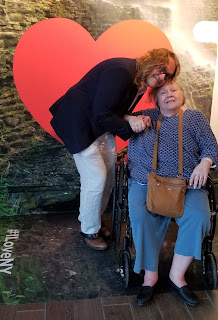
Betty with son August
Geneva, New York, August 2018
Betty and I met at the University of Chicago, where she was an English major a year behind me. We got to know one another at my Alpha Delta Phi fraternity house. She was dating a fraternity brother a year ahead of me. Like me, he was a physics major. When Boyfriend-Number-One graduated, Betty and I began to see more of one another and became square dance partners. (Square dancing was not mainstream at Chicago.) After my graduation, we wrote to one another and had a few opportunities to meet. Two-and-a-half years later, we were married on the Chicago campus, by which time, I was in the Army fighting the Vietnam War with my clarinet.

Betty had wanted to be a children’s librarian and earned her library degree from the University of Hawaii while I was stationed in Honolulu. After we moved to Atlanta to allow me to continue my graduate studies, Betty landed a temporary position at Emory University as a reference librarian. She loved the job, but her failure to be offered a permanent position changed the direction of her career. She earned a second master’s degree, in public administration, at Georgia State University. In Raleigh, North Carolina, she held an administrative position with the National Association of Attorneys General before becoming an owner and worker at a startup canvas works. She also became a mother in Raleigh. Later, in Meadville, Pennsylvania, she worked in the development office of Allegheny College.

In 1987, Betty joined the technical staff of the Software Engineering Institute at Carnegie Mellon University. (I joined the SEI a few months later.) She stayed at that job for a decade before forming her own consulting firm, Gateway Associates, to continue the work she had been doing at the SEI. Her work was directed at software process improvement and involved a good deal of travel, including several stints in Australia.
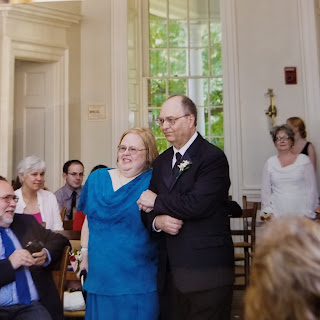
Betty and Lionel at the wedding of August and Sara
Betty and me at the wedding of August and Sara
Annapolis, Maryland, June 2008
So much for the obvious facts. Who was Betty? I’m sure many of her friends would call her a people person. She was a sensitive, caring extrovert, and many mutual friends were surprised when she married me, who was, at least at the time, a not-very-sensitive (if slightly romantic) introvert. Moreover, I was an intellectual and academic, and she was mildly disdainful of those things. She was a person who remembered birthdays and sought out gifts she could give for no obvious reason.

Also, Betty was a liberal, and I was a conservative Republican from New Orleans. We were both interested in politics but seldom let our differences get in the way of our relationship. Betty did convince me not to vote for Nixon in 1968, and I eventually became a committed liberal pretty much on my own. Betty became a feminist, a development that didn’t trouble me, but we clashed over the Equal Rights Amendment. She marched for the ERA; I wrote a letter to the editor against it. Betty was right, and she simply indulged me at the time. Betty also helped elect the first female mayor of Raleigh,

When I was on the faculty at North Carolina State University, we met Don and Vicki Wesen. Don was in animal science and worked with cows. Vicki volunteered as librarian at her Episcopal church. She became good friends with Betty and enlisted her help in organizing the church library. Perhaps not surprisingly, their conversation eventually turned to religion. Vicki was surprised to learn that her friend was not a Christian, having grown up nominally Unitarian. “But you’re the most Christian person I know,” Vicki remarked, presumably based on Betty’s demeanor. As a birthday president, Vicki arranged for Betty to have talks with her priest. This eventually led to both Betty and Geoffrey being baptized. Betty and I were later confirmed in the Episcopal Church. I discovered that the Episcopal Church was the church I had been looking for.

It always seemed surprising that Betty had such success at the SEI and later in her post-SEI career. She had been working with computers since her Georgia State days and was comfortable with computers, having used SPSS and assorted administrative software. I suppose that being married to me also gave her some useful familiarity with technical people. Anyway, she joked about helping software engineers get in touch with their feelings. Mostly, she taught them to be disciplined, something that often doesn’t come naturally to programmers. It was Betty’s communication and interpersonal skills that made her successful in an area far removed from library science.

Most especially, Betty was a planner and a doer. She built a career by making the most of unexpected developments. She led a troop of blind Brownies in Raleigh. She planned the renovation of the kitchen in our newly purchased Mt. Lebanon home. She planned parties and vacations, and she planned psychological exercises for use by our church. She helped individuals by administering and interpreting their Myers–Briggs inventory, an activity for which she actually had credentials. She arranged for Geoffrey to attend a prestigious Anglican boarding school in Australia for a term. She planned how we could finance our son’s college expenses.

We never did return to square dancing, and our dalliance with ballroom dancing was fleeting. We did some hiking in Hawaii, but that was more my thing than hers. We both were movie buffs. Betty was on the board of film society in Raleigh, and we even attended an AFI event in Williamsburg, Virginia. Besides parenting, music probably brought us together more than anything. In Pittsburgh, we enjoyed the symphony, ballet, and opera. We also sang together for many years in the chancel choir of St. Paul‘s Episcopal Church in Mt. Lebanon. Betty took some piano lessons but didn’t stick with it.

For reasons I never completely understood, Betty wanted to live near water and wanted to sail. That and her concern that I would not be able to deal with her medical problems led to our separation and eventual divorce. She planned even that to be as minimally disruptive as possible to everyone’s life. Betty moved to Annapolis, Maryland, and bought a house within shouting distance of a cove that opened into Chesapeake Bay. Alas, her health never allowed her to fully realize her dream, and her life near the water was short-lived.

Her final years were a constant struggle simply to muddle through. Betty moved back to the Chicago area but never achieved a stable living situation. She never lost hope for better times, but she could not overcome her infirmities. In the Finger Lakes, she experienced stability if not happiness. We have remained friends, and I will miss her.

Rest in peace, Betty Deimel, and rise in glory.

May 15, 2020

What Republicans Believe

Trump supporters do not think like the rest of us. They share many odd and dysfunctional views. Although they are not uniform in their opinions, even those ideas not universally held are nonetheless widely believed. Because Donald Trump has effectively reshaped the Republican Party in his own image, characterizing Trump supporters characterizes the GOP itself.

It’s important that we understand what Republicans stand for. Those who see no difference between Democrats and Republicans are fooling themselves. Republicans intend to destroy the United States that came of age in the decades following World War II.

Below, I have created a list of the notions widely held among Republicans. I may have exaggerated a bit, but not a lot. This list was not difficult to construct, but I cannot claim that it’s comprehensive. If your view of the world includes most of the ideas enumerated, you are, or should be, a Republican. If you reject most of these ideas, you are, or should be, something else, most likely a Democrat.

A caveat: Republican officeholders often act in self-serving ways that may not be consistent with their stated opinions. (Remember what Lord Acton said.)

Keep this list in mind when you vote in November.
  • Donald Trump is a very stable genius.
  • Fox News is the most reliable source of information.
  • The United States spends too much money on the defense of other nations.
  • The world is not getting warmer.
  • Deaths from the coronavirus are much exaggerated.
  • The crowd that attended Trump’s inauguration was the largest in history.
  • Public schools expose children to government propaganda.
  • Democrats are in the pocket of Wall Street.
  • U.S. elections are rife with voter fraud.
  • People on welfare should have to work to receive benefits.
  • Wind turbines cause cancer.
  • Widespread possession of guns makes everyone safer.
  • Republicans are the guardians of fiscal responsibility.
  • Russia is a friendly nation.
  • The FBI is corrupt.
  • The U.S. was founded as a Christian nation.
  • Trump was elected despite an illegal plot by Obama to undermine his campaign.
  • The United States should not be the world’s policeman.
  • Illegal immigrants commit crimes and drain public resources.
  • Saudi Arabia is a strong ally and a valuable business customer.
  • Obamacare threatens our freedom.
  • Congress has no legitimate power over the president or his administration.
  • Abortions cause depression in women who have them.
  • Our nation is properly led by white people.
  • Vaccines cause autism.
  • Even legal immigration is a threat to our nation.
  • Donald Trump is our greatest president since George Washington.
  • Recovery from a coronavirus infection confers lifetime immunity.
  • Minimum-wage laws cause unemployment and pay some people more than they’re worth.
  • Fetuses should have the same rights as everyone else.
  • Bill Barr is our greatest attorney general.
  • Religious schools deserve as much public support as public schools.
  • Unions are inimical to free enterprise.
  • Government regulations depress our economy.
  • Israel needs to control all of Palestine to secure its safety from the terrorists who surround it.
  • Journalists are enemies of the people.
  • Muslims are terrorists.
  • Democrats exaggerated the coronavirus pandemic to harm Donald Trump.
  • Senators and Representatives of the president’s party are obliged to support their president.
  • The “real” U.S. is rural and agrarian, not urban.
  • The supply of fossil fuels is virtually inexhaustible. 
  • The Democratic Party is effectively a socialist party.
  • Military spending benefits everyone.
  • Government officials are poorly paid and should use their positions to make money on the side.
  • No president has endured as much undeserved criticism as Donald Trump.
  • The United States Postal Service unfairly competes with services such as FedEx and UPS.
  • Illegal aliens should be deported irrespective of how long they have been in the country.
  • Supporting the United Nations is largely a waste of money.
  • The coronavirus threat has been neutralized through widespread quarantining.
  • U.S. intelligence services are incompetent.
  • The country is too accepting of perverts.
  • Democrats have a visceral and unjustified hatred of Donald Trump.
  • Taxes should be reduced to discourage government overreach.
  • Drug users deserve to be in jail.
  • The government should not subsidize the “arts.”
  • Kim Jong-un only seems hostile because North Korea has not been treated well by the U.S.
  • Too many people escape criminal punishment on technicalities.
  • Free trade invariably harms U.S. interests.
  • Blacks commit most of the crime in this country.
  • Donald Trump always speaks the truth.
  • The United States is the greatest country on earth.
  • People should take responsibility for their own health care.
  • Churches and corporations should be allowed to endorse political candidates.
  • The CDC is particularly hostile to President Trump.
  • Government workers are an impediment to needed change.
  • The #MeToo movement gets too much attention.
  • Building the wall on our southern border should be completed at all costs.
  • God, in his munificence, made Trump president.
  • The Federal Reserve should be controlled by the president.
  • Freedom to act on one’s religious beliefs is our most important civil right. (Well, maybe not quite as important as the right to bear arms.)
  • Many universities undermine our nation’s ideals.
  • Bilateral trade agreements allow us to impose our interests on other countries.
  • Jared Kushner is a multitalented genius.
  • The WHO favors China as opposed to the United States.
  • The moon landing was faked.
  • The world is flat.

May 6, 2020

Sorry, Nancy

Nancy Pelosi
Nancy Pelosi
On August 4, 2018, I wrote a post titled “The Wisdom of Dumping Pelosi.” I argued that Nancy Pelosi, who was then minority leader in the House of Representatives, had become a lightning rod for Republican criticism. I suggested that her reputation among Republicans could have negative consequences in the upcoming congressional elections.

I am writing this post today to apologize for that earlier essay. I mistakenly suggested that Pelosi’s negatives among Republicans could have consequences analogous to those of Hillary Clinton in 2016. Of course, this concern was much overblown. Clinton was widely disliked by citizens of all stripes, and that attitude clearly affected presidential votes. Pelosi, however, was only running in her own district, and her influence on congressional elections generally was likely slight.

Even were Pelosi’s remaining as minority leader a negative influence for Democrats in their various races, it turns out that Ms. Pelosi is an enormous asset to the party. She is, in fact, one of the most—perhaps the most—talented politician on the national scene. It would have been a tragedy to lose her talents in the House.

Republican operatives will smear any Democrat they view as a threat to their exercise of power. If Ms. Pelosi were “dumped,” as I suggested, Republicans would easily have found other Democrats and other Democratic policies to trash.

The Democrats did not dump Pelosi, and we are better off for it. To Nancy Pelosi, I can only say, “I’m sorry.”

May 5, 2020

The Coronavirus and Meat-Processing Plants

I just saw a news report of another coronavirus outbreak at a pork-processing plant. It’s time to think more carefully about the significance of such outbreaks, which are becoming all-to-common and, potentially, are threatening our meat supply.

When it is discovered that, say, a pork-processing plant has hundreds of coronavirus-infected workers in a town that was not thought to be greatly threatened by the current pandemic, we should be worried. News and commentary have suggested that plant workers will go to their homes and infect family members or other people they encounter. This is assuredly a threat.

But the situation is worse than we might imagine. How did so many workers become infected in the first place? Surely, the virus did not come into the plant in hog carcasses. Instead, one or more employees must have brought the virus into the workplace, and that person or persons were in close contact with co-workers on the processing line. In other words, the virus was circulating in the area before the outbreak occurred in the plant. That plant, however, was a perfect incubator for multiplying infections.

We must stop thinking of outbreaks of coronavirus in meat-processing plants as isolated incidents. Instead, they are canaries in the coal mine. We need to ramp up testing rapidly to discover how desperate matters actually are.

May 4, 2020

In Praise of the Diaeresis

I recently encountered a Facebook post that collected several English language quirks. One of my favorite items asked whether the “s” or the “c” of “scent” is silent. (Think about that one.) Another noted that you can drink a drink, but you cannot food a food. (Likewise, you can exit and exit, but you cannot entrance an entrance.)

Most of the observations in the post were clever, but I found one upsetting:
Why are Zoey and Zoe pronounced the same but Joey and Joe aren’t?
By normal English orthographic rules, one expects that the final “e” in “Zoe” should be silent. Thus, “Zoe” should be pronounced as though it were rendered as “Zo,” which, of course, is not pronounced the same as “Zoey.”

There are people named Zoe who pronounce their name using a single syllable. Most people named Zoe, however, pronounce their name as though it were spelled “Zoey.” Other folks render their name as “Zoë.” This last spelling, I assert, is the correct one for the common two-syllable name.

The two dots above the “e” in “Zoë” are not, as some assume, an umlaut, an identical-looking diacritical mark much used in German. English readers most often encounter umlauts in German names, for example, Schröder or Müller. The umlaut indicates that the vowel over which it sits is pronounced differently than it would be in the absence of the diacritical mark. Generally, the sounds indicated by umlauts represent sounds absent in ordinary English. One of the skills one must learn in a German course is how to pronounce these modified vowels. It does not come naturally.

What the unlaut-looking mark in Zoë is is a diaeresis. Rather than telegraphing that the indicated vowel is pronounced in a special fashion, the diaeresis signals that it is to be pronounced individually, rather than being silent or being a participant in a diphthong. Thus, Zoë is pronounced Zo-e. Diaereses are uncommon in English, but the crop up in familiar names such as Chloë and Brotë. Noël, naïve, and naïf may all be seen with diaereses, though the mark is sometimes dropped.

Americans are not fond of odd symbols creeping into their spelling. Thus, words like “rail-road” becomes “railroad,” and “e-mail” becomes “email,” an abomination an electronic neophyte might be tempted to pronounce em-ail. Likewise, “naïve” may be simplified to “naive” out of ignorance, laziness, or inability to render “ï” using a keyboard. Words with which we have become familiar tend to lose their diacritical marks in most writing. Thus, we have the familiar spelling of “cooperate,” which, according to normal English pronunciation rules should be sounded as coop-er-ate. Through repetition, we have learned to ignore the fact that the spelling of this word is actually goofy. The New Yorker and I—and practically no one else— always render this word as “coöperate,” which, I proudly assert, is the only literate spelling. (“Co-operate” is an acceptable alternative for the diaeresis-phobic.)

Although it is seldom called into action, the diaeresis is useful for clarifying how words are to be pronounced, and it is a shame when they disappear. It is worth noting, however, that there are words that would seem to demand the diaeresis but which have never had one. Why isn’t “aorta” written as “aörta”? The answer probably is that “ao” is not recognized as a diphthong, making a-or-ta the only reasonable pronunciation. Tragically, “preaortic“ is also a word, over which the medically naïve might easily stumble.

I conclude with some thoughts about another word. In the world of e-commerce—please, God, do not let this word become ecommerce—one sometimes pre-orders an item such as a book. With increased usage, this word may become “preörder” and, finally, “preorder.” You have likely seen this final form already. Shouldn't the word really be “preörder”?

April 28, 2020

How to Do It

We may not always want to admit it, but our behavior is influenced by what we see in the media. When we see beautiful and seemingly competent people doing even everyday things, we feel that we should be doing things the same way. This is easier said than done. Let me offer three examples.

In the commercials, we see attractive women washing their faces with some promoted brand of soap—or should I say, “beauty bar.” Then the person in the commercial puts her two hands together and deftly collects water that she then splashes elegantly across her face to remove the soap—beauty bar—residue. Somehow, I cannot seem to master this procedure. If I use both hands to collect my rinse water, when I lift my face, the water drips down my shirt because I don’t have a towel handy. The towel rack is too far away to reach with my head down, and, should I put a towel on my shoulder before rinsing off the soap, it will likely fall into the sink. Instead, I keep a towel in one hand and use a single hand to collect rinse water. More than one hand’s worth of water is invariably required. My method works, but it lacks the elegance of what I see on television.

Then there’s the matter of brushing my teeth. At the suggestion of my dentist, I bought an electric toothbrush. I am reasonably convinced that it does a better job of cleaning my teeth than I was able to do with a manual toothbrush. In television commercials, models use their electric toothbrushes smiling and generally looking both beautiful and capable. How hard can using a toothbrush that does most of the work for you be? I haven’t worked on the smiling part—I’m not a perpetual smiler anyway—but I would at least like to look neat. Instead, the brushing procedure seems to produce a foam of toothpaste that I cannot keep completely in my mouth. Instead, it leaks out, making me look like I have rabies. Not a pretty look.

Finally, there is the simple matter of removing a tee-shirt. YouTube hosts a demonstration of what, reputedly, is the fastest way of doing so. It only uses one hand, sort of. I don‘t think that many people use this technique, which looks more like a magic trick than an elegant lifestyle skill learned in charm school. No, what appears to be the standard way one is supposed to remove one’s shirt is to cross your arms, grasp the hem of the shirt with each hand, and pull up, thereby removing the shirt over one’s head. In Equus, Jill performed this maneuver so effortlessly before Alan, revealing that she was wearing nothing underneath. I, however, cannot pull this off. (Pardon the pun.) When I get my arms halfway up, my shirt kind of gets stuck. I can remove the shirt in the end, but I don’t look at all cool. In practice, I pull my shirt at the neck and pull it over my head.

I’m sure there are other everyday tasks I’m not good at, but those described above are the ones that most seem to bug me. Do others share my disabilities?

The Great States

She is hardly the only person to use the locution, but Rachel Maddow repeatedly refers to a state as “The Great State of [wherever].” (I haven’t caught her referring to “The Great Commonwealth of [wherever],” but, then again, I don’t know why Arizona is a state, and Massachusetts is a commonwealth. What is a commonwealth anyway? For what it’s worth, the official seal of Pennsylvania refers to “The State of Pennsylvania,” but the governor’s seal carries a “Commonwealth of Pennsylvania” label. Crazy, but you can look it up!)

Clearly, “The Great State” is intended as a kind of honorific, though it isn’t clear why Ms. Maddow (or anyone else) needs to be so deferential toward a state. Moreover, she seems to be indiscriminate in her usage; she will talk about both “The Great State of California” and “The Great State of Mississippi.” One can perhaps make a case for California’s being a great state, but the corresponding case for Mississippi is, shall we say, weak. Perhaps the objective is to avoid giving Fox News a reason to claim that one state or another—probably one with a Republican governor—was defamed on her show. As for me, if I ever speak about “The Great State of Mississippi,” it is likely that I am being ironic.

I find this “great state” business tiresome. Perhaps at the present moment, however, we have a legitimate way to distinguish great states from not-so-great states. New York, with its Democratic governor who is clearly concerned about the welfare of the state’s people generally and of the well-being of its medical facilities and staffs particularly, would seem to argue, along with other facts, for speaking of “The Great State of New York.” Georgia, with its Republican governor who is eager to resume “normal” economic activity without any cause to believe that coronavirus infections will not massively increase, probably does not deserve to be called “The Great State of Georgia.”