February 27, 2023

New Curve-stitch Designs

I began making curve-stitch designs in junior high school, having been introduced to them by my math teacher, Mrs. Eunice Williams. I quickly graduated from using pencils or ballpoint pens to using drafting pens and India ink on drafting paper. Drawing these figures was satisfying but mind-numbingly tedious. Mistakes could be corrected but only with difficulty. Some people, even more masochistic than my teenage self, produce designs with thread, yarn, or wire on a substrate of some sort. More power to them.

My enthusiasm for curve-stitch designs was rekindled by my discovery that I could produce designs using my computer. Frankly, doing so can be tedious as well, but at least it’s not as physically challenging. Using the computer allowed me to post some of my designs on my Web site and even see them published in China and Australia. I have lately been updating Lionel Deimel’s Farrago and have again begun to create curve-stitch images.

In many ways, my favorite creation is what I call my curve-stitch isometric cube. I too an isometric cube and drew curve-stitch parabolas on all adjacent sides. A framed version of this design hangs in my hallway. It consists of white lines on a black background. Here is a black-on-white version:


I have produced my designs by programming in PostScript. a page-description language designed by Adobe. While updating my Web site, I decided to simplify the code that generates the above image. In the process, I realized that I could generalize this design. My cube has six sides. Here is an analogous design with four sides.

February 22, 2023

“Reform”

I am tired of both politicians and journalists speaking of proposed law changes as “reform.” GOP lawmakers want to “reform” Social Security, by which they mean reduce benefits or eliminate the program entirely. Prime Minister Benjamin Netanyahu wants to “reform” Israel’s judiciary, by which he means stripping power from the courts and giving more power to the Knesset, thus eliminating an important check on legislative and administrative overreach.

“Reform” is a righteous-sounding term that gives a gloss of respectability to any policy to which it is attached. But not only can the word be used to obscure one’s motives but it can introduce ambiguity and confusion into political discourse. Does “reforming” the police mean transferring police duties to non-police personnel or does it mean giving police more money and equipment to help them do their job more efficiently?

We are unlikely to dissuade politicians from using “reform” to bolster support for their proposals, but we can encourage journalists to reform how they speak and write about the politician’s “reform.” Journalists should not just parrot the propaganda of politicians. They can refer to “changes” or they can be more specific about the changes being promoted. Replacing “reform of” with “changes to” is not more specific, but at least it replaces a positive-sounding locution with a more neutral one. In some cases, journalists can be more truthful without being more verbose—“gutting the judiciary” rather than “reforming the judiciary,” for example.

If journalists refuse to automatically repeat calls for “reform,” politicians may actually become less eager to use the term.

February 16, 2023

Non-binary Pronouns

A while ago, I was reading a story of some sort. A few paragraphs into it, I ran into the phrase “they said.” They who? I wondered, as I had as yet encountered only one person’s name. It took me a while to figure out that the “they” of the story was, in fact, the single person named earlier. Apparently, that person identifies neither as male nor female. (I don’t like the term “identifies,” but, when I tried to recast that last sentence without using gendered pronouns, I began to appreciate its usefulness.)

On Zoom, it has become common to see participants whose name is followed by a notation such as “(they, them),” that is, they telegraph “their” pronouns. Other people add “(she, her),” “(he, him),” “(she, her, hers),” or some such. For someone who presents as male or female, the list of pronouns is technically unnecessary, though I suspect it is added to make less prominent the list of those for whom the list is necessary.

Honestly, I don’t understand the whole non-binary thing unless you are an intersex person. On the other hand, I don’t care about it. If you want to be a sexless person, I say go for it. On the other hand, I strongly object to the use of plural pronouns to refer to individual persons. Doing so is a confusing grammatical anomaly. I am sympathetic to the desire of non-binary people to eschew gendered pronouns. I think, however, that they have taken the wrong approach linguistically.

English is unhelpful to the non-binary. It has male, female, and neuter pronouns.  One could argue that the appropriate pronouns should be “it,” “its,” and “itself”. Logic, however, does not account for the discomfort resulting from referring to humans with the same pronouns utilized for file cabinets and garbage dumps. (Some Episcopalians are uncomfortable referring to God as “He,” but they seem equally uncomfortable with “It,” which also seems logical.) The language is really in need of some new, non-binary pronouns. Why not invent some?

That suggestion is more reasonable that it might at first seem. When women wanted an honorific that did not indicate marital status, they—someone, anyway—invented “Ms.” It took some time for this neologism to be widely accepted, but no one gives it a second thought today. It is actually comforting to know that I can respectively address a woman without having to research whether or not she is married. Encouraged by this development, I propose that we adopt new pronouns for non-binary persons.

I would argue that we only need new second-person singular pronouns. Pronouns such as “me” and “them” do not telegraph gender, and there probably is no reason to devise analogous pronouns that do. I will propose specific pronouns, but my concern is simply that we devise some new pronouns. Others may be able to invent more mellifluous ones. By analogy to existing forms, I believe the new words should be monosyllabic where possible and not be easily confused with other English words.

Here are my suggestions for second-person singular pronouns: 

  NOMINATIVE     OBJECTIVE     POSSESSIVE     REFLEXIVE  
          tu           tum           tus           tuself

Here is an example of how these words could be used:

Tu attended the party. Janet met tum there. She was surprised by tus outfit. Tu told her that tu designed it tuself.

As I said, I am advocating new pronouns, but I don’t have strong feelings about what these new words should be. I decided to base my words on the French tu, meaning you. This was convenient for a number of reasons. I invite comments and other suggestions. 

February 14, 2023

Views of My New Church

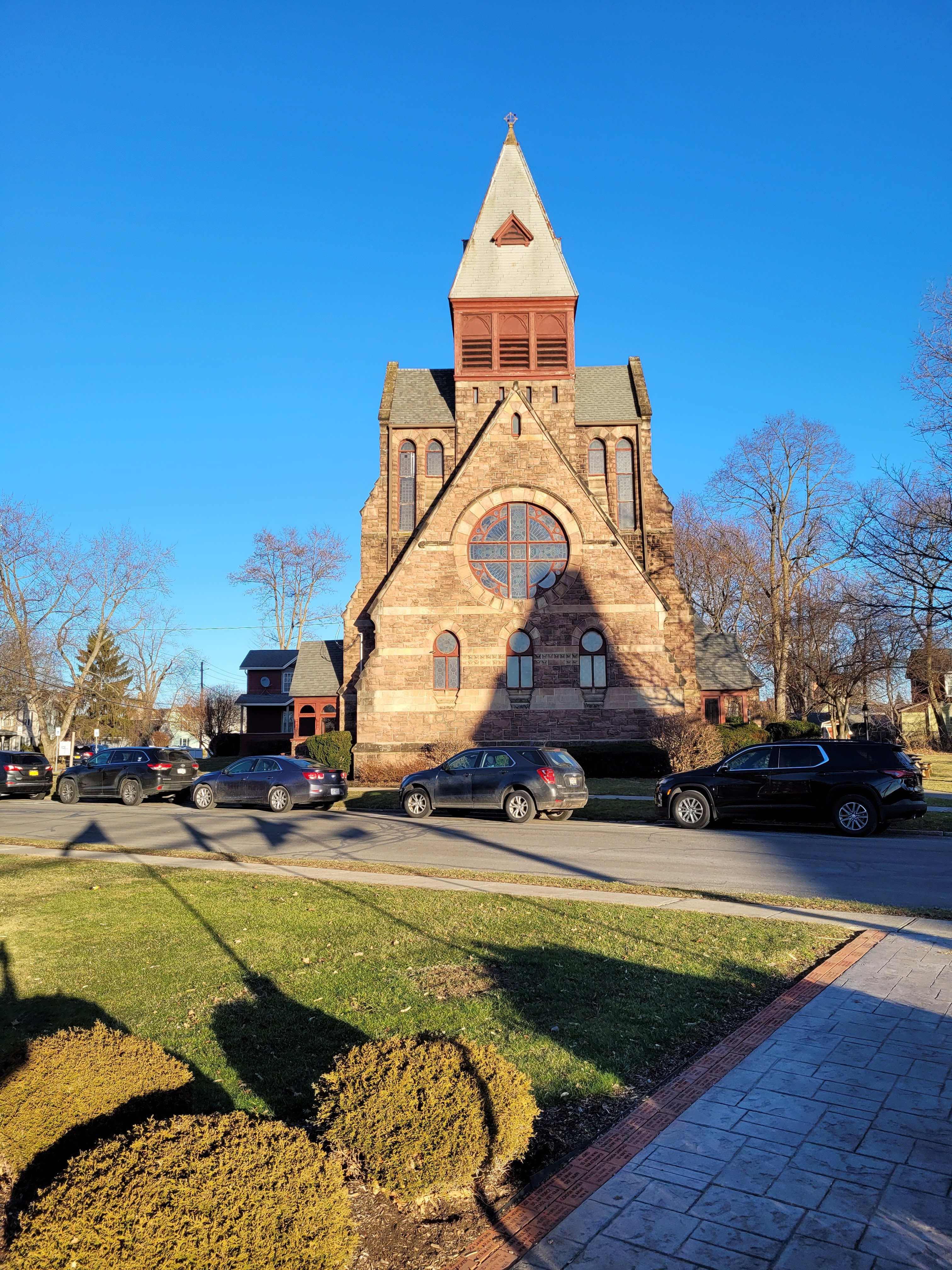
When I moved to Clifton Springs, New York, I was happy to discover that there was an Episcopal Church hardly more than a block away. I have been waiting for a sunny day and an afternoon sun to take pictures of St. John’s Episcopal Church.

This is the shot I had been waiting for:

East side of the church

Unfortunately, I could do nothing about the large shadow on the west face of the building. There is a tall structure across Main St. that is responsible for the shadow. I could not remove that building. Unlike most churches, St. John’s is notable for having the liturgical east end of the church actually facing east. Reviewing this photograph, I wonder if it would have been improved were there a few clouds in the very blue sky.

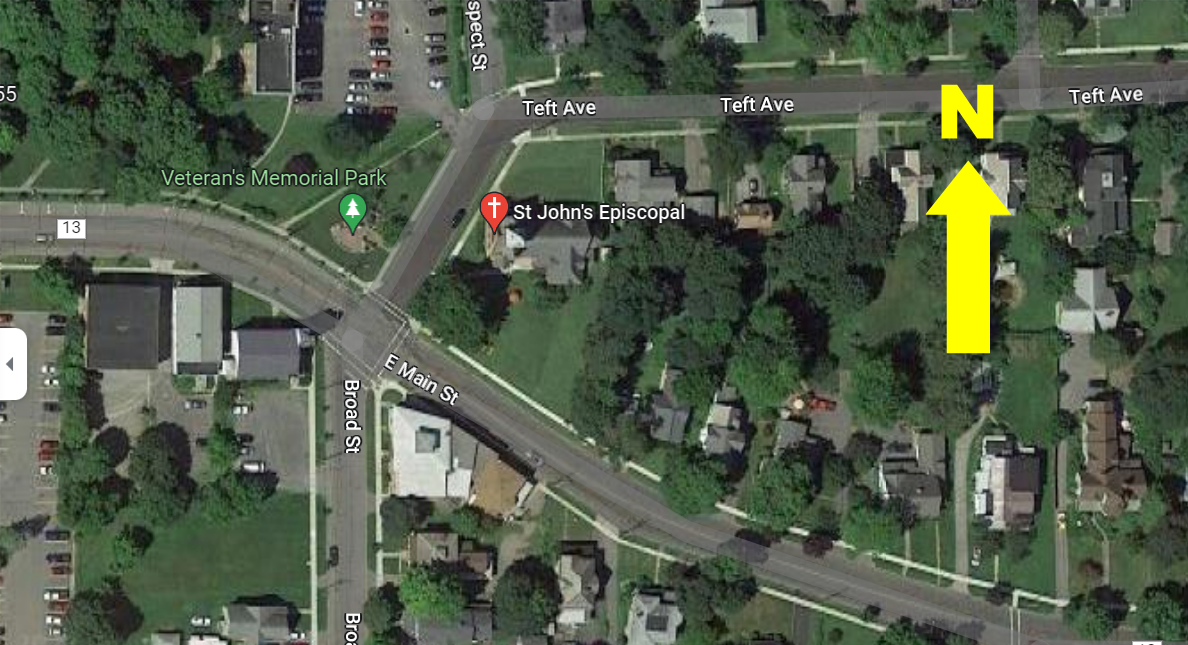
Leaving downtown driving east, St. John’s is nearly in front of you until the road veers to the right, as can be seen in the map below.

Aerial view of the church neighborhood

As you might guess from the photo of the church, St. John’s has been around for a while. Below is a photo of the cornerstone at the northeast corner of the building.

Building cornerstone

As your car goes past the church you can see this sign on the church lawn:

Church sign

And here is the south façade of the church:

South side of church

Clapping on Jeopardy!

I’m not a fan of quiz shows generally, but I regularly watch Jeopardy! This particular program requires knowledge—often arcane knowledge—imagination, strategy, dexterity, and a little bit of luck. It is fast-paced and challenging for viewers who take the game seriously. And trying to come up with the proper responses can be seriously humbling.

I’ve noticed a phenomenon on the program that I’ve observed (and disliked) on other quiz shows. Contestants sometimes clap when other contestants offer a correct response. Surely this is insincere. Contestants are contesting against one another after all. Generally, a successful response from someone else diminishes your chance of winning. Could that possibly please you if you actually understand the game?

It is possible, of course, that someone might offer an extraordinarily brilliant response to a difficult clue, for which admiring applause might seem appropriate. Although playing the game requires knowledge and cleverness, absolute brilliance is not usually necessary, so I think this situation arises seldom if at all.

Another reason for clapping for a correct response from someone else is strategic. For example, if you are leading another player by a small amount, a correct response by a far-behind third player is not a threat to you and prevents the second-place player from gaining on you by offering a correct response. Your applause could be quite genuine, but it would represent bad sportsmanship. It would be the equivalent of clapping for a missed response.

At the end of the game, losing contestants usually clap for the winner. Unlike other opportunities for applause, this is perfectly respectable, acknowledging as it does, the winner of a hard-faught game. That would represent good sportsmanship.

February 10, 2023

A Hospital Adventure

Moving to a new town requires finding new sources of goods and services—doctors, mechanics, food stores, clothing stores, etc. Yesterday, I had my first visit with my new primary care physician. Because I had been experiencing knee pain, he ordered X-rays of the troublesome joint.

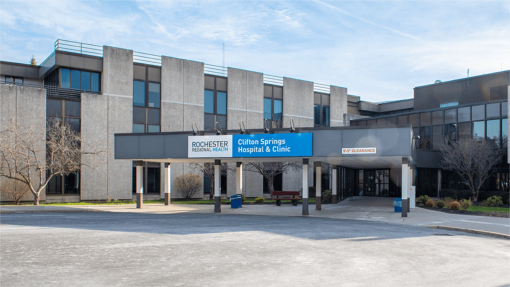
This morning, I walked to Clifton Springs Hospital & Clinic to have the ordered images taken. This was convenient, as the hospital is directly behind my apartment building. Although I can see the hospital from my building, my doctor had to tell me how to get into it, as the main entrance is not visible from my building.

I negotiated the revolving door, entered the lobby, and donned the required mask. I explained the reason for my visit to the receptionist, who directed me to another reception desk at a different entrance. I found that quickly enough and explained why I was there. The receptionist tried to find me in her computer system. I told her I likely wouldn’t be found, as I had never had any contact with the hospital or the hospital system of which it was a part. (I would have been totally freaked out had she discovered information about me on her computer.) Once she concluded that I was not in the system she excused herself and left through a nearby door. She returned in a few moments and invited me to follow her. I was handed off to a man in a small office who was apparently going to check me in.

My communication with this clerk began predictably enough. I gave him the order from my doctor and answered questions about my Social Security number, marital status, and so forth. At some point, however, he was clearly having trouble entering the needed information into his computer. He excused himself, presumably to get some advice, and soon returned to his desk. I was surprised that whatever he needed to do did not seem routine, and I expressed my surprise at his difficulties. He told me that new patients do not often present themselves. (Well, that was interesting!)

We made some progress in the intake interview but ran into another snag. The clerk excused himself and returned with another person or two. (I wasn’t keeping track.) Before I knew it, four people were trying to help my perplexed clerk. This collective was able to move the process along, and the four outsiders left the room.  It wasn’t long before this process had to be repeated. The clerk left the room and returned with one helper, who was soon joined by another. Together, they seem to have concluded that the computer system understood that I was at the hospital but did not know why. Entering information about my X-ray needs seemed to have unblocked the intake process. (This step actually did require all three people to complete.) The helpers left, I was required to sign a few documents, and I was handed a piece of paper that was my ticket to the radiology department.

The clerk walked me to the hallway and directed me to radiology. He apologized profusely for my having to wait so long to be checked in and thanked me for my patience. I replied that the delay was no problem and was actually very amusing. Checking in had taken about 45 minutes.

In the radiology waiting room, I handed in my paperwork and took a seat, expecting to read a bit of the book I had brought along. I had read perhaps one paragraph when I was called for my X-rays. Happily, I did not need to undress or put on a hospital gown; all I had to do was stand in front of the X-ray machine. The process took perhaps five minutes. It took longer than that for me to find my way back to the main entrance.

When I next have business at the hospital, I expect that check-in will be easier. 


Clifton Springs Hospital & Clinic

February 8, 2023

Table of Contents Returns

For quite some time, I couldn’t update my Web site, Lionel Deimel’s Farrago. Because of this, I couldn’t keep the table of contents for Lionel Deimel’s Web Log current. I am pleased to report that an updated table of contents is now available. You can find it here. On this or other blog pages, you can find a link to the table of contents in the column at the right of the page under the heading “LINKS.”

Finding an older blog post can be difficult. Whereas Web sites often have site maps, blogs generally do not. As a result, older blog posts are seldom visited. A post can perhaps be found using a search engine such as Google, but one may not know a good set of search terms needed to find it. And a blog post may appear far down the list of sites returned by a search.

In the case of this blog, there is a Google search box at the top left of every page. This is helpful only if you have a clear idea of what it is you want to find. At the right of blog pages under the heading “BLOG ARCHIVE,” posts are listed by the month in which they were written. In principle, one can generate a chronological list of all posts using this resource, but doing so would be tedious.

The blog table of contents not only lists all posts and the dates of their composition but also gives brief descriptions of the posts themselves. Posts are color-coded, distinguishing those about language, about church matters, about the blog itself, and about everything else. (Actually, that last category is large.)

My hope is that visitors will use the table of contents to find particular remembered essays or simply to browse through the more than two decades of blog essays.

February 6, 2023

More Frustration from Facebook

When I first opened the Facebook app on my phone this morning, I was asked if I wanted to complete a survey about my use of Facebook. I have complained about the mechanics of Facebook both on my blog and on Facebook itself, and I thought the survey might provide an opportunity to communicate some of my complaints directly to the people responsible.

Almost immediately, I got to a question about where I would like to see changes to the system. (For reasons that will become obvious, I cannot say exactly how the question was phrased.) I immediately checked the “Other” option and began thinking about how I wanted to describe my complaints in the associated text box. After a few moments, I decided that I needed time to consider my response and that I should write it out on paper before entering my comments into the survey. I left open the survey and read items from The New York Times while I ate breakfast.

When I returned to the Facebook app, the screen was blank. When I clicked on the Back button, I was asked “Are you sure you want to exit the survey?” The choices were “EXIT” and “KEEP GOING.” I chose the latter, of course, and found myself back to the black screen. I repeated this little dance a couple of times, always with the same result. Finally, I selected “EXIT.” As I expected, this took me to my news feed without any option to respond to the survey.

Can’t Facebook do even the simplest things right? (In this case, the app simply needed to do nothing at all!)

February 2, 2023

Pull Out All the Stops

 The phrase “pull out all the stops” is a common phrase meaning to do everything in one’s power, using all resources at one’s disposal, to achieve an objective. If, for example, a large asteroid was headed for a collision with the earth, humans would do well to pull out all the stops to prevent disaster.

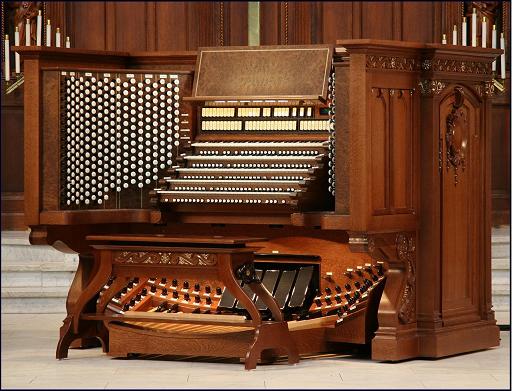
Stops are selected using the knobs to the left and
right of the manuals (keyboards).
As a musician, I have always assumed that this phrase derives from the world of organs. In organ parlance, a stop is a collection of pipes intended to produce notes of different pitches but having similar sound quality. A stop may be a single rank of pipes or may involve more than one rank. (A rank is a group of pipes of identical construction differing only in length, and therefore pitch.) An organist controls which pipes sound when a key is pressed by choosing one or more stops. This is most often done by pulling (drawing) a knob labeled with the stop name (see photo). That knob is called a draw knob or stop knob or simply a stop. To pull out all the stops of an organ means to pull all the draw knows, which causes all the organ pipes to sound at once.

Merriam-Webster attests that the meaning of “pull out all the stops” indeed derives from the world of organs. I was therefore surprised when I read a different explanation of the origin of the phrase. I was reading the chapter titled “Generator” in John R. Stilgoe’s Metropolitan Corridor: Railroads and the American Scene. The chapter deals with electrical generating stations, both their architecture and their mechanics. Stilgoe writes

The colloquialism “pull out all the stops” derives from the safety governor that spun atop most stationary engines; removing one or more of the weighted metal stops caused the engine to work faster and faster—removing all meant running the risk of a runaway engine, broken belts, and catastrophe.

Merriam-Webster notes that a stop can be a device for arresting or limiting motion, so Stilgoe’s explanation certainly makes sense. I suspect that the phrase applied to organs is more venerable, though I cannot prove that.

Tracking down the origin of words and phrases can be a tricky business.

January 19, 2023

Let’s Slay the Debt-Ceiling Dragon

Today, Treasury Secretary Janet Yellen announced that the United States has reached its statutory debt limit. The government apparently cannot issue additional securities to finance its operation. As a result, the Treasury Department has begun to engage in financial legerdemain, euphemistically called “extraordinary measures,” by which it makes essential payments and defers inessential ones. Absent an increase to the debt ceiling, treasury will exhaust its ability to avoid default on government obligations sometime early this summer. In its entire history, the United States has never defaulted on paying its debts. It is universally agreed that, should the U.S. do so, very bad things will happen.

The debt ceiling is an odd construct. It was invented during World War I. Congress was being asked repeatedly for more money to pursue the war. Rather than having to make these requests over and over, Congress set a limit on how big the country’s debt could be. This eliminated a certain amount of congressional irritation, but as long as there was a formal limit to the nation’s debt, that limit had to be periodically revised. In practice, this meant raising the debt limit.

It might seem logical to revise the debt ceiling in conjunction with Congress’s spending authorizations. Instead, Congress causes money to be spent and increases the debt ceiling as necessary after the fact. In other words, increases do not accommodate future spending; they authorize the treasury to pay bills already incurred. Failure to raise the debt ceiling is akin to buying goods and services on one’s credit card and refusing to pay when the credit card bill shows up.

This Alice-in-Wonderland method of managing the country’s finances makes raising the debt ceiling essential while at the same time allowing a small number of members of Congress to hold the country hostage by making their votes on increasing the debt ceiling contingent on their achieving some unrelated legislative victory. In the current instance, it appears likely that Republican House members will demand budget cuts, possibly in popular programs like Social Security.

Republicans would no doubt argue that the debt ceiling mechanism operates to keep the government accountable. I believe, and I think most Democrats believe. that it is simply an invitation to mischief.

When Donald Trump was president, Republicans offered virtually no objections to raising the debt ceiling. In fact, during the Trump presidency, the national debt was greatly expanded, in part as a result of GOP-sponsored tax cuts. Republican legislators claim they are now interested in fiscal responsibility, but the reality is that, for many of their number, the real interest is in neutering the federal government’s ability to do much of anything beyond providing for the national defense.

As of this moment, Speaker of the House Kevin McCarthy has promised a small number of House members that the House will not approve a debt ceiling measure without demanding major spending cuts. President Biden has made it clear that he expects to sign a debt ceiling increase bill unencumbered with other provisions. Ironically, if Republicans force a federal government default, it will raise the government’s cost of borrowing, thereby increasing, not decreasing the national debt. The effects, not only on the cost of borrowing but also on the perceived trustworthiness of the U.S. and the stability of the world’s financial system will likely be catastrophic.

The whole debt ceiling mechanism is irrational and counterproductive. What seemed a useful and enlightened idea during World War I has become a monkey wrench in the gears of government. It makes sense for Congress to set an upper bound on the government’s ability to borrow, but it is morally unacceptable to prevent the government from paying for spending that Congress has already authorized.

Given the radical GOP ideologues now in the House of Representatives, the country seems headed for a showdown unlikely to end well. The Biden administration, should, I think, take drastic action that could put an end to legislative blackmail.

Section 4 of the Fourteenth Amendment says, in part:

The validity of the public debt of the United States, authorized by law, including debts incurred for payment of pensions and bounties for services in suppressing insurrection or rebellion, shall not be questioned.

 Failure to allow the government to pay “public debt of the United States, authorized by law” surely constitutes “questioning” such debt. The Biden administration should declare that failure to pay existing obligations is unconstitutional and should direct the treasury to issue debt obligations as needed to continue to pay the government’s bills. If the Congress is unhappy with the level of debt, it can try to cut spending in the usual legislative process, but not through debt-ceiling blackmail.

This would be a gutsy move by President Biden, and I suspect that Republicans would try to block it through the courts. The relevant provision of the Fourteenth Amendment has never really been litigated, and a particular judicial outcome is not guaranteed. The whole debt-ceiling thing is a hypocritical mess, however, and it may be time to kill its malignant effects once and for all.

January 18, 2023

When Is a Fetus a Human Being?

 Last month, The New York Times published a piece by Elizabeth Dias titled “When Does Life Begin?” My reaction to the essay was that it asked the wrong question. A fertilized egg is undoubtedly alive and it is most certainly human. In no way, however, is it a human or, if you prefer, a person.

Two weeks after “When Does Life Begin?” appeared, the newspaper offered a sampling of reader reactions to it. The most helpful reader comment, I thought, came from Richard Ambron, professor emeritus of cell biology at Vagelos College of Physicians and Surgeons of Columbia University.  He wrote:

When during gestation does an embryo become a human? This question has baffled philosophers and theologians largely because they do not understand the workings of the nervous system and the brain.

Two attributes are widely accepted as criteria to be considered human. First is an awareness through our senses that we exist and that we exist within a world of objects. Second is the ability of the brain to use the information from our senses to create ideas and make predictions about how to best survive in that world.

When during embryonic development do these activities emerge? The heartbeat becomes audible on a Doppler fetal monitor at about the 10th week of gestation, movements begin sometime after the 15th week, but the brain and most of the sensory systems develop later.

Each sensation requires the formation of millions of interconnecting neuronal circuits in the cerebral hemispheres that reach critical points of development between the 24th and the 28th week of gestation. Around that time, rhythmic brain waves resembling those of a newborn can be detected, indicating that neuronal circuits in the brain are highly integrated.

What this tells us is that a fetus cannot perceive most sensations, the first attribute of being human, until at least six months after fertilization. The ability to formulate ideas, the second attribute of humans, probably does not occur until after birth when the newborn’s brain begins to correlate all of the sensations into a coherent experience of its surroundings.

Thus, claiming that we become human at the moment of conception is merely a belief that argues against data from decades of research in embryology, neurology and developmental neuroscience.

Ambron implies that it is not a heart that makes us human—animals less complex than humans have beating hearts, but they are not human because of it. It is not unreasonable to assert that it is our working brains that make us human. Significantly, brain death is generally taken to mark the end of one’s life, with the ability to harvest organs for transplant being the only reason for being kept “alive.” Does it not make sense, therefore, to consider a developing fetus less than a human being prior to substantial brain development?

If one has to pick a point in fetal development beyond which abortion should be prohibited, Ambron offers facts that should be considered.

January 7, 2023

Grievances vs. Resentments

I read and hear repeatedly how grass-roots Republicans act (and vote) out of “white grievance,” though the supposed sources of their aggrievement are seldom clear. Suggested candidate sources of grievance often seem exaggerated, trivial, and petty—emigrants seeking asylum, minorities demanding equal treatment, advocates promoting assault-weapon bans, people wishing them “Happy Holidays,” and so forth.

A couple of days ago, New York Times columnist Paul Krugman, in an essay titled “Making America the Opposite of Great,” offered useful insight into the whole grievance thing. He wrote:

For another, I don’t think there are many on the U.S. left (such as it is) who define themselves the way so many on the right do: by their resentments.

And yes, I mean “resentments” rather than “grievances.” Grievances are about things you believe you deserve, and might be diminished if you get some of what you want. Resentment is about feeling that you’re being looked down on, and can only be assuaged by hurting the people you, at some level, envy.

It is worth re-reading that excerpt. It explains a lot. Krugman continued:

Consider the phrase (and associated sentiment), popular on the right, “owning the libs.” In context, “owning” doesn’t mean defeating progressive policies, say, by repealing the Affordable Care Act. It means, instead, humiliating liberals personally—making them look weak and foolish.

In fact, right-wing partisans exult in dismissing their political opponents with terms like “libs,” “woke,”  “feminazis,” and “socialists.” They can’t seem even to correctly name the political party they denigrate; their opponents belong to the “Democrat Party,” a party that does not actually exist, at least not by that name.

It is ironic that all this rhetorical nastiness is practiced by a party that wants us to think of its adherents as Christian. Actually, I don’t think Jesus would approve. But then again, Jesus’s preaching of charity, tolerance, service, and forgiveness is not actually part of their version of Christianity.

We are ourselves being charitable (and imprecise) when we call right-wing zealots “conservative.” They are instead reactionaries who would gleefully bring back the days of Calvin Coolidge or perhaps those of George III.

December 5, 2022

U.S. Oaths of Office

It is likely that most readers have watched an incoming president recite the oath of office. That oath is prescribed in Article II, Section 1 of the U.S. Constitution:

 I do solemnly swear (or affirm) that I will faithfully execute the Office of President of the United States, and will to the best of my Ability, preserve, protect and defend the Constitution of the United States.

Somewhat surprisingly, the Constitution does not specify an analogous oath for other officeholders. Article VI, however, states that there must be such an oath (or oaths):

The Senators and Representatives before mentioned, and the Members of the several State Legislatures, and all executive and judicial Officers, both of the United States and of the several States, shall be bound by Oath or Affirmation, to support this Constitution; but no religious Test shall ever be required as a Qualification to any Office or public Trust under the United States.

Beginning in 1789, Congress employed a succinct oath:

I do solemnly swear (or affirm) that I will support the Constitution of the United States.

The outbreak of the Civil War led to an expanded congressional oath, an oath that has been modified several times since then. Senators now take the following oath:

I do solemnly swear (or affirm) that I will support and defend the Constitution of the United States against all enemies, foreign and domestic; that I will bear true faith and allegiance to the same; that I take this obligation freely, without any mental reservation or purpose of evasion; and that I will well and faithfully discharge the duties of the office on which I am about to enter: So help me God.

The enhanced oath seems especially pertinent in 2022.

Members of the House of Representatives take the same oath, though the name of the representative is inserted after the initial “I.”

Traditionally, incoming presidents append “So help me God” to their oath. Given that the Constitution was intended to create a secular government—the word “God” does not appear in the document—both this addition and the corresponding official endings of the congressional affirmations are contrary to the spirit of the Constitution.

Perhaps someday, an incoming atheist legislator will object to his or her oath of office as unconstitutional. Likely, however, courts will argue that “So help me God” does not constitute a religious test for office.  Instead, they will dismiss it as an instance of “ceremonial deism,” a rationale used to justify the use of  “In God we trust.”


NOTE: I am not a fan of ceremonial deism. See my essay “A Matter of Mottos.”

November 9, 2022

Thoughts on Midterm Elections

I have heard it said repeatedly that the party of the president nearly always loses seats in Congress in midterm elections. This is certainly true, and the losses are often quite large. Do you suppose, however,  that this means that every president, at least in his first two years in office, performs badly? Are we really that bad at choosing our chief executive?

I doubt that is the case. Instead, there are other explanations for the usual outcome. No president ever has (or ever could) achieve everything he promised to do on the campaign trail, particularly in his first two years in office. The president is dependent on Congress to get many things done, and Congress may not coöperate.

People who opposed the election of the sitting president consider their negative expectations realized and see the midterms as an opportunity to register their dissatisfaction. Or they may just vote against the president’s party to get even for the election held two years earlier.

People who voted for the current president are likely to feel that they achieved their objective through their vote and may fail to vote in the midterms out of complacency. Even some supporters may be frustrated by what they see as slow progress achieved by the administration. Again, they may fail to vote or may even vote for the other party.

No president is going to make America the perfect country sought by all. Not everyone desires the same country. Many voters are bound to be dissatisfied.

Although the president is powerful, he does not control everything. Unanticipated events, either foreign or domestic, can upset the best of intentions. President Biden did not cause supply-chain problems, nor could he have done much about them. He did as well as could be expected dealing with COVID, but he couldn’t make the virus go away. He could not stop Russia from invading Ukraine nor prevent the resulting inflation. In fact, it is the job of the Federal Reserve to keep inflation low, and the president has, for good reason, no control over the Federal Reserve. President Biden accomplished a lot with a Congress barely controlled by Democrats.

In the past, voting for the other guys in the midterms seemed reasonable enough. How bad could electing members of the other party be? Well, this year, it could be pretty bad. Not only does the GOP have an agenda of which most voters, if they understood what it is, would disapprove, but the GOP is willing to fight for their agenda even if it means seriously damaging the standing of the United States in the world and wounding our democracy at home.

Automatically voting against the party of the president in the midterms never made much sense. This year, it had the potential to be a step toward ending the American Experiment.

Like many citizens, I anticipated the results of the November 8 elections with dread. Although not all races have been decided, it appears that the voting was atypical this year. Democrats did not suffer the bloodbath Republicans were hoping for, though the party made gains that will upset the Democratic agenda. Maybe there is some hope for the United States after all. Nonetheless, we are probably in for two years of government stalemate.

Every vote counts!

October 29, 2022

Watching Out for the Loonies

The premise of Minority Report always seemed farfetched. Especially incredible was the mechanism, the insights of a trio of clairvoyants, by which authorities determined who was going to commit a crime. I was reminded of the 2002 movie after learning about the activities of David DePape, the 42-year-old attacker of Nancy Pelosi’s husband, Paul Pelosi.

Apparently, DePape is an all-too-common angry, right-wing loony. According to Matthew Gertz,  he has a blog that Getz says “reads like a standard case of right-wing online radicalization. QAnon, Great Reset, Pizzagate, Gamergate are all there, along with MRA/misogyny, hatred of Blacks/Jews/trans people/‘groomers,’ and anti-vax conspiracy theories.”

The question that comes to mind is whether violent action by such a person was, if not completely predictable, at least probable. Did authorities know about this guy beforehand? Should they have? We shouldn’t have sent Tom Cruise to arrest DePape, of course, but perhaps DePepe needed a visit from one or more specialists trained to suss out his present or likely future intentions and perhaps turn his mind to more productive pursuits.

October 26, 2022

What Do We Need in Our Citizens?

Writing in The Washington Post yesterday, columnist Catherine Rampell argues that more people need to be attending college:

Enrollment in higher education is plummeting, and K-12 students are falling behind on key skills needed to succeed in college and later in life. The issue is broader than dismal new reading and math scores for youths. These trends threaten our future workforce and, ultimately, the U.S. economy.

Rampell points out that we need skilled workers, particularly as older workers retire. But our primary and secondary schools are not doing a good job of preparing their graduates for post-secondary education. All this is true, of course, and the cost of going to college can be daunting.

What Rampell failed to observe is that we need more than just job training from higher education. We also need citizens who understand the workings of democracy and have a grounding in political history. And we need citizens with reasoning skills and the ability to distinguish credible claims from nonsensical ones. Rampell might well have added: These trends threaten our future citizenry and, ultimately, the U.S. democracy.

That so many fellow citizens believe that Democratic Party leaders are cannibalistic pedophiles or that the 2020 election was stolen from its rightful winner, Donald Trump, suggests that we are failing to educate our youth properly. Why do people not demand concrete evidence for these improbable beliefs beyond the fact that certain public figures repeatedly assert them while offering no supporting facts whatever?

Not only does the country have a significant cadre of naïve, ignorant, and gullible citizens, but we are permitting those citizens to perpetuate their ilk by indulging their demands to suppress the teaching of history, censor the literature to which children may be exposed, and suppress even the mention in classrooms of ideas different from their own. Their notion that children should never be made uncomfortable in school undermines the most important goal of education, the expanding of young minds. (In their defense, of course, one must recognize that they see the goal of education as indoctrination in their own values.)

The 2022 midterm elections are now less than two weeks away, and Democratic majorities in the House of Representatives and the Senate are threatened by fact-denying Republican candidates and their fact-ignoring constituents.

Pollsters tell us that the number one issue with voters is inflation. Certainly, the current inflation is worrisome. But the assertion that inflation is caused by Democrats does not follow from the fact that a Democrat is in the White House. More obvious explanations are at hand: disruptions of both workforce and supply chains caused by COVID; assaults to the world economy resulting from Russia’s invasion of Ukraine; and corporations earning record profits because they can get away with raising prices far beyond what can be justified by their own increased costs. If President Biden caused inflation at home, is he also responsible for double-digit inflation in the U.K. and elsewhere? Are the usual GOP programs of tax cuts for the rich and the slashing funds for social programs really likely to make life in America better for most of us?

Crime is another issue of voter concern. Here again, it is unclear that Democratic control at the federal level has much to do with local crime rates. (Arguably, Democrats could do more to address corporate crime, but Republicans won’t touch that issue either.) Democrats have actually tightened gun laws, and that should improve the crime situation at least a little. But crime is a local problem. Significantly, areas with the highest murder rates are in the South, in Republican-controlled states. Crime is hardly a reason to vote GOP.

In fact, people do not always vote on the basis of candidates’ declared (or presumed) policy positions. But shouldn’t they? Is basing one’s vote on the recommendation of an immoral, racist, chauvinistic, lying ex-president really a better idea?

October 20, 2022

“Shambles”

Shambles is an odd word. It is a noun that is plural in form but can be either singular or plural in meaning. The word is frequently misused, largely, I suspect, because people are confused about what the word really means. That is to say, they have no idea what it means.

I often hear people say something like “the room is in shambles.”  This is an improper use of the word, but everyone knows what the speaker means—the room is a chaotic mess.

The basic meaning of shambles is “slaughterhouse.” By extension, it can refer to a scene of slaughter or bloodshed —a Civil War battlefield perhaps—or, by somewhat greater extension, a chaotic mess. It would be perfectly correct to say that “the room is a shambles.”

In shambles, however, makes no sense. In a shambles would make sense but likely wouldn’t mean what the speaker thinks it does. There is, by the way, no such thing as a shamble. (The verb to shamble, on the other hand, means to walk clumsily with dragging feet. The verb is unrelated to shambles.)

September 30, 2022

Two (or maybe three) Language Complaints

If we ever establish a language police force in this country, I will be one of the first people to sign up. I am constantly irritated by people who regularly violate longstanding grammatical rules. Admittedly, some English rules are arbitrary—actually, the whole language is arbitrary; the rules were not handed down by God on stone tablets—but many rules exist for clarity or graciousness. People violate grammatical rules out of ignorance, laziness, or sheer perverseness.

What set me off this morning was a piece in The New York Times, “These 12 College Students Don’t Like The System They’re In.” The 12 college students were part of a focus group eliciting opinions on their college experiences. Quotations from the panel members were generally articulate—I suspect that editing was minimal—but, every now and then, a sentence caught my language-policeman attention. For example:

This is specifically about me being a woman of color in school.

A proper sentence would have been

This is specifically about my being a woman of color in school.

The grammatical rule here is that a noun or pronoun before (and serving as the subject of) a gerund should be possessive. A gerund, remember, is a verb form ending in ing that functions as a substantive. This is explained nicely on the TERMIUM Plus Web site of the Canadian government. The site offers this commentary:

In informal writing, there is a trend toward dropping the possessive before a gerund. We often use a simple noun or an object pronoun instead … However, in formal writing, the use of the possessive form before a gerund is still preferred. Also, the possessive form may be important for clarity.

I suspect that those people who fail to use a possessive before a gerund in speech or informal writing do so in formal writing as well because they were never taught (or understood) the rule. I experience this “trend” all the time, and I am mildly upset wherever I encounter it. Is it really so hard to remember to say my rather than me?

TERMIUM Plus helpfully provides an example in which the case before a gerund makes a semantic difference (ignore the Canadian spelling):

Jorge is in favour of the candidate being interviewed Friday.
versus
Jorge is in favour of the candidate’s being interviewed Friday.

Think about that. Careful speakers should ignore the “trend.”


A grammatical lapse that is probably more common involves the speaker (or writer) and someone else. I was always taught that, as a matter of courtesy, one always names the other person first, for example:

Mary and I went to see the new movie.
The announcer called out to Christopher and me.

What we often hear instead is

Me and Mary went to see the new movie.
The announcer called out to me and Christopher.

This me-and-somebody construction is rapidly becoming universal. I hear it all the time from celebrities and presumably well-educated speakers. Although both of the sentences are, by conventional rules, wrong, the first one is doubly so. This is because the pronoun Me is in the wrong case. It is always helpful to drop the conjunction in order to get the case right:

Me went to see the new movie.
The announcer called out to me.

The first sentence should sound wrong to every native speaker. The second sentence, on the other hand, is just fine. Of course, getting pronoun cases wrong can lead to other illiteracies:

Mary and me went to see the new movie
The announcer called out to Christopher and I.

These errors, too, and not uncommon.


Returning to the Times piece, I was struck by the fact that students focused on training for a profession rather than on obtaining a liberal education. As a University of Chicago alumnus whose son graduated from St. John’s College, I find this very worrisome. Here are some quotations from the focus group:

You want to get a good degree. You want to get to a good school. You want to get a good-paying job.

But I feel very behind in school because I didn’t want to take out loans. I did the classes that I could pay for now.

But I feel like college is filled with a lot of extra classes that we don’t need. And it just takes up a lot of time and money when we could just go directly and be focused on what we want to do.

It is difficult to be too hard on these students, however. College has become inordinately expensive, and neither foregoing a degree nor being saddled with crippling debt for the rest of your life is an attractive prospect. Participating in a community of scholars is easily eclipsed by a desire to get out alive.

Clearly, for most students, college is outrageously expensive. Few can earn their way through college, which was once common. It isn’t clear how much colleges themselves can address this problem. Teaching is very labor-intensive, and students and parents have come to expect comfortable living quarters and elaborate sports and recreational facilities. On the other hand, raising tuition to increase a school’s prestige is not unknown. Colleges and universities can always find ways to use the money.

Perhaps some jobs do not really require a college education, and some students will not benefit from one. We should rethink the notion that everyone should go to college.

Many wealthy countries provide free or low-cost higher education. The United States should do so as well.

September 21, 2022

A Fetterman Rally

Pennsylvania lieutenant governor and senatorial candidate John Fetterman was in Indiana, Pennsylvania, for a brief rally yesterday. Fetterman is running against Republican surgeon, snake-oil huckster, and carpetbagger Dr. Mehmet Oz. Electing Fetterman will replace a Republican senator with a Democratic one and, one can hope, contribute to an actual Democratic majority in the Senate.

Indiana County definitely leans Republican, but a good crowd turned out for the event, which was held in the lobby of the Kovalchick Convention and Athletic Center on the Indiana University of Pennsylvania campus. The Indiana Gazette described the crowd as consisting of “more than 500 supporters.” I was hardly in a position to count bodies, but the lobby was certainly packed.

The event began with various local Democratic speakers, after which Gisele Barreto Fetterman, wife of the candidate, was called upon to introduce her husband. Gisele Fetterman has played an especially prominent role in the campaign ever since Fetterman suffered a stroke just before the primary election. I was eager to see for myself if the candidate exhibited visible signs of cognitive impairment.

When the candidate took to the podium, he acted more or less like any other candidate, though he certainly didn’t look like a candidate from Central Casting. Fetterman is big, with a bald head and goatee. He wore a black hoodie with sleeves partially rolled up, exposing tattoos on his right forearm consisting of a series of dates. The dates memorialize violent deaths in Braddock, Pennsylvania, during his time of mayor there. From time to time, the tattoo on his right forearm could be seen. It is “15104,” the Zip Code of Braddock. Fetterman spoke of his stroke but showed no sign of its affecting his performance.

Despite his decided workingman appearance, John Fetterman has earned two graduate degrees, a Master of Business Administration from the University of Connecticut and a Master of Public Administration from Harvard University. He is an AmeriCorps alumnus and was mayor of Braddock before being elected lieutenant governor.

Fetterman’s address excited the crowd, but it contained no surprises. He said he wants to get rid of the filibuster in the Senate, protect reproductive rights, raise the minimum wage, and promote good union jobs. He took a few jabs at opponent Dr. Oz.

After his brief speech, Fetterman shook hands with people in the crowd. His wife did the same and took selfies with people who requested them.

The photos below capture the feel of the event.
 

Line of people waiting to enter the Kovalchick Center
People arrived early for the event and were allowed in shortly after the
official 5:30 pm start time.
 

Crowd inside
From my vantage point in front of the stage, this was the view to my right.
 

Crowd inside
And this was the view to my left.


Gisele Fetterman
Gisele Fetterman introducing her husband


John Fetterman
John Fetterman


John Fetterman
John Fetterman


John Fetterman
John Fetterman


John Fetterman with crowd
Pressing the flesh


A goodbye wave
A final wave to the crowd

September 4, 2022

A New Battery for My Honda CR-V

I remember the days when automobiles were often a bit slow to start, even requiring several tries before getting them going. My 2018 Honda CR-V (and most relatively new cars) start almost instantly when the Start button is pressed.

A few days ago, the car started with perhaps half a second additional delay, and that delay began growing with each trip. When I went to the usual Friday wine tasting at the local liquor store Friday, I worried about my ability to start the car for the return home. In fact, the car started, but the delay had become really worrisome.

At that point, I concluded that I probably needed to replace the car battery, but late on the Friday of a long Labor Day weekend was not an opportune time to be seeking auto service. I did get home, however, and I left the car out of the garage for easy access to the engine compartment.

I had recently received e-mail from AAA promoting their battery service and decided that AAA was my best option to get a new battery—if indeed I needed one—and to assure that I could reliably drive to and from church on Sunday.

The AAA message included a link to a Web page where I could fill in information about my car, since different cars need different batteries. On Saturday morning, I followed this link. Oddly—very oddly indeed—the page would not let me actually enter any information at all! I switched to my phone and encountered the same problem. For plan C, I opened the AAA app on my phone. There was no provision for requesting road service specifically for a battery problem, so I was careful to enter the information I knew would be needed from the defective Web page.

In about an hour, a small AAA van labeled for battery service showed up. I expressed my surprise that a tow truck was not sent. The technician, Michael, explained that his vehicle uses less gas than a tow truck, an important consideration in this time of high gas prices. That made perfect sense, though, ironically, Michael left the van running the entire time he was servicing my car!

Michael made a quick check of the battery with a meter and asked me to try to start the car. It did actually start, but he concluded that the battery indeed needed replacement. He placed some device inside the car—I realized later that this was to power such devices as the radio so as to preserve custom settings—and proceeded to remove the old battery and to swap in the new one. The process was quick, as Michael had specialized tools to make the job easier. 

It was not long before the job was done and I was asked to start the car. It turned over instantly. I was advised to let it run for a few minutes before turning it off. Michael packed up and left, though not before I wrote him a check for the new battery. I had planned to pay by credit card but was told there would be a 4% additional charge for using a credit card. This was the second time in a fortnight that I paid for a repair by check to avoid a surcharge. Have these now become common?

A bit later Saturday morning, I started the car again to make a quick trip to the farmers’ market. Immediately, the instrument panel displayed warning lights I was unused to seeing and showing various messages about car functions that were not working. I experience a moment of panic and regret that I let Michael get away before I had assured myself that that car was fully restored to its normal state.

The infotainment system displayed the Honda logo. This was not normal either, but I remembered how to reboot the system. The reboot seemed to work fine. My discomfort was not relieved, however, when my attempt to recalibrate the tire pressure sensors—they were the subject of one of the warning messages—failed. I decided to just sit and wait for a while. Sure enough, systems slowly began coming online. After a time, everything looked normal, though I did need to change the radio to the NPR station I most frequently listen to. My trip to the farmers’ market and later to the liquor store for another wine tasting seemed completely normal.

This morning (Sunday), I found the driver’s side door unlocked when I went to open it. This was not normal, as the car generally locks itself when I walk away and only unlocks when someone with the proper key fob touches the special spot on the door handle. Although I had earlier checked many settings for the car, usually choosing the defaults, turning on the automatic locking feature was apparently not a default setting. It took me a bit of hunting around to find the screen on which to restore the feature. I finally accomplished the change, and the car now seems to work like it did before the new battery was installed.

If you have a late-model car with lots of fancy features, be warned that replacing your battery may be a more troublesome activity than you might have expected. 

The new battery
The new battery