I am not looking forward to the new MLB season. In fact, I think the game should no longer be called baseball. Like the reformulation that produced New Coke, the MLB game should be called New Baseball. We can hope that the history of New Baseball will be a replay of the history of New Coke.
March 30, 2023
Baseball Changes
March 27, 2023
March 26, 2023
Thoughts on Trump’s Legal Future
Like many people, I suspect, I am frustrated by Donald Trump’s unconstitutional behavior as president and his outrageous behavior as a civilian. He should have been removed from office and should be indicted and convicted of the misdeeds for which he is currently under investigation. Will this megalomaniacal psychopath again escape justice? He is now a citizen like any other and should receive no special treatment for having been president. In fact, since we have a right to expect more of our chief executive, he should be treated especially harshly.
If Donald Trump is indicted for his part in attempting to overturn the 2020 election by masterminding a coup, he should be arrested and placed in jail. He should definitely not be released on his own recognizance, as he clearly will remain a threat to the body politic. Even in jail, given modern communications, he could remain a threat to civil peace. He should therefore be incarcerated without the ability to communicate with anyone but his lawyers.
Most likely, of course, Trump will be treated with kid gloves. However he is treated, his Republican minions will decry his treatment and demand his release and exoneration. We must assure that that doesn’t happen.
March 13, 2023
On the SVB Collapse
The Federal Reserve took control of Silicon Valley Bank (SVB) on Friday. Depositors were immediately reassured that insured deposits would be available on Monday morning, that is, today. Yesterday, however, the reassurances got substantially better: All deposits, even those beyond the nominal insurance maximum, will be made available. This, despite the FDIC’s explanation of insurance benefits:
The standard insurance amount is $250,000 per depositor, per insured bank, for each account ownership category.
As it happens, SVB is a favorite bank of venture capitalists and startups, and, unlike many banks, most accounts were much larger than $250,000. We are being told that no taxpayer funds are being expended to make depositors whole; the required funds will come from the FDIC account, which is funded by levies on banks. What we are watching, officials emphasize, is not a bailout.
Well, it certainly looks like a bailout. At the very least, we have created a moral hazard—why should large depositors worry about insurance limits if the government will protect them whatever their apparent exposure. The funds not covered by SVB assets that will pay back depositors will have come from banks that pay into the insurance fund. This makes FDIC insurance less able to pay actually insured losses in the future. The FDIC, if necessary, will charge banks more. This cost of business ultimately gets passed on to customers, i.e., taxpayers.Ask yourself the question: if your own ordinary bank failed and you had more than $250,000 on deposit, do you really think you would get it all back? Or, if your house burned down and your insurance coverage was written for less than its current value, would you expect the insurance company to pay the full value of your loss? But since SVB held lots of corporate funds, the government felt it had to indemnify them. Once again, we find that big companies are “too big to fail,” and the corporate world doesn’t play by the same rules as the rest of us. Are you as tired of this as I am?
Senator Elizabeth Warren wrote about the SVB situation in The New York Times. She argued that (1) the managers of SVB were irresponsible, and (2) that irresponsibility was facilitated by the government’s having removed some of the safeguards of the Donn-Frank Act. That loosening of banking requirements resulted from—you guessed—heavy-duty corporate lobbying.
Welcome to the world of unconstrained capitalism.
March 11, 2023
Q
In English, Q has led a rather forlorn existence. It is the second least used letter of our 26-letter alphabet; only Z occurs less often. (Q and Z, alone among the letters, are worth 10 points in Scrabble.) In English words not borrowed from other languages. Q is invariably followed by U. Naked Qs occur most often in borrowings from unrelated languages such as Arabic, Hebrew, and Chinese.
When I was in elementary school, I was told that a solitary Q only occurs in the name “Iraq.” Lately, however, Qs are showing up in a surprising number of pharmaceutical names. These include Rinvoq, Kisqali, and Cibinqo among others.
I have no idea why drug companies have suddenly become enamored of such a rarely-used letter. Are they trying to increase its pathetic usage statistics? Has Q somehow become cool (or are manufacturers trying to make it cool)? Naked Qs in medicine names is an odd trend not limited to one company. Rinvoq, Kisqali, and Cibinqo are all marketed by different firms. Are they each using the same consultants to come up with new names for drugs?
One can appreciate the difficulty in naming new drugs. Names need to be pronounceable, reasonably concise—a three-syllable name like Cibinqo is pushing it—and not a word, particularly an objectionable word, in any foreign language. Names should be catchy, however you might define that. Pharmaceutical names sometimes suggest, at least vaguely, what they might be used for. Flonase and Claritin, for example, are allergy medications. Rinvoq, Kisqali, and Cibinqo do not himt at how they might be used. Rinvoq claims to be a treatment for ailments as diverse as eczema and rheumatoid arthritis, so there’s an obvious problem there.
But why all the Qs. In every medicine name I have encountered, the Q is sounded like a K and could easily be replaced with a K. Why do we not have Rinvok (or Rinvoke), Kiskali (or even Kiscali, which would sound the same), or Cibinko? I have no idea. This seems to be novelty for novelty’s sake.
I do hope this trend does not continue. Children have enough trouble with spelling without confusing them further.
March 4, 2023
GOP: The Party of Freedom
It is supremely ironic that the Republican Party insists that it is the party of freedom, whereas its policies are mostly those that limit freedom. This led me to make the graphic below, which outlines the freedom that the GOP offers the nation. This graphic may be freely copied.
A Disclaimer for Fox News
I frequently watch movies on disk. (No, I’m not a troglodyte who doesn’t know how to stream content. Many of the films I want to watch, particularly older ones, are only available on DVD or Blu-ray disks.) These disks often include commentary or interviews. In such cases, a disclaimer is invariably included similar to this one I encountered recently from Lions Gate:
This Blu-ray Disk audio commentary contains views, opinions, and statements of the individuals participating herein.
Lions Gate Entertainment Inc. does not represent or endorse such views, opinions, or statements.
In other words, although the studio is responsible for the movie on the disk, it takes no responsibility for the extra-movie material over which it has exercised limited control.
Through discovery in the Dominion Voting Systems defamation lawsuit against Fox News, we’ve learned that neither the on-camera talent nor the management of Fox actually believed that the 2020 presidential election was stolen from President Donald Trump. Nevertheless, the Big Lie, in all its aspects, has been promoted heavily on the channel with the enthusiastic support of management.Under the circumstances, Fox should perhaps follow the lead of movie studios on the consumer disks they market. Fox programs could be preceded by a disclaimer such as the following:
This program contains views, opinions, and statements of on-camera Fox News employees and guests.
Neither Fox News, its management, nor its on-camera employees represent or endorse such views, opinions, or statements.
On the other hand, a more straightforward explanation might be more appropriate, something like the following:
The following program is for entertainment only and is not guaranteed to be factual or reasonable.
March 1, 2023
Adolescent Women
I heard a phrase on NPR this morning I have never heard before: “adolescent women.” Why not “adolescent girls” or “adolescent females,” I thought. Is calling a teenage female a girl not politically correct now? Women often refer to themselves as girls. My immediate reaction to “adolescent women” is not that it is more respective of teenage girls as it is less respective of women. But that’s just my gut reaction.
Are teenage boys now going to be “adolescent men”? Will we now speak of “toddler women” or “infant men”? Does anyone else find this strange?
Writing Someone Else’s Congressperson
I read something that Congressman Jamie Raskin said and wanted to express my approval of his having said it. He complained about Republicans using “Democrat” as an adjective, as in “Democrat Party.” I had written about Republicans’ avoidance of the word “Democratic” myself. I thought I would write to the congressman and include a link to my blog post, which he might perhaps find amusing.
![]() |
| Rep. Jamie Raskin |
my own Zipcode is not in his Maryland district. This is not the first time I have encountered this problem trying to communicate with a member of congress who does not technically represent me.
I appreciate that a congressperson can be easily overwhelmed with messages even from constituents. (Framers of the Constitution intended for representatives to have many fewer constituents than they do today. They did not anticipate Congress’s limiting the number of members of the House of Representatives, thereby eliminating the cap on the constituent-to-representative ratio.) Messages from non-constituents can make the deluge of messages seem even more overwhelming.
Modern American media give members of Congress national exposure, and it is not unreasonable to think that someone who is not a constituent might have good reason to communicate with a representative or senator. In my case, I wanted to praise Mr. Raskin for saying what has been needed to be said for years and to encourage him to continue saying it. I also wanted to communicate my thoughts on the same subject as set forth in my 2017 blog post.
Having been denied the opportunity to send the representative e-mail—I don’t know his e-mail address, and the form on his Web site prevented my sending e-mail through that mechanism—I thought of calling his office. I did have access to a telephone number, but I thought that communicating my blog post over the telephone would be cumbersome. Before picking up the phone, however, I realized that I could write a letter and enclose a copy of my blog essay. So that’s what I did.
I later discovered that Mr. Raskin has a Facebook page, and I could conceivably have communicated with him through Facebook. I think the letter was a better idea, and perhaps demonstrated greater commitment to getting my voice heard. That message was not time-sensitive, and I’m not sure what would have been the best channel to use had it been. Probably I would have used the telephone in that case.
I am offended by public officials limiting who is allowed to contact them conveniently. Mr. Raskin is not the only offender here. Not long ago, I wanted to send a message to Senator Liz Chaney and ran into the same restriction—I was not from her state. I dropped the project.
I suspect that not all members of Congress have a pressing need to limit their e-mail messages. But those with a high profile may consider that a necessity. This is a shame, and I don’t know what to do about it. Legislators could be given much bigger staffs to handle communication, I suppose, though the real problem is that we have too few people in Congress given the number of citizens needing to be represented. I don’t see us fixing that problem anytime soon.
February 27, 2023
New Curve-stitch Designs
I began making curve-stitch designs in junior high school, having been introduced to them by my math teacher, Mrs. Eunice Williams. I quickly graduated from using pencils or ballpoint pens to using drafting pens and India ink on drafting paper. Drawing these figures was satisfying but mind-numbingly tedious. Mistakes could be corrected but only with difficulty. Some people, even more masochistic than my teenage self, produce designs with thread, yarn, or wire on a substrate of some sort. More power to them.
My enthusiasm for curve-stitch designs was rekindled by my discovery that I could produce designs using my computer. Frankly, doing so can be tedious as well, but at least it’s not as physically challenging. Using the computer allowed me to post some of my designs on my Web site and even see them published in China and Australia. I have lately been updating Lionel Deimel’s Farrago and have again begun to create curve-stitch images.
In many ways, my favorite creation is what I call my curve-stitch isometric cube. I too an isometric cube and drew curve-stitch parabolas on all adjacent sides. A framed version of this design hangs in my hallway. It consists of white lines on a black background. Here is a black-on-white version:
I have produced my designs by programming in PostScript. a page-description language designed by Adobe. While updating my Web site, I decided to simplify the code that generates the above image. In the process, I realized that I could generalize this design. My cube has six sides. Here is an analogous design with four sides.
February 22, 2023
“Reform”
I am tired of both politicians and journalists speaking of proposed law changes as “reform.” GOP lawmakers want to “reform” Social Security, by which they mean reduce benefits or eliminate the program entirely. Prime Minister Benjamin Netanyahu wants to “reform” Israel’s judiciary, by which he means stripping power from the courts and giving more power to the Knesset, thus eliminating an important check on legislative and administrative overreach.
“Reform” is a righteous-sounding term that gives a gloss of respectability to any policy to which it is attached. But not only can the word be used to obscure one’s motives but it can introduce ambiguity and confusion into political discourse. Does “reforming” the police mean transferring police duties to non-police personnel or does it mean giving police more money and equipment to help them do their job more efficiently?
We are unlikely to dissuade politicians from using “reform” to bolster support for their proposals, but we can encourage journalists to reform how they speak and write about the politician’s “reform.” Journalists should not just parrot the propaganda of politicians. They can refer to “changes” or they can be more specific about the changes being promoted. Replacing “reform of” with “changes to” is not more specific, but at least it replaces a positive-sounding locution with a more neutral one. In some cases, journalists can be more truthful without being more verbose—“gutting the judiciary” rather than “reforming the judiciary,” for example.
If journalists refuse to automatically repeat calls for “reform,” politicians may actually become less eager to use the term.
February 16, 2023
Non-binary Pronouns
A while ago, I was reading a story of some sort. A few paragraphs into it, I ran into the phrase “they said.” They who? I wondered, as I had as yet encountered only one person’s name. It took me a while to figure out that the “they” of the story was, in fact, the single person named earlier. Apparently, that person identifies neither as male nor female. (I don’t like the term “identifies,” but, when I tried to recast that last sentence without using gendered pronouns, I began to appreciate its usefulness.)
On Zoom, it has become common to see participants whose name is followed by a notation such as “(they, them),” that is, they telegraph “their” pronouns. Other people add “(she, her),” “(he, him),” “(she, her, hers),” or some such. For someone who presents as male or female, the list of pronouns is technically unnecessary, though I suspect it is added to make less prominent the list of those for whom the list is necessary.
Honestly, I don’t understand the whole non-binary thing unless you are an intersex person. On the other hand, I don’t care about it. If you want to be a sexless person, I say go for it. On the other hand, I strongly object to the use of plural pronouns to refer to individual persons. Doing so is a confusing grammatical anomaly. I am sympathetic to the desire of non-binary people to eschew gendered pronouns. I think, however, that they have taken the wrong approach linguistically.
English is unhelpful to the non-binary. It has male, female, and neuter pronouns. One could argue that the appropriate pronouns should be “it,” “its,” and “itself”. Logic, however, does not account for the discomfort resulting from referring to humans with the same pronouns utilized for file cabinets and garbage dumps. (Some Episcopalians are uncomfortable referring to God as “He,” but they seem equally uncomfortable with “It,” which also seems logical.) The language is really in need of some new, non-binary pronouns. Why not invent some?
That suggestion is more reasonable that it might at first seem. When women wanted an honorific that did not indicate marital status, they—someone, anyway—invented “Ms.” It took some time for this neologism to be widely accepted, but no one gives it a second thought today. It is actually comforting to know that I can respectively address a woman without having to research whether or not she is married. Encouraged by this development, I propose that we adopt new pronouns for non-binary persons.
I would argue that we only need new second-person singular pronouns. Pronouns such as “me” and “them” do not telegraph gender, and there probably is no reason to devise analogous pronouns that do. I will propose specific pronouns, but my concern is simply that we devise some new pronouns. Others may be able to invent more mellifluous ones. By analogy to existing forms, I believe the new words should be monosyllabic where possible and not be easily confused with other English words.
Here are my suggestions for second-person singular pronouns:
| NOMINATIVE | OBJECTIVE | POSSESSIVE | REFLEXIVE |
| tu | tum | tus | tuself |
Here is an example of how these words could be used:
Tu attended the party. Janet met tum there. She was surprised by tus outfit. Tu told her that tu designed it tuself.
As I said, I am advocating new pronouns, but I don’t have strong feelings about what these new words should be. I decided to base my words on the French tu, meaning you. This was convenient for a number of reasons. I invite comments and other suggestions.
February 14, 2023
Views of My New Church
When I moved to Clifton Springs, New York, I was happy to discover that there was an Episcopal Church hardly more than a block away. I have been waiting for a sunny day and an afternoon sun to take pictures of St. John’s Episcopal Church.
This is the shot I had been waiting for:
Unfortunately, I could do nothing about the large shadow on the west face of the building. There is a tall structure across Main St. that is responsible for the shadow. I could not remove that building. Unlike most churches, St. John’s is notable for having the liturgical east end of the church actually facing east. Reviewing this photograph, I wonder if it would have been improved were there a few clouds in the very blue sky.
Leaving downtown driving east, St. John’s is nearly in front of you until the road veers to the right, as can be seen in the map below.
As you might guess from the photo of the church, St. John’s has been around for a while. Below is a photo of the cornerstone at the northeast corner of the building.
As your car goes past the church you can see this sign on the church lawn:
And here is the south façade of the church:
Clapping on Jeopardy!
I’ve noticed a phenomenon on the program that I’ve observed (and disliked) on other quiz shows. Contestants sometimes clap when other contestants offer a correct response. Surely this is insincere. Contestants are contesting against one another after all. Generally, a successful response from someone else diminishes your chance of winning. Could that possibly please you if you actually understand the game?
It is possible, of course, that someone might offer an extraordinarily brilliant response to a difficult clue, for which admiring applause might seem appropriate. Although playing the game requires knowledge and cleverness, absolute brilliance is not usually necessary, so I think this situation arises seldom if at all.
Another reason for clapping for a correct response from someone else is strategic. For example, if you are leading another player by a small amount, a correct response by a far-behind third player is not a threat to you and prevents the second-place player from gaining on you by offering a correct response. Your applause could be quite genuine, but it would represent bad sportsmanship. It would be the equivalent of clapping for a missed response.
At the end of the game, losing contestants usually clap for the winner. Unlike other opportunities for applause, this is perfectly respectable, acknowledging as it does, the winner of a hard-faught game. That would represent good sportsmanship.
February 10, 2023
A Hospital Adventure
Moving to a new town requires finding new sources of goods and services—doctors, mechanics, food stores, clothing stores, etc. Yesterday, I had my first visit with my new primary care physician. Because I had been experiencing knee pain, he ordered X-rays of the troublesome joint.
This morning, I walked to Clifton Springs Hospital & Clinic to have the ordered images taken. This was convenient, as the hospital is directly behind my apartment building. Although I can see the hospital from my building, my doctor had to tell me how to get into it, as the main entrance is not visible from my building.
I negotiated the revolving door, entered the lobby, and donned the required mask. I explained the reason for my visit to the receptionist, who directed me to another reception desk at a different entrance. I found that quickly enough and explained why I was there. The receptionist tried to find me in her computer system. I told her I likely wouldn’t be found, as I had never had any contact with the hospital or the hospital system of which it was a part. (I would have been totally freaked out had she discovered information about me on her computer.) Once she concluded that I was not in the system she excused herself and left through a nearby door. She returned in a few moments and invited me to follow her. I was handed off to a man in a small office who was apparently going to check me in.
My communication with this clerk began predictably enough. I gave him the order from my doctor and answered questions about my Social Security number, marital status, and so forth. At some point, however, he was clearly having trouble entering the needed information into his computer. He excused himself, presumably to get some advice, and soon returned to his desk. I was surprised that whatever he needed to do did not seem routine, and I expressed my surprise at his difficulties. He told me that new patients do not often present themselves. (Well, that was interesting!)
We made some progress in the intake interview but ran into another snag. The clerk excused himself and returned with another person or two. (I wasn’t keeping track.) Before I knew it, four people were trying to help my perplexed clerk. This collective was able to move the process along, and the four outsiders left the room. It wasn’t long before this process had to be repeated. The clerk left the room and returned with one helper, who was soon joined by another. Together, they seem to have concluded that the computer system understood that I was at the hospital but did not know why. Entering information about my X-ray needs seemed to have unblocked the intake process. (This step actually did require all three people to complete.) The helpers left, I was required to sign a few documents, and I was handed a piece of paper that was my ticket to the radiology department.
The clerk walked me to the hallway and directed me to radiology. He apologized profusely for my having to wait so long to be checked in and thanked me for my patience. I replied that the delay was no problem and was actually very amusing. Checking in had taken about 45 minutes.
In the radiology waiting room, I handed in my paperwork and took a seat, expecting to read a bit of the book I had brought along. I had read perhaps one paragraph when I was called for my X-rays. Happily, I did not need to undress or put on a hospital gown; all I had to do was stand in front of the X-ray machine. The process took perhaps five minutes. It took longer than that for me to find my way back to the main entrance.
When I next have business at the hospital, I expect that check-in will be easier.
![]() |
| Clifton Springs Hospital & Clinic |
February 8, 2023
Table of Contents Returns
For quite some time, I couldn’t update my Web site, Lionel Deimel’s Farrago. Because of this, I couldn’t keep the table of contents for Lionel Deimel’s Web Log current. I am pleased to report that an updated table of contents is now available. You can find it here. On this or other blog pages, you can find a link to the table of contents in the column at the right of the page under the heading “LINKS.”
Finding an older blog post can be difficult. Whereas Web sites often have site maps, blogs generally do not. As a result, older blog posts are seldom visited. A post can perhaps be found using a search engine such as Google, but one may not know a good set of search terms needed to find it. And a blog post may appear far down the list of sites returned by a search.
In the case of this blog, there is a Google search box at the top left of every page. This is helpful only if you have a clear idea of what it is you want to find. At the right of blog pages under the heading “BLOG ARCHIVE,” posts are listed by the month in which they were written. In principle, one can generate a chronological list of all posts using this resource, but doing so would be tedious.
The blog table of contents not only lists all posts and the dates of their composition but also gives brief descriptions of the posts themselves. Posts are color-coded, distinguishing those about language, about church matters, about the blog itself, and about everything else. (Actually, that last category is large.)
My hope is that visitors will use the table of contents to find particular remembered essays or simply to browse through the more than two decades of blog essays.
February 6, 2023
More Frustration from Facebook
When I first opened the Facebook app on my phone this morning, I was asked if I wanted to complete a survey about my use of Facebook. I have complained about the mechanics of Facebook both on my blog and on Facebook itself, and I thought the survey might provide an opportunity to communicate some of my complaints directly to the people responsible.
Almost immediately, I got to a question about where I would like to see changes to the system. (For reasons that will become obvious, I cannot say exactly how the question was phrased.) I immediately checked the “Other” option and began thinking about how I wanted to describe my complaints in the associated text box. After a few moments, I decided that I needed time to consider my response and that I should write it out on paper before entering my comments into the survey. I left open the survey and read items from The New York Times while I ate breakfast.
When I returned to the Facebook app, the screen was blank. When I clicked on the Back button, I was asked “Are you sure you want to exit the survey?” The choices were “EXIT” and “KEEP GOING.” I chose the latter, of course, and found myself back to the black screen. I repeated this little dance a couple of times, always with the same result. Finally, I selected “EXIT.” As I expected, this took me to my news feed without any option to respond to the survey.
Can’t Facebook do even the simplest things right? (In this case, the app simply needed to do nothing at all!)
February 2, 2023
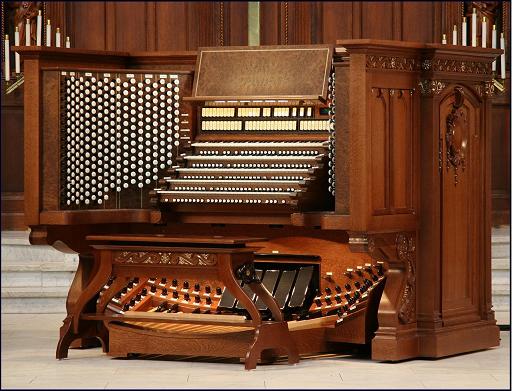
Pull Out All the Stops
The phrase “pull out all the stops” is a common phrase meaning to do everything in one’s power, using all resources at one’s disposal, to achieve an objective. If, for example, a large asteroid was headed for a collision with the earth, humans would do well to pull out all the stops to prevent disaster.
![]() |
| Stops are selected using the knobs to the left and right of the manuals (keyboards). |
Merriam-Webster attests that the meaning of “pull out all the stops” indeed derives from the world of organs. I was therefore surprised when I read a different explanation of the origin of the phrase. I was reading the chapter titled “Generator” in John R. Stilgoe’s Metropolitan Corridor: Railroads and the American Scene. The chapter deals with electrical generating stations, both their architecture and their mechanics. Stilgoe writes
The colloquialism “pull out all the stops” derives from the safety governor that spun atop most stationary engines; removing one or more of the weighted metal stops caused the engine to work faster and faster—removing all meant running the risk of a runaway engine, broken belts, and catastrophe.
Merriam-Webster notes that a stop can be a device for arresting or limiting motion, so Stilgoe’s explanation certainly makes sense. I suspect that the phrase applied to organs is more venerable, though I cannot prove that.
Tracking down the origin of words and phrases can be a tricky business.
January 19, 2023
Let’s Slay the Debt-Ceiling Dragon
Today, Treasury Secretary Janet Yellen announced that the United States has reached its statutory debt limit. The government apparently cannot issue additional securities to finance its operation. As a result, the Treasury Department has begun to engage in financial legerdemain, euphemistically called “extraordinary measures,” by which it makes essential payments and defers inessential ones. Absent an increase to the debt ceiling, treasury will exhaust its ability to avoid default on government obligations sometime early this summer. In its entire history, the United States has never defaulted on paying its debts. It is universally agreed that, should the U.S. do so, very bad things will happen.
The debt ceiling is an odd construct. It was invented during World War I. Congress was being asked repeatedly for more money to pursue the war. Rather than having to make these requests over and over, Congress set a limit on how big the country’s debt could be. This eliminated a certain amount of congressional irritation, but as long as there was a formal limit to the nation’s debt, that limit had to be periodically revised. In practice, this meant raising the debt limit.
It might seem logical to revise the debt ceiling in conjunction with Congress’s spending authorizations. Instead, Congress causes money to be spent and increases the debt ceiling as necessary after the fact. In other words, increases do not accommodate future spending; they authorize the treasury to pay bills already incurred. Failure to raise the debt ceiling is akin to buying goods and services on one’s credit card and refusing to pay when the credit card bill shows up.
This Alice-in-Wonderland method of managing the country’s finances makes raising the debt ceiling essential while at the same time allowing a small number of members of Congress to hold the country hostage by making their votes on increasing the debt ceiling contingent on their achieving some unrelated legislative victory. In the current instance, it appears likely that Republican House members will demand budget cuts, possibly in popular programs like Social Security.
Republicans would no doubt argue that the debt ceiling mechanism operates to keep the government accountable. I believe, and I think most Democrats believe. that it is simply an invitation to mischief.
When Donald Trump was president, Republicans offered virtually no objections to raising the debt ceiling. In fact, during the Trump presidency, the national debt was greatly expanded, in part as a result of GOP-sponsored tax cuts. Republican legislators claim they are now interested in fiscal responsibility, but the reality is that, for many of their number, the real interest is in neutering the federal government’s ability to do much of anything beyond providing for the national defense.
As of this moment, Speaker of the House Kevin McCarthy has promised a small number of House members that the House will not approve a debt ceiling measure without demanding major spending cuts. President Biden has made it clear that he expects to sign a debt ceiling increase bill unencumbered with other provisions. Ironically, if Republicans force a federal government default, it will raise the government’s cost of borrowing, thereby increasing, not decreasing the national debt. The effects, not only on the cost of borrowing but also on the perceived trustworthiness of the U.S. and the stability of the world’s financial system will likely be catastrophic.
The whole debt ceiling mechanism is irrational and counterproductive. What seemed a useful and enlightened idea during World War I has become a monkey wrench in the gears of government. It makes sense for Congress to set an upper bound on the government’s ability to borrow, but it is morally unacceptable to prevent the government from paying for spending that Congress has already authorized.
Given the radical GOP ideologues now in the House of Representatives, the country seems headed for a showdown unlikely to end well. The Biden administration, should, I think, take drastic action that could put an end to legislative blackmail.
Section 4 of the Fourteenth Amendment says, in part:
The validity of the public debt of the United States, authorized by law, including debts incurred for payment of pensions and bounties for services in suppressing insurrection or rebellion, shall not be questioned.
Failure to allow the government to pay “public debt of the United States, authorized by law” surely constitutes “questioning” such debt. The Biden administration should declare that failure to pay existing obligations is unconstitutional and should direct the treasury to issue debt obligations as needed to continue to pay the government’s bills. If the Congress is unhappy with the level of debt, it can try to cut spending in the usual legislative process, but not through debt-ceiling blackmail.
This would be a gutsy move by President Biden, and I suspect that Republicans would try to block it through the courts. The relevant provision of the Fourteenth Amendment has never really been litigated, and a particular judicial outcome is not guaranteed. The whole debt-ceiling thing is a hypocritical mess, however, and it may be time to kill its malignant effects once and for all.
January 18, 2023
When Is a Fetus a Human Being?
Last month, The New York Times published a piece by Elizabeth Dias titled “When Does Life Begin?” My reaction to the essay was that it asked the wrong question. A fertilized egg is undoubtedly alive and it is most certainly human. In no way, however, is it a human or, if you prefer, a person.
Two weeks after “When Does Life Begin?” appeared, the newspaper offered a sampling of reader reactions to it. The most helpful reader comment, I thought, came from Richard Ambron, professor emeritus of cell biology at Vagelos College of Physicians and Surgeons of Columbia University. He wrote:
When during gestation does an embryo become a human? This question has baffled philosophers and theologians largely because they do not understand the workings of the nervous system and the brain.
Two attributes are widely accepted as criteria to be considered human. First is an awareness through our senses that we exist and that we exist within a world of objects. Second is the ability of the brain to use the information from our senses to create ideas and make predictions about how to best survive in that world.
When during embryonic development do these activities emerge? The heartbeat becomes audible on a Doppler fetal monitor at about the 10th week of gestation, movements begin sometime after the 15th week, but the brain and most of the sensory systems develop later.
Each sensation requires the formation of millions of interconnecting neuronal circuits in the cerebral hemispheres that reach critical points of development between the 24th and the 28th week of gestation. Around that time, rhythmic brain waves resembling those of a newborn can be detected, indicating that neuronal circuits in the brain are highly integrated.
What this tells us is that a fetus cannot perceive most sensations, the first attribute of being human, until at least six months after fertilization. The ability to formulate ideas, the second attribute of humans, probably does not occur until after birth when the newborn’s brain begins to correlate all of the sensations into a coherent experience of its surroundings.
Thus, claiming that we become human at the moment of conception is merely a belief that argues against data from decades of research in embryology, neurology and developmental neuroscience.
Ambron implies that it is not a heart that makes us human—animals less complex than humans have beating hearts, but they are not human because of it. It is not unreasonable to assert that it is our working brains that make us human. Significantly, brain death is generally taken to mark the end of one’s life, with the ability to harvest organs for transplant being the only reason for being kept “alive.” Does it not make sense, therefore, to consider a developing fetus less than a human being prior to substantial brain development?
If one has to pick a point in fetal development beyond which abortion should be prohibited, Ambron offers facts that should be considered.