May 27, 2023

Lessons from the CNN Trump Town Hall

No doubt, many are still reeling from the Donald Trump town hall staged on CNN earlier this month. The former president was questioned by Kaitlan Collins before an audience of seemingly rabid Trump devotees.

Although Collins asked reasonable questions and tried valiantly to elicit relevant answers, she failed to force Trump to answer what was asked or to prevent him from lying boldly and repeatedly. A particularly distressing aspect of the town hall was the enthusiastic audience reaction to Trump’s falsehoods and outrageous assertations. The town hall was nothing so much as a mini-Trump rally.

Whereas CNN was widely criticized for its Trump circus, the network defended its presentation as a service to the nation, exhibiting the true character of the once and future president. Trump, of course, exhibited no surprises.

We already knew that Trump was a sociopath and pathological liar. His performance was perfectly predictable. CNN did perhaps offer insights into the MAGA phenomenon. The town hall made clear that all too many Trump supporters are at least as devoid of compassion, thoughtfulness, and commitment to democratic ideals as is the object of their perverse affection. And CNN demonstrated how difficult it is for a normal journalist to get Donald Trump to behave like a normal interviewee. Collins attracted criticism for her failure to control Trump, but she did sincerely try. But she was overmatched.

It is to be hoped that the CNN debacle—for that’s what it was—will have taught journalists and their managers lessons they will take into the developing campaign for the GOP presidential nomination and, God forbid, beyond. Those lessons, of course, should already have been learned.

Lesson number one for the journalistic community is that Trump deserves the same sort of coverage provided to other candidates. He might never have become president had not his deranged rallies been covered on television as if they were as important as a State of the Union Address or a Superbowl. (They may have been so for ratings, but the health of the Republic is more important than ratings.) Trump enjoyed more free media than any candidate before him. Repeated and extended exposure to Trump propaganda unleashed the darkest impulses of susceptible viewers. Journalists should excerpt Trump rallies and town halls, not cover them slavishly from start to finish.

Like any candidate, journalists will want to interview Trump. Fine. But interviews should never be broadcast live. As was so graphically demonstrated in the CNN town hall, Trump’s steamroller tactics can easily control an interview despite the interviewer’s intentions. Recorded interviews can be edited to minimize Trump indirection. Better still, when a question is asked and Trump does not answer it, the question should be asked again, possibly in a slightly different form. An unanswered question should be asked as many times as necessary to elicit either an actual answer or an explicit admission by the candidate that he is refusing to give an answer. It may be tempting to edit out the back-and-forth attempt to evoke an answer, but that temptation should be resisted. Viewers should see Trump’s evasiveness for what it is. An interview should not have an audience, and the press should think twice about extensive coverage of any event at which an audience has excluded any but Trump supporters. Fox News will, of course, ignore all this advice.

Finally, there is the matter of campaign debates (or whatever it is that we stage every four years). Although debates can be excerpted for newscasts, the events themselves must be offered live to the public. Neither moderators nor other candidates have shown the ability to control the Trump juggernaut. Moderators (or producers behind the scene) need to be given a secret weapon against Trump bluster. That secret weapon is a microphone switch. Trump’s microphone should be on when he has the right to speak and off when he does not. Fairness, or the appearance of fairness, demands that other candidates be treated the same way. Debate producers should also demand other rules designed to facilitate civil discourse. These might include tolerating only a brief period before a candidate begins a relevant response to a question. If a candidate blatantly digresses, the secret weapon can be used. Also, ad hominem attacks should be prohibited and likewise dealt with. Criticizing a candidate’s actions or policies is fair game. Name-calling or criticizing a candidate’s person should be off-limits. This includes Trump’s insulting names for his competitors.

In reality, I suspect that Trump, as the flamboyant narcissist that he is, will indeed get more free media than he deserves. I hope that it is less than formerly. A second Trump presidency would be a catastrophe for humanity.

May 20, 2023

Kill the Debt Ceiling Once and for All

It has often and rightly been said that the Constitution is not a suicide pact. And yet, some substantial numbers of Republicans in the House of Representatives seem willing to throw the country, and in fact, the world, into economic chaos by refusing to raise the debt ceiling without demanding spending cuts for which they do not have the votes to enact through regular legislative order. Their position has properly been called blackmail.

It is ironic that the World War I era debt ceiling was enacted to facilitate government borrowing, not to preclude it. Congress grew tired of the executive’s repeatedly returning for authorization to borrow money in a time of war. In recent times, however, the debt ceiling has become a weapon for the minority party to get its way. Well, to try, anyway.

This country is increasingly governed by Republicans, even though they represent a minority of citizens. This is the result of gerrymandering and accidents of history combined with singleminded strategizing to pack the judicial branch with radical, barely qualified, right-wing judges. It is time to remove the debt ceiling as yet another anti-democratic weapon from the GOP arsenal.

Although President Biden has repeatedly said that he would not negotiate spending cuts in order to increase the debt ceiling, negotiations nevertheless appear to be ongoing. But the president should stick to his guns. It is fine to negotiate with the blackmailers about spending, but a clean debt ceiling increase must be a separate, nonnegotiable issue. And if Republican legislators want to talk about controlling the federal debt, the administration should not even be speaking to them unless they are willing to consider tax hikes. Republicans don’t actually care about the nation’s debt; they want instead to cripple or destroy the welfare and administrative state.

Various procedures have been suggested to avoid the country’s going over the fiscal cliff if Congress cannot agree on a debt ceiling increase. The idea of minting a trillion-dollar coin is one of the more intriguing schemes that has been proposed, but the idea suffers from simply being weird.

Then there is the matter of the Fourteenth Amendment. Section 4 of the amendment reads

The validity of the public debt of the United States, authorized by law, including debts incurred for payment of pensions and bounties for services in suppressing insurrection or rebellion, shall not be questioned. But neither the United States nor any State shall assume or pay any debt or obligation incurred in aid of insurrection or rebellion against the United States, or any claim for the loss or emancipation of any slave; but all such debts, obligations and claims shall be held illegal and void.

This amendment was passed after the Civil War to assure that the Union’s war debt would be paid. Its provisions are general, however, and they are helpful in maintaining the rock-solid integrity of federal obligations. Allowing the government to default on its debt is surely unconstitutional. If Congress has authorized spending and that spending has taken place, the government must stand behind any debt obligations incurred to finance that spending. The government, by analogy to individuals, must pay its credit card bills. (Paul Klugman recently pointed out, however, that this analogy can be taken only so far.)

No doubt, President Biden is reluctant to cite the Fourteenth Amendment to continue paying government obligations in the absence of a legislative debt ceiling increase. Republicans would view such a move as a kluge, as somehow illegitimate, though not as bizarre as the trillion-dollar coin trick. It would likely attract a lawsuit to block or undo the president’s action. This might even cause a delay that, in the end, did in fact, result in default. That is a chance that must be taken.

If the Republican House does not pass a clean debt ceiling increase lasting at least two years, Mr. Biden should let things stand until the government is on the brink of default. He should then announce that the government will continue paying bills, as the Fourteenth Amendment requires it, and he has sworn to uphold the Constitution.

It is interesting to consider who could file such a lawsuit in response to such an administrative action. Who would have standing? Would standing require a plaintiff harmed by the government’s not defaulting on its debt? These are crazy times, and if doctors whose sensitivities could be assaulted by having to treat a patient who had a bad reaction to a medicinal abortion can file a lawsuit to reverse an FDA drug approval, who knows who could get through the courthouse door opposing the plain meaning of the Fourteenth Amendment? Likely, the House or House members would file, arguing that the authority had been usurped. Let them do so.

Any such suit would quickly reach the nation’s highest court. But even today’s conservative Supreme Court recognizes that the Constitution is not a suicide pact. The government should not only argue that the Fourteenth Amendment means that the government must pay its bills but also that the very idea of a debt ceiling is unconstitutional. The administration and the court will have an opportunity to kill the dysfunctional debt ceiling once and for all.

They should, by all means, do so.

April 28, 2023

Lamenting the Loss of the Red Envelopes

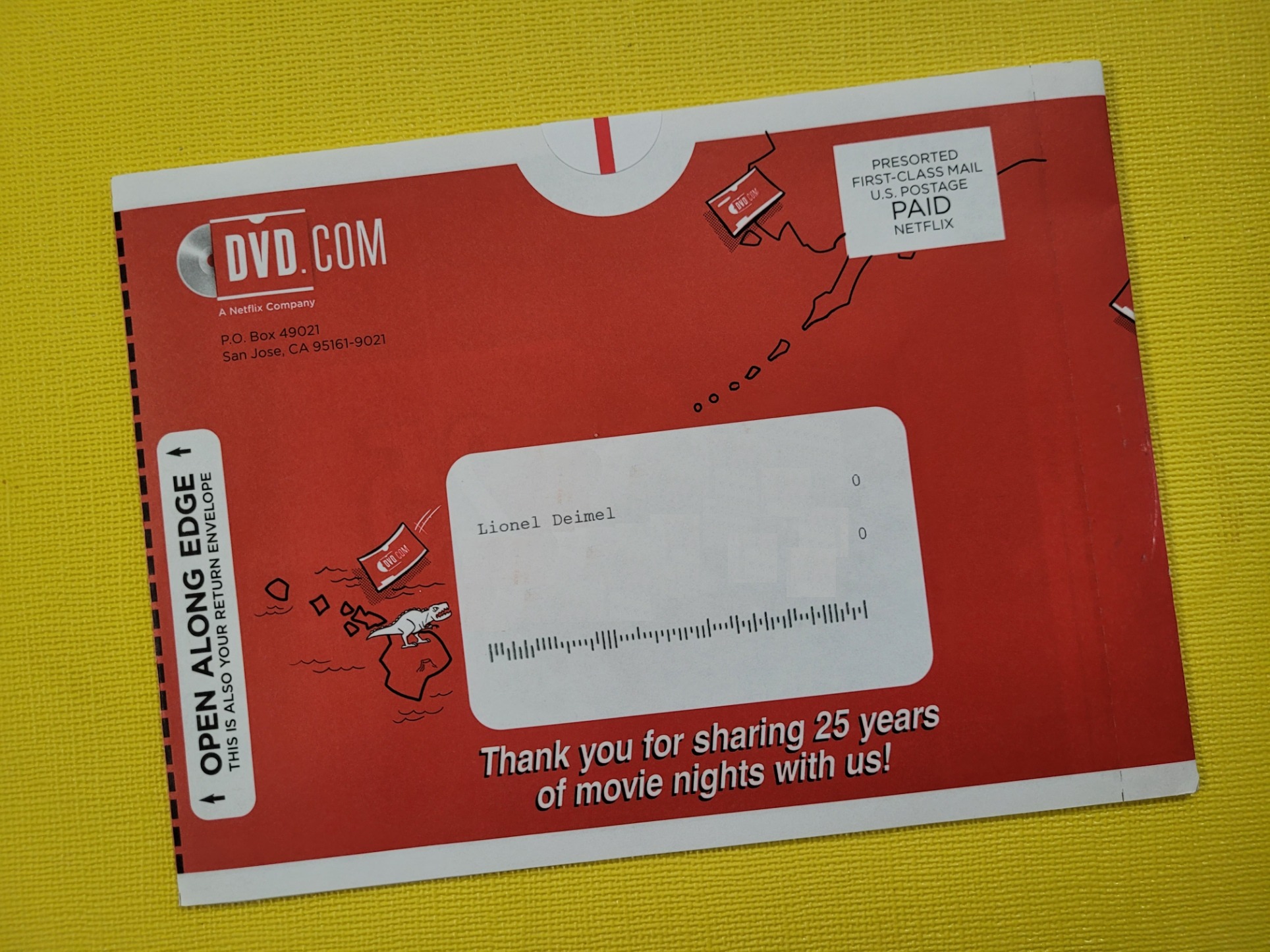
I was very upset by the recent announcement that Netflix was terminating its DVD delivery service this fall. I first joined Netflix when all content was delivered by the Postal Service. I have continued to receive DVD and Blu-ray disks in the mail, though I use Netflix’s streaming service as well. The good news is that I will be paying Netflix less, but much is being lost.

Why do I continue to receive physical disks? No, I am not a Luddite; I enjoy the content I can receive via streaming. There are two losses I will experience when the red envelopes cease to arrive in my mailbox, however. The most important loss is access to films not available via streaming. Secondarily, I will lose access to the extra content that is frequently found on DVD or Blu-ray disks.

My interest in watching movies is atypical of Netflix users generally, but may not be atypical of DVD.com subscribers. I do not search available movies for “somethng to watch.” In a sense, I am not looking for “entertainment.” Instead, I am seeking insight into movie history, seeking classics every movie buff should see, and exploring the films of particular actors or directors. Because of my somewhat academic interest in cinema, I will even watch moves that I don’t expect to like. On physical disks, I can see older movies and movies lacking universal appeal. And, of course, I can even watch well-liked movies that are simply not available on Netflix for whatever reason.

Of course, the bonus of getting those disks in the mail is the extras usually found on DVDs and Blu-ray disks: commentaries, deleted scenes, “making-of” documentaries, biographical information, and the like. Such extras help put a film into a larger context and provide insight into the movie-making process. Seldom do I return a disk without watching all the extra on that disk.

In principle, there is no reason that movies available only through the mail could not be streamed. And why couldn’t those extras be streamed as well?

Will the demise of DVD.com result in movies now only available by mail becoming available to stream? I can hope, though I don’t expect it. I wonder what will happen to the large inventory of physical disks held by Netflix.

While there is still time, I am trying to see all the DVD.com movies I can before the service ends.


Netflix (DVD) envelope
One of the famous red envelopes

April 10, 2023

Fed Up

I often post graphics on Facebook that never appear here on my blog. What appears below began as a Facebook post. I thought others might want to see or use it. This may be copied freely.

April 4, 2023

Of Course, It’s Political

I am tired of hearing Trump and his minions complain that the various investigations of the former president—and now at least one actual indictment—are “political.” Yes, in fact, they are, but being political does not make them illegitimate. The primary meaning of “political” is, according to Merriam-Webster, “of or relating to government, a government, or the conduct of government.” In this sense, the judicial system is definitely and intrinsically political.

Of course, “political” can also refer to party politics. This is clearly the meaning in Trump’s mind and those of his supporters when they complain of political persecution. The term is imprecise and technically ambivalent. What they should be saying—not because it’s true but because it is what they want the public to believe—is that the investigations of Trump’s behavior is partisan. This word means “feeling, showing, or deriving from strong and sometimes blind adherence to a particular party, faction, cause, or person.”

One suspects that Donald Trump, who exhibits little concern for truth, is equally indifferent to the subtleties of the English language. 

April 1, 2023

A Walking Tour of Clifton Springs

Today was the first day of sunny, 70-degree weather in Clifton Springs since I moved here in November. I had to go outside just after noon and decided to walk south along Sulphur Creek. I was surprised to see dozens of ducks both in the creek and on its banks. (I’m still learning to identify ducks. I can recognize mallards, but I’m not good at naming other waterfowl.) The creek flows past the Clifton Springs hospital, and I discovered a pond with a fountain on the hospital grounds. There were more ducks around the pond, two mute swans in the water, and two turtles sunning themselves on a rock. I had a very pleasant stroll.

I’ve wanted to explore Clifton Springs further. The pleasant weather and my discoveries along the creek inspired me to take a longer walk through the town. Clifton Springs is a small village, and it is not unreasonable to plan to explore each of its streets. I thought of doing this by car, but today it seemed like a walking tour was indicated. My walk lasted more than an hour. Although I have not yet explored every street in the town, I am off to a good start.

I returned home with a number of impressions. First, the town has a large amount of parkland for such a small place. The housing stock seems surprisingly good, sometimes even charming. And, although sidewalks are not universal, there are a lot of them. Finally, I was already aware that this area is not a bastion of liberal sentiment. (I have disliked virtually every vote my Republican congresswoman has cast, for example.) I was a bit taken aback by a number of Christian-oriented signs I saw in front of houses, which I assume were not indicating the presence of Episcopalian families. (One house had a large cross that said: “JESUS SAVES.”) I saw only one Trump sign and a distressing banner: “JESUS IS MY SAVIOR/TRUMP IS MY PRESIDENT” No, actually, he isn’t.


On the whole, Clifton Springs, New York, is a fine place. I doubt I will be able to do much to improve the sentiments of its residents.

March 30, 2023

Baseball Changes

 Major League Baseball begins a new season today. And the season begins with new rules intended to increase scoring and get games over with faster. A sport that was distinctive for lacking a clock will now have a pitch clock, larger bases, restrictions on pickoff plays, and a prohibition of the defensive shifts that have frustrated batters. The universal introductions of the designated hitter and video replays seem like minor tweaks compared to the rule changes that will color the 2023 season.

Baseball rules have been remarkably stable over the game’s long history. Past changes have primarily been made to increase safety or fairness. (Changes to the mound height and the introduction of pitchless intentional walks are exceptions.) I have always thought that the size of the diamond and its bases are perfect. The dimensions make scoring a single or stealing a base difficult, which makes them more exciting when they occur.

I am not looking forward to the new MLB season. In fact, I think the game should no longer be called baseball. Like the reformulation that produced New Coke, the MLB game should be called New Baseball. We can hope that the history of New Baseball will be a replay of the history of New Coke.

March 26, 2023

Thoughts on Trump’s Legal Future

Like many people, I suspect, I am frustrated by Donald Trump’s unconstitutional behavior as president and his outrageous behavior as a civilian. He should have been removed from office and should be indicted and convicted of the misdeeds for which he is currently under investigation. Will this megalomaniacal psychopath again escape justice? He is now a citizen like any other and should receive no special treatment for having been president. In fact, since we have a right to expect more of our chief executive, he should be treated especially harshly.

If Donald Trump is indicted for his part in attempting to overturn the 2020 election by masterminding a coup, he should be arrested and placed in jail. He should definitely not be released on his own recognizance, as he clearly will remain a threat to the body politic. Even in jail, given modern communications, he could remain a threat to civil peace. He should therefore be incarcerated without the ability to communicate with anyone but his lawyers.

Most likely, of course, Trump will be treated with kid gloves. However he is treated, his Republican minions will decry his treatment and demand his release and exoneration. We must assure that that doesn’t happen.

March 13, 2023

On the SVB Collapse

The Federal Reserve took control of Silicon Valley Bank (SVB) on Friday. Depositors were immediately reassured that insured deposits would be available on Monday morning, that is, today. Yesterday, however, the reassurances got substantially better: All deposits, even those beyond the nominal insurance maximum, will be made available. This, despite the FDIC’s explanation of insurance benefits:

The standard insurance amount is $250,000 per depositor, per insured bank, for each account ownership category.

As it happens, SVB is a favorite bank of venture capitalists and startups, and, unlike many banks, most accounts were much larger than $250,000. We are being told that no taxpayer funds are being expended to make depositors whole; the required funds will come from the FDIC account, which is funded by levies on banks. What we are watching, officials emphasize, is not a bailout.

Silicon Valley Bank sign
Well, it certainly looks like a bailout. At the very least, we have created a moral hazard—why should large depositors worry about insurance limits if the government will protect them whatever their apparent exposure. The funds not covered by SVB assets that will pay back depositors will have come from banks that pay into the insurance fund. This makes FDIC insurance less able to pay actually insured losses in the future. The FDIC, if necessary, will charge banks more. This cost of business ultimately gets passed on to customers, i.e., taxpayers.

Ask yourself the question: if your own ordinary bank failed and you had more than $250,000 on deposit, do you really think you would get it all back? Or, if your house burned down and your insurance coverage was written for less than its current value, would you expect the insurance company to pay the full value of your loss? But since SVB held lots of corporate funds, the government felt it had to indemnify them. Once again, we find that big companies are “too big to fail,” and the corporate world doesn’t play by the same rules as the rest of us. Are you as tired of this as I am?

Senator Elizabeth Warren wrote about the SVB situation in The New York Times. She argued that (1) the managers of SVB were irresponsible, and (2) that irresponsibility was facilitated by the government’s having removed some of the safeguards of the Donn-Frank Act. That loosening of banking requirements resulted from—you guessed—heavy-duty corporate lobbying.

Welcome to the world of unconstrained capitalism.

March 11, 2023

Q

No, I am not interested in the insane pronouncements by a reputed government insider that has ensorcelled weak-minded so-called conservatives and thereby threatened the Republic. I am not interested in a person, real or imagined, at all. This post is actually about the letter Q.

In English, Q has led a rather forlorn existence. It is the second least used letter of our 26-letter alphabet; only Z occurs less often. (Q and Z, alone among the letters, are worth 10 points in Scrabble.) In English words not borrowed from other languages. Q is invariably followed by U. Naked Qs occur most often in borrowings from unrelated languages such as Arabic, Hebrew, and Chinese.

When I was in elementary school, I was told that a solitary Q only occurs in the name “Iraq.” Lately, however, Qs are showing up in a surprising number of pharmaceutical names. These include Rinvoq, Kisqali, and Cibinqo among others.

I have no idea why drug companies have suddenly become enamored of such a rarely-used letter. Are they trying to increase its pathetic usage statistics? Has Q somehow become cool (or are manufacturers trying to make it cool)? Naked Qs in medicine names is an odd trend not limited to one company. Rinvoq, Kisqali, and Cibinqo are all marketed by different firms. Are they each using the same consultants to come up with new names for drugs?

One can appreciate the difficulty in naming new drugs. Names need to be pronounceable, reasonably concise—a three-syllable name like Cibinqo is pushing it—and not a word, particularly an objectionable word, in any foreign language. Names should be catchy, however you might define that. Pharmaceutical names sometimes suggest, at least vaguely, what they might be used for. Flonase and Claritin, for example, are allergy medications. Rinvoq, Kisqali, and Cibinqo do not himt at how they might be used. Rinvoq claims to be a treatment for ailments as diverse as eczema and rheumatoid arthritis, so there’s an obvious problem there. 

But why all the Qs. In every medicine name I have encountered, the Q is sounded like a K and could easily be replaced with a K. Why do we not have Rinvok (or Rinvoke), Kiskali (or even Kiscali, which would sound the same), or Cibinko? I have no idea. This seems to be novelty for novelty’s sake.

I do hope this trend does not continue. Children have enough trouble with spelling without confusing them further.

March 4, 2023

GOP: The Party of Freedom

It is supremely ironic that the Republican Party insists that it is the party of freedom, whereas its policies are mostly those that limit freedom. This led me to make the graphic below, which outlines the freedom that the GOP offers the nation. This graphic may be freely copied.

A Disclaimer for Fox News

I frequently watch movies on disk. (No, I’m not a troglodyte who doesn’t know how to stream content. Many of the films I want to watch, particularly older ones, are only available on  DVD or Blu-ray disks.) These disks often include commentary or interviews. In such cases, a disclaimer is invariably included similar to this one I encountered recently from Lions Gate:

This Blu-ray Disk audio commentary contains views, opinions, and statements of the individuals participating herein.

Lions Gate Entertainment Inc. does not represent or endorse such views, opinions, or statements.

In other words, although the studio is responsible for the movie on the disk, it takes no responsibility for the extra-movie material over which it has exercised limited control.

Fox News logo
Through discovery in the Dominion Voting Systems defamation lawsuit against Fox News, we’ve learned that neither the on-camera talent nor the management of Fox actually believed that the 2020 presidential election was stolen from President Donald Trump. Nevertheless, the Big Lie, in all its aspects, has been promoted heavily on the channel with the enthusiastic support of management.

Under the circumstances, Fox should perhaps follow the lead of movie studios on the consumer disks they market. Fox programs could be preceded by a disclaimer such as the following:

This program contains views, opinions, and statements of on-camera Fox News employees and guests.

Neither Fox News, its management, nor its on-camera employees represent or endorse such views, opinions, or statements.

On the other hand, a more straightforward explanation might be more appropriate, something like the following:

The following program is for entertainment only and is not guaranteed to be factual or reasonable.

March 1, 2023

Adolescent Women

I heard a phrase on NPR this morning I have never heard before: “adolescent women.” Why not “adolescent girls” or “adolescent females,” I thought. Is calling a teenage female a girl not politically correct now? Women often refer to themselves as girls. My immediate reaction to “adolescent women” is not that it is more respective of teenage girls as it is less respective of women. But that’s just my gut reaction. 

Are teenage boys now going to be “adolescent men”? Will we now speak of “toddler women” or “infant men”? Does anyone else find this strange?

Writing Someone Else’s Congressperson

I read something that Congressman Jamie Raskin said and wanted to express my approval of his having said it. He complained about Republicans using “Democrat” as an adjective, as in “Democrat Party.” I had written about Republicans’ avoidance of the word “Democratic” myself. I thought I would write to the congressman and include a link to my blog post, which he might perhaps find amusing.

Rep. Jamie Raskin
Rep. Jamie Raskin
I found Mr. Raskin’s congressional Web site, filled in my name, address, and e-mail address, and typed my message. When I tried to send my comments, however, I received an error indicating that my Zipcode was wrong, in other words,
my own Zipcode is not in his Maryland district. This is not the first time I have encountered this problem trying to communicate with a member of congress who does not technically represent me.

I appreciate that a congressperson can be easily overwhelmed with messages even from constituents. (Framers of the Constitution intended for representatives to have many fewer constituents than they do today. They did not anticipate Congress’s limiting the number of members of the House of Representatives, thereby eliminating the cap on the constituent-to-representative ratio.) Messages from non-constituents can make the deluge of messages seem even more overwhelming.

Modern American media give members of Congress national exposure, and it is not unreasonable to think that someone who is not a constituent might have good reason to communicate with a representative or senator. In my case, I wanted to praise Mr. Raskin for saying what has been needed to be said for years and to encourage him to continue saying it. I also wanted to communicate my thoughts on the same subject as set forth in my 2017 blog post.

Having been denied the opportunity to send the representative e-mail—I don’t know his e-mail address, and the form on his Web site prevented my sending e-mail through that mechanism—I thought of calling his office. I did have access to a telephone number, but I thought that communicating my blog post over the telephone would be cumbersome. Before picking up the phone, however, I realized that I could write a letter and enclose a copy of my blog essay. So that’s what I did.

I later discovered that Mr. Raskin has a Facebook page, and I could conceivably have communicated with him through Facebook. I think the letter was a better idea, and perhaps demonstrated greater commitment to getting my voice heard. That message was not time-sensitive, and I’m not sure what would have been the best channel to use had it been. Probably I would have used the telephone in that case.

I am offended by public officials limiting who is allowed to contact them conveniently. Mr. Raskin is not the only offender here. Not long ago, I wanted to send a message to Senator Liz Chaney and ran into the same restriction—I was not from her state. I dropped the project.

I suspect that not all members of Congress have a pressing need to limit their e-mail messages. But those with a high profile may consider that a necessity. This is a shame, and I don’t know what to do about it. Legislators could be given much bigger staffs to handle communication, I suppose, though the real problem is that we have too few people in Congress given the number of citizens needing to be represented. I don’t see us fixing that problem anytime soon.

February 27, 2023

New Curve-stitch Designs

I began making curve-stitch designs in junior high school, having been introduced to them by my math teacher, Mrs. Eunice Williams. I quickly graduated from using pencils or ballpoint pens to using drafting pens and India ink on drafting paper. Drawing these figures was satisfying but mind-numbingly tedious. Mistakes could be corrected but only with difficulty. Some people, even more masochistic than my teenage self, produce designs with thread, yarn, or wire on a substrate of some sort. More power to them.

My enthusiasm for curve-stitch designs was rekindled by my discovery that I could produce designs using my computer. Frankly, doing so can be tedious as well, but at least it’s not as physically challenging. Using the computer allowed me to post some of my designs on my Web site and even see them published in China and Australia. I have lately been updating Lionel Deimel’s Farrago and have again begun to create curve-stitch images.

In many ways, my favorite creation is what I call my curve-stitch isometric cube. I too an isometric cube and drew curve-stitch parabolas on all adjacent sides. A framed version of this design hangs in my hallway. It consists of white lines on a black background. Here is a black-on-white version:


I have produced my designs by programming in PostScript. a page-description language designed by Adobe. While updating my Web site, I decided to simplify the code that generates the above image. In the process, I realized that I could generalize this design. My cube has six sides. Here is an analogous design with four sides.

February 22, 2023

“Reform”

I am tired of both politicians and journalists speaking of proposed law changes as “reform.” GOP lawmakers want to “reform” Social Security, by which they mean reduce benefits or eliminate the program entirely. Prime Minister Benjamin Netanyahu wants to “reform” Israel’s judiciary, by which he means stripping power from the courts and giving more power to the Knesset, thus eliminating an important check on legislative and administrative overreach.

“Reform” is a righteous-sounding term that gives a gloss of respectability to any policy to which it is attached. But not only can the word be used to obscure one’s motives but it can introduce ambiguity and confusion into political discourse. Does “reforming” the police mean transferring police duties to non-police personnel or does it mean giving police more money and equipment to help them do their job more efficiently?

We are unlikely to dissuade politicians from using “reform” to bolster support for their proposals, but we can encourage journalists to reform how they speak and write about the politician’s “reform.” Journalists should not just parrot the propaganda of politicians. They can refer to “changes” or they can be more specific about the changes being promoted. Replacing “reform of” with “changes to” is not more specific, but at least it replaces a positive-sounding locution with a more neutral one. In some cases, journalists can be more truthful without being more verbose—“gutting the judiciary” rather than “reforming the judiciary,” for example.

If journalists refuse to automatically repeat calls for “reform,” politicians may actually become less eager to use the term.

February 16, 2023

Non-binary Pronouns

A while ago, I was reading a story of some sort. A few paragraphs into it, I ran into the phrase “they said.” They who? I wondered, as I had as yet encountered only one person’s name. It took me a while to figure out that the “they” of the story was, in fact, the single person named earlier. Apparently, that person identifies neither as male nor female. (I don’t like the term “identifies,” but, when I tried to recast that last sentence without using gendered pronouns, I began to appreciate its usefulness.)

On Zoom, it has become common to see participants whose name is followed by a notation such as “(they, them),” that is, they telegraph “their” pronouns. Other people add “(she, her),” “(he, him),” “(she, her, hers),” or some such. For someone who presents as male or female, the list of pronouns is technically unnecessary, though I suspect it is added to make less prominent the list of those for whom the list is necessary.

Honestly, I don’t understand the whole non-binary thing unless you are an intersex person. On the other hand, I don’t care about it. If you want to be a sexless person, I say go for it. On the other hand, I strongly object to the use of plural pronouns to refer to individual persons. Doing so is a confusing grammatical anomaly. I am sympathetic to the desire of non-binary people to eschew gendered pronouns. I think, however, that they have taken the wrong approach linguistically.

English is unhelpful to the non-binary. It has male, female, and neuter pronouns.  One could argue that the appropriate pronouns should be “it,” “its,” and “itself”. Logic, however, does not account for the discomfort resulting from referring to humans with the same pronouns utilized for file cabinets and garbage dumps. (Some Episcopalians are uncomfortable referring to God as “He,” but they seem equally uncomfortable with “It,” which also seems logical.) The language is really in need of some new, non-binary pronouns. Why not invent some?

That suggestion is more reasonable that it might at first seem. When women wanted an honorific that did not indicate marital status, they—someone, anyway—invented “Ms.” It took some time for this neologism to be widely accepted, but no one gives it a second thought today. It is actually comforting to know that I can respectively address a woman without having to research whether or not she is married. Encouraged by this development, I propose that we adopt new pronouns for non-binary persons.

I would argue that we only need new second-person singular pronouns. Pronouns such as “me” and “them” do not telegraph gender, and there probably is no reason to devise analogous pronouns that do. I will propose specific pronouns, but my concern is simply that we devise some new pronouns. Others may be able to invent more mellifluous ones. By analogy to existing forms, I believe the new words should be monosyllabic where possible and not be easily confused with other English words.

Here are my suggestions for second-person singular pronouns: 

  NOMINATIVE     OBJECTIVE     POSSESSIVE     REFLEXIVE  
          tu           tum           tus           tuself

Here is an example of how these words could be used:

Tu attended the party. Janet met tum there. She was surprised by tus outfit. Tu told her that tu designed it tuself.

As I said, I am advocating new pronouns, but I don’t have strong feelings about what these new words should be. I decided to base my words on the French tu, meaning you. This was convenient for a number of reasons. I invite comments and other suggestions. 

February 14, 2023

Views of My New Church

When I moved to Clifton Springs, New York, I was happy to discover that there was an Episcopal Church hardly more than a block away. I have been waiting for a sunny day and an afternoon sun to take pictures of St. John’s Episcopal Church.

This is the shot I had been waiting for:

East side of the church

Unfortunately, I could do nothing about the large shadow on the west face of the building. There is a tall structure across Main St. that is responsible for the shadow. I could not remove that building. Unlike most churches, St. John’s is notable for having the liturgical east end of the church actually facing east. Reviewing this photograph, I wonder if it would have been improved were there a few clouds in the very blue sky.

Leaving downtown driving east, St. John’s is nearly in front of you until the road veers to the right, as can be seen in the map below.

Aerial view of the church neighborhood

As you might guess from the photo of the church, St. John’s has been around for a while. Below is a photo of the cornerstone at the northeast corner of the building.

Building cornerstone

As your car goes past the church you can see this sign on the church lawn:

Church sign

And here is the south façade of the church:

South side of church

Clapping on Jeopardy!

I’m not a fan of quiz shows generally, but I regularly watch Jeopardy! This particular program requires knowledge—often arcane knowledge—imagination, strategy, dexterity, and a little bit of luck. It is fast-paced and challenging for viewers who take the game seriously. And trying to come up with the proper responses can be seriously humbling.

I’ve noticed a phenomenon on the program that I’ve observed (and disliked) on other quiz shows. Contestants sometimes clap when other contestants offer a correct response. Surely this is insincere. Contestants are contesting against one another after all. Generally, a successful response from someone else diminishes your chance of winning. Could that possibly please you if you actually understand the game?

It is possible, of course, that someone might offer an extraordinarily brilliant response to a difficult clue, for which admiring applause might seem appropriate. Although playing the game requires knowledge and cleverness, absolute brilliance is not usually necessary, so I think this situation arises seldom if at all.

Another reason for clapping for a correct response from someone else is strategic. For example, if you are leading another player by a small amount, a correct response by a far-behind third player is not a threat to you and prevents the second-place player from gaining on you by offering a correct response. Your applause could be quite genuine, but it would represent bad sportsmanship. It would be the equivalent of clapping for a missed response.

At the end of the game, losing contestants usually clap for the winner. Unlike other opportunities for applause, this is perfectly respectable, acknowledging as it does, the winner of a hard-faught game. That would represent good sportsmanship.