October 14, 2023

No Eclipse

 The last time I experienced a partial eclipse of the sun was August 21, 2017. Although my track record for seeing astronomical phenomena unobscured by clouds is poor, I actually saw a diminished sun on that date.

I had hoped to see a bit of an eclipse today. In my neck of the woods, only 20 or 30 percent of the sun was to be obscured, but any eclipse is worth seeing. Unfortunately, in my move to Clifton Springs, I seem to have lost or misplaced my eclipse glasses, but I had a backup plan involving a white surface and a large magnifier.

I was outside at the appointed time, but the day was so overcast—it was raining, in fact—that I couldn’t even tell in what direction the sun was, much less see it. Nevertheless, I thought I might see everything get darker. Well, I didn’t. Had I not known that an eclipse was taking place, I would have been blissfully unaware of it.

I’ll be in the path of a total eclipse next April. I’m hoping for better weather.

September 18, 2023

Terrible Customer Support: Nu Skin Edition

At the suggestion of my former eye doctor, I have been taking Pharmanex LifePak anti-aging packets, each of which contains four capsules. The packets come in a box of 60—essentially a two month’s supply—sent to me every two months by Nu Skin Enterprises, Inc. My most recent shipment was on August 21. When that shipment arrived, I still had nearly a month’s worth of packets left. I wasn’t sure how shipments and usage had gotten out of sync, but I put the package in the pantry and thought no more about it.

On September 16, I received e-mail indicating that my next shipment would be on September 21. This was clearly inappropriate, and I telephoned Nu Skin today with the intention of changing the shipment date to November 21. The call did not go well. First, I dialed the telephone number listed on the September 16 message. This resulted in my hearing a recorded message to the effect that the Nu Skin number had been changed as of August 1.

I then called the new number. (Happily, there was a number to call, and my call was answered after a brief delay.) I explained my consternation over the September 16 message. I was told that, in fact, my next shipment would be on October 21. I received no explanation for the message that occasioned the call. October 21 was actually the expected shipping date given that the last shipment was on August 21. I explained, however, that I had not yet opened my last package, and I asked for the next shipment to be on November 21.

Incredibly, I was told that the computer system did not allow that change to be made today. To make the change, I would have to call back after October 1. I remarked on the failures of the IT department, noting also the outdated telephone number on the September 16 message. I was told that changing references to the former telephone number was in progress. I somehow managed not to scream at the agent, something I could do after the call. Instead, I asked that my standing order be canceled, so that I would never receive another shipment. I was assured that this would be done.

After the call, I was asked to complete a four-question survey about my telephone experience. I indicated that the call did not resolve my problem and that I was unhappy with the outcome. A few minutes later, I received an e-mail message confirming the cancellation. Rather than screaming after concluding the telephone call, I decided to write this essay.

Complaints about poor customer service are legion. Often, it is difficult even to figure out how to contact a representative of a company. (I have often failed to find a telephone number on a company Web site but found one through a Google search. I highly recommend this strategy.) Nu Skin deserves credit for publishing a customer service number and actually answering the number promptly. I’m not sure if the representative was a native speaker of English, but she spoke well enough that I had no trouble understanding her.

That said, what Nu Skin did was unforgivable. Why did I get the apparently erroneous September 16 message? Why did a message carry an outdated telephone number a month and a half after the number was changed? Why is the Nu Skin order tracking software so inflexible? Why did the agent make no effort to save an account from being canceled over such a simple problem?

There is no excuse for customer service such as I experienced today. I have a standing order for cat food from Chewy, Inc. Changing a shipping date for that order has been a snap. Perhaps Nu Skin can figure out how to operate as competently as Chewy.

September 11, 2023

Digital Invariants Discussion Revised

My treatment of PPDIs/Armstrong numbers on Lionel Deimel’s Farrago has been checked and revised. I have added a new theorem and revised a corollary that it affects. Although it remains to be proven that all bases above 2 contain non-trivial PPDIs, I can now confidently assert that {302}{1208}5130 is a PPDI. I’m sure my readers were eager to learn this. The discussion on my Web site begins here.


September 4, 2023

A Meditation on Donald Trump and Juries

 That Donald Trump may soon find himself in a courtroom at the defendant’s table has led me to think about juries generally and juries that may stand in judgment of the former president in particular.

I have never served on a jury, although I once came close to being selected. (I made a first cut, but was not included in the final selection.) Conventional wisdom declares that the more education one has the less likely you are to be chosen to be on a jury. My chance of ever being on a jury is likely slight.

It is sometimes argued that jury selection is the most critical aspect of a trial. Attorneys on each side want to select jurors likely to favor their side of the case. The task is difficult, as conspicuous indicators of bias regularly result in the dismissal of potential jurors. If the defendant is accused of killing a policeman, for example, relatives of police officers will surely be excluded from the jury pool.

In a criminal case, prosecutors look for people likely to possess strong law-and-order sentiments. Defense attorneys, on the other hand, seek sympathetic souls, particularly if the defense’s case is weak. An empathetic juror who doesn’t have the fortitude to stand up for his or her opinion, however, will likely be ineffective as an advocate for the defendant.

In principle, a jury should be objective and unbiased. Our adversarial judicial system, however, does not directly seek such a jury, instead relying on the interests of competing parties to select a panel likely to render a just verdict. This system works surprisingly well. Juries make news when they render verdicts widely thought to be incorrect, but such news is uncommon. Nevertheless, the time a jury spends deliberating is a time of great anxiety for all concerned.

Again in principle, the ideal juror should be capable of understanding both the law and the evidence and be able to relate one to the other. Potential jurors are typically given a questionnaire to rule out certain disqualifying characteristics. They are then questioned by attorneys on both sides. This process attempts to weed out the prejudiced and mentally unsuitable.

What potential jurors are not generally filtered for is logical thinking. It is easy for jurors to be led astray by emotion or to reach conclusions that do not strictly follow from the evidence, the law, and the charge of the judge. Being a juror is unlike nearly every other role one is likely to experience in life. One must take into account material presented in the courtroom and exclude from consideration everything else. Jurors are expected to use their common sense yet introduce into consideration no knowledge obtained outside the courtroom. This is, in a sense, contradictory, but it usually seems to work out in practice. For instance, a juror may appeal to his or her own experience but cannot introduce something heard on a television newscast about the defendant. It is difficult to know how strictly logical jury deliberations are in practice.

Because I have a doctorate in computer science with a minor in mathematics, I believe I can reason about evidence and the law particularly well. I believe this would make me an excellent juror, but attorneys on either side might consider me either unpredictable or an actual threat.

This brings us to the matter of Donald Trump. Although I believe that, as a juror in almost any criminal case, I could logically reach an objective, proper verdict, I am less certain in any case involving the former president. I would almost certainly believe Trump to be guilty going into the trial, whatever the charge. I think I could weigh the evidence fairly. If, however, I found the evidence wanting, I just might be tempted to vote guilty for the sake of the country. Although I doubt that situation would arise, I could become, legally speaking, a loose cannon. Defense attorneys will try to filter out anyone with proclivities such as mine. I wonder how hard that will be to do. How my Americans would, given the right circumstances, be tempted to engage in jury nullification?

August 26, 2023

Observations on the Recent GOP Debate

The GOP debate of presidential hopefuls on August 23 was mildly useful, though it illustrated again that the mechanics of these events are all wrong. 

Candidates at August 23, 2023 GOP Debate
First, let me offer a few quick observations.

The most animated participant, Vivek Ramaswamy, was insufferable and pretty much acted as a stand-in for the former president. He was born into a Hindu Brahmin family and appears to think that this automatically makes him a member of the highest caste in the United States. He is a businessman, and we have ample reason to believe that is a disastrous qualification for high office. Besides, he is barely old enough to be president. He will not go far, at least anytime soon.

Ron DeSantis, the personality-challenged Florida governor was unimpressive. Enough said.

The remaining candidates, except for Nikki Haley, were unremarkable. The former U.N. ambassador displayed a realization that the policy positions needed to obtain the GOP nomination are the same ones that will doom the standard bearer in the general election. She is clearly the strongest candidate and will therefore fail to be nominated.

Now, as to the debate mechanics. I should begin by saying that the moderators, Bret Baier and Martha MacCallum of Fox News, largely asked reasonable and relevant questions. (The UFO question asked of Chris Christie was the exception.) They were hampered by two ongoing problems: the presence of an audience, and the lack of an adequate mechanism to enforce the agreed-upon rules of engagement.

I don’t know how the audience was selected, but it clearly favored the Republican Party in general and Donald Trump in particular.  Reactions of the local audience cannot but influence the remote audience and perhaps even the candidates themselves. Moreover, the audience interrupted the debate. It was unsurprising that Bret Baier felt the need to turn around and admonish the crowd, which was becoming unruly. (In my more mischievous moments, I’ve thought that it would be interesting to have a Democratic audience for a Republican debate.)

Disruptive audience reaction is not a new problem but is one that is easily ameliorated: eliminate the audience. Put them in another room with a remote feed, but remove them as a factor in debates. I suspect that getting a ticket to a debate is a perk offered by the network or the candidates. (As I said, I don’t know how the audience is selected.) Fine, give them a comfortable auditorium with a big TV screen and generous hors d’oeuvres. They can cheer and boo to their hearts’ content. Meanwhile, the debate can be held in a much smaller venue, perhaps in a television studio.

Then there is the matter of controlling the candidates themselves. It is clear that the rules for who can speak and in what circumstances are not self-enforcing. The moderators ringing a bell to indicate that a speaker’s time has expired was conspicuously useless in shutting anyone up. If candidates perceive that they can gain a rhetorical advantage by flouting the rules, they will do so. This has been shown to be true time and time again. The solution to uncontrolled debate is also simple: mute the microphone as soon as a candidate speaks beyond his or her allotted time. No one will be able to speak out of turn if an active microphone is not available. If a speaker is in the middle of a sentence, it may be appropriate to allow a three-second grace period before a microphone is cut off. This more aggressive timekeeping is probably best done by a technician. Not only do moderators already have enough to think about, but it is best not to give a candidate reason to be angry with a moderator, either during the debate or later.

My suggestions are not rocket science, and I surely am not the first person to think of them. Why haven’t they been implemented? As long as a debate is staged by a television network, there is an incentive to make the event as entertaining as possible. Audience reactions—to a point, anyway—and verbal fireworks among the participants are audience magnets, at least among those more interested in entertainment than politics. Nothing leads to changing the channel faster than a boring discussion. I suspect that even participants appreciate a certain anarchy in political debates. They are not above stealing more time than they deserve, and they want to display their passion or machismo. (Can a woman show machismo or is there another non-sexist word I could use?)

Of course, my suggestions will not be implemented. None of the participants seems to have an incentive to participate in a thoughtful, polite discussion.

August 14, 2023

Lock Him Up!

This evening, Rachel Maddow and Hillary Clinton are having a discussion as we await information about the just-issued indictment in Georgia. One of the matters they have spoken about is a proper sentence for Donald Trump. Clinton seems reluctant to say that Trump should go to prison.

I don’t remember when first I said I wanted to see Trump in prison, but it was a long time ago. I feel even stronger about the matter today. There are two reasons for desiring that result. First, it is important to make it clear that the undermining of the Republic that was the program of Donald Trump must never happen again and that the punishment for such behavior is sure and harsh. In addition, however, putting Trump in prison is a way to shut him up, to remove his poisonous influence from the body politic.

A say, as I have said before, “Lock him up!”

Meteor Hunting

This past weekend, I went meteor hunting. August, of course, is the month in which the Perseid Meteor Shower can be seen, and the celestial show was supposed to be at its zenith Saturday and Sunday. I have fond memories of my first encounter with the Perseids. I was attending family camp at Sheldon Calvary Camp, an Episcopal Church retreat on Lake Erie. I lay on the grass and watched one meteor after another one memorable night. I have been trying to duplicate that evening of wonder ever since.

To view the Perseids, one needs three things: the right timing, darkness, and a clear sky. I could generally get the timing right, but finding a place away from urban lights has always been a problem. And clear skies always seemed a big problem in southwestern Pennsylvania. Last year, on the condominium deck in a dimly lit development, I did see a handful of meteors, one of which was dramatic.

Having lived in Clifton Springs, New York, for less than a year, I wasn’t sure where I might find a good spot to view meteors. According to The New York Times, the best time to see meteors is between midnight and dawn. I am not such an astrology freak that I was willing to lose a major chunk of sleep to view the sky at the ideal hour. I thought I might have a fair shot of finding darkness at an earlier hour, and I hoped that the weather would coöperate.

Saturday afternoon had seen showers—the watery kind—and I wasn’t sure whether the cloud cover would prevent me from seeing anything in the sky. Nonetheless, I set out after 10 o’clock to have a look. There are two parks a block from my apartment, and I suspected that in one of those, it would be dark enough for meteor viewing. What I discovered is that this small village has a lot of illumination at night. There are streetlamps on Spring Street, lights from the apartments on Main Street, and, much to my surprise, bright lighting at the large pavilion in one of the parks. Nevertheless, I lay down on a paved path in the park near the pavilion and looked up at the sky. I saw some sky, but, mostly, I saw clouds. After 20 minutes or so, I gave up my search.

I decided to try my luck on Sunday. After 10 o’clock, I set out with water bottle and exercise mat. I walked around a bit looking for a dark spot and ended up on a pickleball court in the other park. I decided this position was dark enough. Moreover, lying on my exercise mat was considerably more comfortable than lying on concrete, as I had the night before. I lay on the pickleball court for about an hour. The sky was mostly clear, although some clouds drifted by from time to time.

I am happy to report that I did see meteors. I saw one really good one. There were others that I think I saw but cannot be sure about. They were faint, were not where I had been looking, and were visible for but a brief moment. Watching the sky was like an eye test I’ve been subjected to in which I had to press a button when I saw a flash but was often unsure whether I had seen something or not.

Although I had not duplicated my experience of 30 years earlier, I returned home. At least I had seen some meteors. Perhaps I will be more ambitious and lucky next year.

August 12, 2023

A Delightful Organ Concert

Organ in its present home,
the former Methodist Episcopal Church
On August 6, I attended an organ concert in Lodi, New York, some 36 miles from where I now live. A friend had made me aware of the concert; my usual sources of event information were silent on the matter. I am a fan of organs generally, but what attracted me to the recent concert was that the instrument being played was an 1852 instrument made by E. & G. G. Hook. (The instrument is Hook Opus 140. The Hook firm built more than 2500 organs over its lifetime.) The concert was sponsored by the Lodi Historical Society. The Historical Society owns the former church in which the organ is installed. Opus 140 was erected originally in Canandaigua, New York. The organ remains substantially as built, though the decoration on the visible pipes is a later addition.

The musicians are all members of the Sears family. Both Father David F. Sears and daughter Rebecca A. Sears hold doctoral degrees. Mother Permelia S. Sears has a master’s degree in organ performance. The entire program involved the organ. David played organ and piano; Permelia played organ and viola; and Rebecca played violin and piano. The concert was the only organ concert I can remember that included no music from any member of the Bach family. The music was from the seventeenth, eighteenth, and nineteenth centuries. The Sears family is apparently dedicated to playing old tracker-action organs, and they do a fine job of it.

The organ is a two-manual affair of 14 ranks. I am told it is tuned to a pitch of A=444 Hz using unequal temperament. Since it lacks the ability to choose a desired collection of ranks at the push of a button, the organ was often being played by one person while two other people were pulling and pushing stops. The 
Searses were resourceful in playing music intended for a larger instrument. There were occasionally two people at the console and, in a transcription of the Grand March from Aida, Rebecca played on the grand piano to compensate for the fact that the organ’s 16-foot pedal stop has only 13 pipes. The Aida March was surprisingly effective.

If you ever have an opportunity to hear these musicians in concert, be sure to avail yourself of it.

Organ and instrumentalists before concert
L to R: David, Permelia, Rebecca

July 19, 2023

“Yo”

I occasionally write a comment in response to an opinion piece from The New York Times. My thoughts may have little influence, but it is satisfying to express a strong opinion or point out a fact or idea not considered in the original essay.

I was frustrated today that, after reading “Is ‘Yo’ the Gender-Neutral Pronoun We’re Looking For?” by linguistics professor John McWhorter, I was not given the opportunity to leave a comment. Was the essay so controversial that the Times didn’t want to encourage a fight among its readers? Is Professor McWhorter too busy to be bothered with reader feedback? I’m not sure how often opinion pieces in the Times do not support reader comments, but never before have I wanted to write a response but was not given the opportunity to do so.

McWhorter correctly notes that the lack of a gender-neutral personal pronoun in English creates problems and that various neologisms have been offered to solve the problem. None has caught on. Actually, I don’t think “yo” is the solution. (Is there a declension for “yo” or is it the same in every case and number?) Actually, English has a gender-neutral pronoun: “it.” No one seems comfortable using that pronoun to refer to people, however. (There is no distinctive plural of “it,” of course, so this might be considered a problem.) I have often thought that we should refer to God as “It” if we truly believe that the deity is sexless. One could make a case for “They” to refer to the Trinity. But I digress.

McWhorter mentions the use of “they” as a singular, gender-neutral pronoun, suggesting that this usage might have a bright future. Frankly, it drives me crazy. I have often encountered such a “they” without a trigger warning that it is intended to refer to a single person. I then search the preceding text to figure out who are the persons “they” refers to.

Well, the Times hasn’t let me rant, but there are other venues for comment.

July 6, 2023

CDs from the Library

Since I arrived in Clifton Springs, New York, I have been borrowing CDs from the local library. The collection is not great—there are hardly any classical recordings, and the collection has not been updated in quite a while—but I have been able to find recordings of artists I already like and have listened to CDs of other artists about which I knew little.

I am especially fond of library collections of recorded music. When I was young, I borrowed LPs from the New Orleans Public Library. At the time, my knowledge of classical music was pretty much limited to that found in the 1940 Walt Disney film Fantasia. I may also have been familiar with Peter and the Wolf. I don’t remember if Peter led me to check out a recording of the Prokofiev Second Piano Concerto or whether I chose a recording of it at random. In any case, I listened to the concerto over and over and fell in love with Prokofiev’s music. I now own an extensive collection of Prokofiev recordings, sheet music, and biographies.

Perhaps you now understand why I was investigating the Clifton Springs Library CD collection as soon as I got a library card.

I can report on some of my experiences from doing so. My happiest discovery was the singing of Diana Krall. I may have encountered her once before on YouTube, but that hadn’t really registered. I plan to hear more of Ms. Krall. I borrowed a CD of Britney Spears to see what she is all about. I could not finish listening to it. I plan never to hear from her again. I took out a Taylor Swift CD. I actually listened to this several times without coming to hate her. She clearly has talent, but if I never hear her sing again, I will not regret it. 

I have checked out many recordings of singers I already knew and liked, among them Gordon Lightfoot, Carly Simon, James Taylor, and Willie Nelson.

The jewel case and liner notes—do people still use that term—for Taylor Swift’s Red is on my desk right now. I like the fact that the lyrics for all the tracks appear in the accompanying booklet. It is introduced by a “PROLOGUE” written by the artist. I am somewhat mystified by that booklet, however. To begin with, all the body text is set in red 8-point sans serif font. It is very hard to read. Lyrics, rather than being presented in the usual fashion, is run in with virgules separating the lines. This increases the reading difficulty. But the really strange feature of the text is the occasional substitution of a capital letter for what should be a lowercase one. (See the image below of a sample page of the booklet.) What is this all about? Was the text input by an incompetent typist? Is there some hidden message here only understood by Swifties? Who knows?


I will not become a Swifty myself. Swift’s music and subject matter don’t appeal to me, though Ms. Swift is easy on the eyes.

Well, it’s time to go back to the library for a new set of disks.

July 4, 2023

An Independence Day Meditation


Today, we celebrate what we view as the birth of the United States of America. Colonists on these shores declared their independence from Great Britain on this day two hundred forty-seven years ago. Having asserted their independence as a country, they needed to fight a war to secure it and thirteen years—how poetically appropriate!—to craft the outlines of a viable system of governance. The history-making Constitution of 1789 was soon amended by the Bill of Rights in 1791. Thirteen years later two additional perfecting amendments had been added to the Constitution.

That Constitution of 1804 and its interpretation by the Supreme Court remained the law of the land until the unresolved issue of slavery led to civil war. The victory of Union forces over the insurrectionist slave-holding states in 1865 was followed by the adoption of Amendments Thirteen, Fourteen, and Fifteen, which ushered in a more democratic American government. Additional amendments have been made to the Constitution to expand democracy or to improve governmental operations. (Amendments Eighteen and Twenty-one are exceptions, of course, representing a fit of insanity and a national recovery therefrom.)

This brings us to today, when we would like to celebrate the nation’s two-hundred-forty-seven-year run without ambivalence. There will, of course, be ceremonies, speeches, concerts, fireworks, and picnics this July Fourth. But the thoughtful among us cannot but see the United States of America as being at an inflection point. Whereas some are celebrating expanded rights for themselves and similarly situated citizens obtained at the expense of others, many view the historic expansion of American liberty as facing a decline that may be difficult to reverse.

Although it seems especially intense in 2023, the nation is no stranger to conflict. Fortunately, conflict only once led to organized armed conflict. In the best of times, we have managed to compromise and move forward, sometimes in very small steps. There have been reverses—one thinks of the paroxysms of McCarthyism, for example—but the country has tended to recover from its ill-conceived excesses. Now, however, compromise is often viewed as surrender, and we all too often approach public policy decisions with a take-no-prisoners attitude. In a country once known for citizens’ propensity to band together in organizations formed for the improvement of society, we now find organizations of whatever ilk, including those of government itself, viewed with suspicion, if not outright hatred.

Addressing the nation in a Labor Day poem I wrote more than a decade ago, I penned the line “Where oh where did you go wrong?” There is no single answer to my question. We went wrong when Milton Friedman asserted that the corporation’s only obligation is to its shareholders. We went wrong when Ronald Reagan declared war on public-sector unions. We went wrong when Phyllis Schlafy almost single-handedly torpedoed the Equal Rights Amendment. We went wrong when Christian pastors chose to pursue political power rather than spiritual power. We went wrong when we stopped using antitrust legislation to curtail corporate power. We went wrong when Rupert Murdoch created a “news” channel that belied its name. We went wrong when the Federalist Society was created to capture the judiciary for corporate America. We went wrong when Evangelicals were convinced that abortion was evil in order to win their political allegiance to a wider agenda not in their best interest. We went wrong when Bill Clinton abandoned the downtrodden for legislation supported by their enemies. We went wrong when we fought wars with vague objectives and poor prospects for success. We went wrong when we let a Republican senator deny a Supreme Court nomination to a Democratic president. We went wrong when we elected a sociopath as president and unleashed the worst impulses that had lay dormant in the populace. We went wrong when we confused our own rights with our ability to curtail the rights of others. We continue to go wrong in believing that the effects of racism are no longer with us, even as racism persists.

One could build a long list of societal changes that would move our country toward the ideals we used to espouse—freedom of speech, freedom of worship, respect for all human beings, freedom to use one’s body as one sees fit, valuing public education to benefit not only individuals but also society at large, freedom from want, decent housing for all, and freedom from oppression by the rich and powerful. That list could be expanded. Generally, we need a newfound concern for society and a more modest concern for the individual.

Fortunately, the laundry list of projects that might seem to imply need not dismay us. What is needed, on one hand, is our support of institutions and organizations that make positive contributions to society. We need to offer our money and our help in any way we can. Second, we need to support the Democratic Party, as the Republican Party has become an instrument of destruction of what is best about America. Vote Democrat. Support Democrats. Argue for Democrats. If possible, run for public office yourself. The elected school board member of today can become the member of Congress in future years. So much of the change needed in this country can only be effected by Democratic legislators in sufficient numbers that their legislative agenda cannot be blocked by Republicans. We can hope that Democratic success will either result in reform of the Republican Party or in its replacement by a new party committed to traditional American values.

Some will find my analysis here obscenely partisan. I offer it without embarrassment. The Republican Party, financed as it is by billionaires who hide behind innocuous-sounding lobbying groups, is the greatest threat to our democracy.

The Great Seal proclaims the United States to be a new order of the ages (Novus ordo seclorum). We should be proud of that aspiration, even though we sometimes seem to fall prey to the vices of other societies in other times. Let us celebrate this day what our nation has already accomplished and pledge to help it “secure the Blessings of Liberty to ourselves and our Posterity.”

Happy Independence Day.

July 2, 2023

Discrimination and the Student Loan Forgiveness Program

I have mixed feelings about the Supreme Court’s having struck down President Biden’s student loan forgiveness program in Biden v. Nebraska two days ago. Indeed, there were strong arguments both for and against the program. Democrats were especially disappointed because it fulfilled a campaign promise made to a small but important group of voters, and it was expected to have a positive effect on the economy. Nevertheless, it was not supported broadly, and the process by which the administration sought to forgive student loans was questionable.

One of the arguments advanced against the program, however, deserves special comment. It was asserted that the plan discriminated against people who didn’t go to college or didn’t have student loans. This complaint misunderstands how the government works. The Fourteenth Amendment assures that people in similar circumstances must be treated equally. It does not assure that everything the government does benefits everyone equally.

Arguing that the loan forgiveness program was discriminatory has interesting, though pernicious implications. By this reasoning, I should be able to question the legitimacy of government subsidies to agriculture, the fossil fuel industry, and big sugar. After all, since I do not grow corn, process petroleum, or refine sugar, I am being discriminated against, since I am not a beneficiary of those subsidies. I consider those subsidies unwise and undemocratic, but an argument that they discriminate against me personally is simply ludicrous.

June 14, 2023

Trial of the Century

Over the course of the twentieth century, various trials were declared to be “The Trial of the Century.” Clearly, not all of them deserved the designation, which exposes the dangers of bestowing such a title too early. (And no, I am not going to choose my own trial of the last century, even though that century is now past.)

Donald Trump’s upcoming trial for mishandling classified documents and for obstructing the government’s attempts to retrieve them may possibly become a legitimate Trial of the (twenty-first) Century, particularly if it results in Trump’s going to prison. Of course, Eugene Debs ran for president from prison, and Trump will surely do the same if justice puts him in the slammer before the 2024 election. This trial may be less consequential than one might imagine.

If Trump is indicted for his part in the Epiphany Insurrection (my favorite designation for the events of January 6, 2021), the resulting trial may well deserve the trial-of-the-century title. Conviction could not only put Trump in prison but would also, by virtue of the Fourteenth Amendment, prevent him from holding public office ever again.

Stay tuned.

___________________________________
NOTES:

  1. Trump, besides having retained classified documents, retained unclassified documents as well. Surely, doing so was illegal. Why has the government largely ignored this admittedly less significant crime?
  2. “Epiphany Insurrection” reflects the fact that the attack on the Capitol occurred on a major Christian holiday. But the term has another significance. If there was any doubt that Trump was disdainful of our democratic institutions, the events of January 6 exposed that disdain for all the world to see.

May 27, 2023

Lessons from the CNN Trump Town Hall

No doubt, many are still reeling from the Donald Trump town hall staged on CNN earlier this month. The former president was questioned by Kaitlan Collins before an audience of seemingly rabid Trump devotees.

Although Collins asked reasonable questions and tried valiantly to elicit relevant answers, she failed to force Trump to answer what was asked or to prevent him from lying boldly and repeatedly. A particularly distressing aspect of the town hall was the enthusiastic audience reaction to Trump’s falsehoods and outrageous assertations. The town hall was nothing so much as a mini-Trump rally.

Whereas CNN was widely criticized for its Trump circus, the network defended its presentation as a service to the nation, exhibiting the true character of the once and future president. Trump, of course, exhibited no surprises.

We already knew that Trump was a sociopath and pathological liar. His performance was perfectly predictable. CNN did perhaps offer insights into the MAGA phenomenon. The town hall made clear that all too many Trump supporters are at least as devoid of compassion, thoughtfulness, and commitment to democratic ideals as is the object of their perverse affection. And CNN demonstrated how difficult it is for a normal journalist to get Donald Trump to behave like a normal interviewee. Collins attracted criticism for her failure to control Trump, but she did sincerely try. But she was overmatched.

It is to be hoped that the CNN debacle—for that’s what it was—will have taught journalists and their managers lessons they will take into the developing campaign for the GOP presidential nomination and, God forbid, beyond. Those lessons, of course, should already have been learned.

Lesson number one for the journalistic community is that Trump deserves the same sort of coverage provided to other candidates. He might never have become president had not his deranged rallies been covered on television as if they were as important as a State of the Union Address or a Superbowl. (They may have been so for ratings, but the health of the Republic is more important than ratings.) Trump enjoyed more free media than any candidate before him. Repeated and extended exposure to Trump propaganda unleashed the darkest impulses of susceptible viewers. Journalists should excerpt Trump rallies and town halls, not cover them slavishly from start to finish.

Like any candidate, journalists will want to interview Trump. Fine. But interviews should never be broadcast live. As was so graphically demonstrated in the CNN town hall, Trump’s steamroller tactics can easily control an interview despite the interviewer’s intentions. Recorded interviews can be edited to minimize Trump indirection. Better still, when a question is asked and Trump does not answer it, the question should be asked again, possibly in a slightly different form. An unanswered question should be asked as many times as necessary to elicit either an actual answer or an explicit admission by the candidate that he is refusing to give an answer. It may be tempting to edit out the back-and-forth attempt to evoke an answer, but that temptation should be resisted. Viewers should see Trump’s evasiveness for what it is. An interview should not have an audience, and the press should think twice about extensive coverage of any event at which an audience has excluded any but Trump supporters. Fox News will, of course, ignore all this advice.

Finally, there is the matter of campaign debates (or whatever it is that we stage every four years). Although debates can be excerpted for newscasts, the events themselves must be offered live to the public. Neither moderators nor other candidates have shown the ability to control the Trump juggernaut. Moderators (or producers behind the scene) need to be given a secret weapon against Trump bluster. That secret weapon is a microphone switch. Trump’s microphone should be on when he has the right to speak and off when he does not. Fairness, or the appearance of fairness, demands that other candidates be treated the same way. Debate producers should also demand other rules designed to facilitate civil discourse. These might include tolerating only a brief period before a candidate begins a relevant response to a question. If a candidate blatantly digresses, the secret weapon can be used. Also, ad hominem attacks should be prohibited and likewise dealt with. Criticizing a candidate’s actions or policies is fair game. Name-calling or criticizing a candidate’s person should be off-limits. This includes Trump’s insulting names for his competitors.

In reality, I suspect that Trump, as the flamboyant narcissist that he is, will indeed get more free media than he deserves. I hope that it is less than formerly. A second Trump presidency would be a catastrophe for humanity.

May 20, 2023

Kill the Debt Ceiling Once and for All

It has often and rightly been said that the Constitution is not a suicide pact. And yet, some substantial numbers of Republicans in the House of Representatives seem willing to throw the country, and in fact, the world, into economic chaos by refusing to raise the debt ceiling without demanding spending cuts for which they do not have the votes to enact through regular legislative order. Their position has properly been called blackmail.

It is ironic that the World War I era debt ceiling was enacted to facilitate government borrowing, not to preclude it. Congress grew tired of the executive’s repeatedly returning for authorization to borrow money in a time of war. In recent times, however, the debt ceiling has become a weapon for the minority party to get its way. Well, to try, anyway.

This country is increasingly governed by Republicans, even though they represent a minority of citizens. This is the result of gerrymandering and accidents of history combined with singleminded strategizing to pack the judicial branch with radical, barely qualified, right-wing judges. It is time to remove the debt ceiling as yet another anti-democratic weapon from the GOP arsenal.

Although President Biden has repeatedly said that he would not negotiate spending cuts in order to increase the debt ceiling, negotiations nevertheless appear to be ongoing. But the president should stick to his guns. It is fine to negotiate with the blackmailers about spending, but a clean debt ceiling increase must be a separate, nonnegotiable issue. And if Republican legislators want to talk about controlling the federal debt, the administration should not even be speaking to them unless they are willing to consider tax hikes. Republicans don’t actually care about the nation’s debt; they want instead to cripple or destroy the welfare and administrative state.

Various procedures have been suggested to avoid the country’s going over the fiscal cliff if Congress cannot agree on a debt ceiling increase. The idea of minting a trillion-dollar coin is one of the more intriguing schemes that has been proposed, but the idea suffers from simply being weird.

Then there is the matter of the Fourteenth Amendment. Section 4 of the amendment reads

The validity of the public debt of the United States, authorized by law, including debts incurred for payment of pensions and bounties for services in suppressing insurrection or rebellion, shall not be questioned. But neither the United States nor any State shall assume or pay any debt or obligation incurred in aid of insurrection or rebellion against the United States, or any claim for the loss or emancipation of any slave; but all such debts, obligations and claims shall be held illegal and void.

This amendment was passed after the Civil War to assure that the Union’s war debt would be paid. Its provisions are general, however, and they are helpful in maintaining the rock-solid integrity of federal obligations. Allowing the government to default on its debt is surely unconstitutional. If Congress has authorized spending and that spending has taken place, the government must stand behind any debt obligations incurred to finance that spending. The government, by analogy to individuals, must pay its credit card bills. (Paul Klugman recently pointed out, however, that this analogy can be taken only so far.)

No doubt, President Biden is reluctant to cite the Fourteenth Amendment to continue paying government obligations in the absence of a legislative debt ceiling increase. Republicans would view such a move as a kluge, as somehow illegitimate, though not as bizarre as the trillion-dollar coin trick. It would likely attract a lawsuit to block or undo the president’s action. This might even cause a delay that, in the end, did in fact, result in default. That is a chance that must be taken.

If the Republican House does not pass a clean debt ceiling increase lasting at least two years, Mr. Biden should let things stand until the government is on the brink of default. He should then announce that the government will continue paying bills, as the Fourteenth Amendment requires it, and he has sworn to uphold the Constitution.

It is interesting to consider who could file such a lawsuit in response to such an administrative action. Who would have standing? Would standing require a plaintiff harmed by the government’s not defaulting on its debt? These are crazy times, and if doctors whose sensitivities could be assaulted by having to treat a patient who had a bad reaction to a medicinal abortion can file a lawsuit to reverse an FDA drug approval, who knows who could get through the courthouse door opposing the plain meaning of the Fourteenth Amendment? Likely, the House or House members would file, arguing that the authority had been usurped. Let them do so.

Any such suit would quickly reach the nation’s highest court. But even today’s conservative Supreme Court recognizes that the Constitution is not a suicide pact. The government should not only argue that the Fourteenth Amendment means that the government must pay its bills but also that the very idea of a debt ceiling is unconstitutional. The administration and the court will have an opportunity to kill the dysfunctional debt ceiling once and for all.

They should, by all means, do so.

April 28, 2023

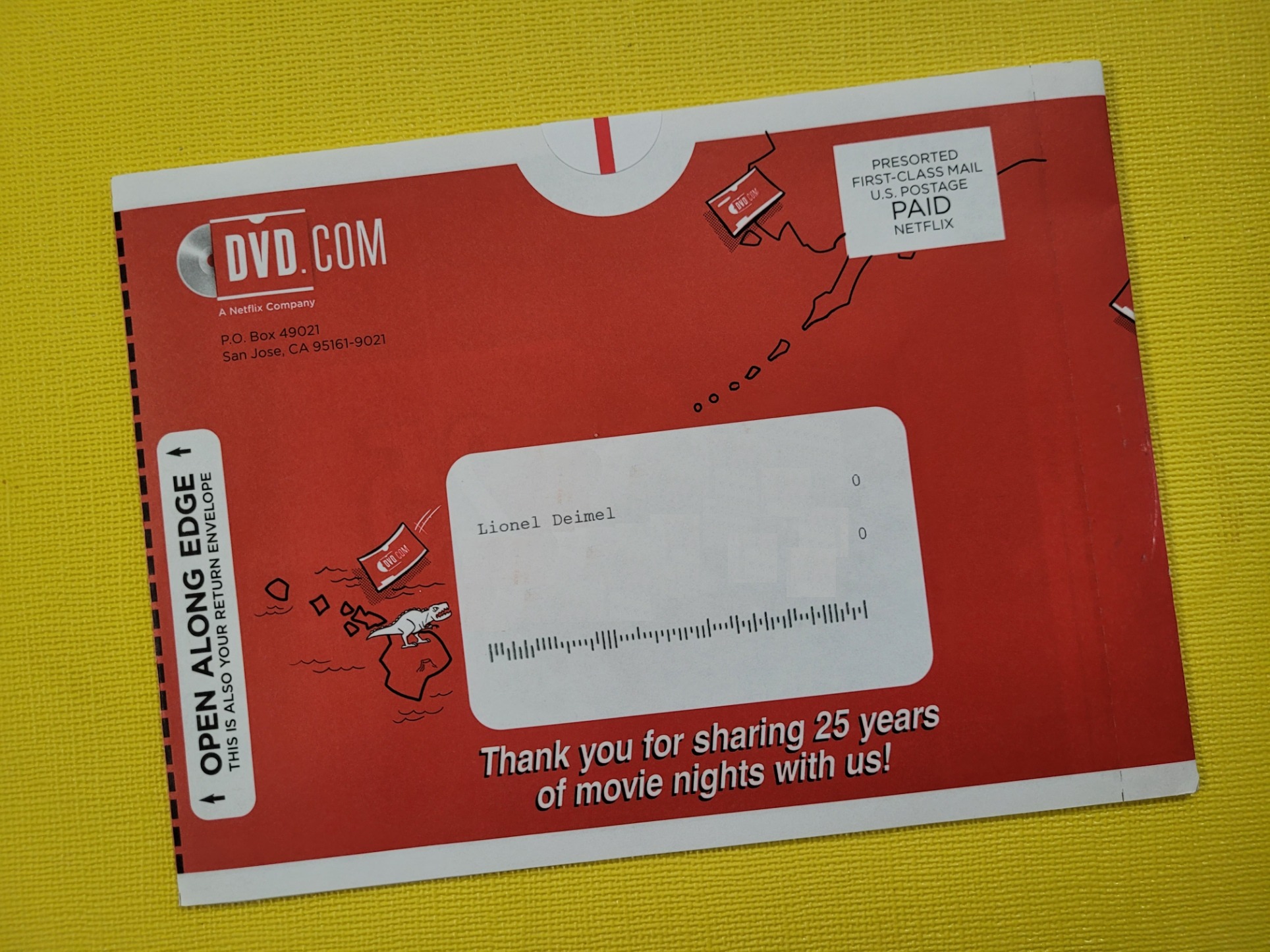
Lamenting the Loss of the Red Envelopes

I was very upset by the recent announcement that Netflix was terminating its DVD delivery service this fall. I first joined Netflix when all content was delivered by the Postal Service. I have continued to receive DVD and Blu-ray disks in the mail, though I use Netflix’s streaming service as well. The good news is that I will be paying Netflix less, but much is being lost.

Why do I continue to receive physical disks? No, I am not a Luddite; I enjoy the content I can receive via streaming. There are two losses I will experience when the red envelopes cease to arrive in my mailbox, however. The most important loss is access to films not available via streaming. Secondarily, I will lose access to the extra content that is frequently found on DVD or Blu-ray disks.

My interest in watching movies is atypical of Netflix users generally, but may not be atypical of DVD.com subscribers. I do not search available movies for “somethng to watch.” In a sense, I am not looking for “entertainment.” Instead, I am seeking insight into movie history, seeking classics every movie buff should see, and exploring the films of particular actors or directors. Because of my somewhat academic interest in cinema, I will even watch moves that I don’t expect to like. On physical disks, I can see older movies and movies lacking universal appeal. And, of course, I can even watch well-liked movies that are simply not available on Netflix for whatever reason.

Of course, the bonus of getting those disks in the mail is the extras usually found on DVDs and Blu-ray disks: commentaries, deleted scenes, “making-of” documentaries, biographical information, and the like. Such extras help put a film into a larger context and provide insight into the movie-making process. Seldom do I return a disk without watching all the extra on that disk.

In principle, there is no reason that movies available only through the mail could not be streamed. And why couldn’t those extras be streamed as well?

Will the demise of DVD.com result in movies now only available by mail becoming available to stream? I can hope, though I don’t expect it. I wonder what will happen to the large inventory of physical disks held by Netflix.

While there is still time, I am trying to see all the DVD.com movies I can before the service ends.


Netflix (DVD) envelope
One of the famous red envelopes

April 10, 2023

Fed Up

I often post graphics on Facebook that never appear here on my blog. What appears below began as a Facebook post. I thought others might want to see or use it. This may be copied freely.

April 4, 2023

Of Course, It’s Political

I am tired of hearing Trump and his minions complain that the various investigations of the former president—and now at least one actual indictment—are “political.” Yes, in fact, they are, but being political does not make them illegitimate. The primary meaning of “political” is, according to Merriam-Webster, “of or relating to government, a government, or the conduct of government.” In this sense, the judicial system is definitely and intrinsically political.

Of course, “political” can also refer to party politics. This is clearly the meaning in Trump’s mind and those of his supporters when they complain of political persecution. The term is imprecise and technically ambivalent. What they should be saying—not because it’s true but because it is what they want the public to believe—is that the investigations of Trump’s behavior is partisan. This word means “feeling, showing, or deriving from strong and sometimes blind adherence to a particular party, faction, cause, or person.”

One suspects that Donald Trump, who exhibits little concern for truth, is equally indifferent to the subtleties of the English language. 

April 1, 2023

A Walking Tour of Clifton Springs

Today was the first day of sunny, 70-degree weather in Clifton Springs since I moved here in November. I had to go outside just after noon and decided to walk south along Sulphur Creek. I was surprised to see dozens of ducks both in the creek and on its banks. (I’m still learning to identify ducks. I can recognize mallards, but I’m not good at naming other waterfowl.) The creek flows past the Clifton Springs hospital, and I discovered a pond with a fountain on the hospital grounds. There were more ducks around the pond, two mute swans in the water, and two turtles sunning themselves on a rock. I had a very pleasant stroll.

I’ve wanted to explore Clifton Springs further. The pleasant weather and my discoveries along the creek inspired me to take a longer walk through the town. Clifton Springs is a small village, and it is not unreasonable to plan to explore each of its streets. I thought of doing this by car, but today it seemed like a walking tour was indicated. My walk lasted more than an hour. Although I have not yet explored every street in the town, I am off to a good start.

I returned home with a number of impressions. First, the town has a large amount of parkland for such a small place. The housing stock seems surprisingly good, sometimes even charming. And, although sidewalks are not universal, there are a lot of them. Finally, I was already aware that this area is not a bastion of liberal sentiment. (I have disliked virtually every vote my Republican congresswoman has cast, for example.) I was a bit taken aback by a number of Christian-oriented signs I saw in front of houses, which I assume were not indicating the presence of Episcopalian families. (One house had a large cross that said: “JESUS SAVES.”) I saw only one Trump sign and a distressing banner: “JESUS IS MY SAVIOR/TRUMP IS MY PRESIDENT” No, actually, he isn’t.


On the whole, Clifton Springs, New York, is a fine place. I doubt I will be able to do much to improve the sentiments of its residents.

March 30, 2023

Baseball Changes

 Major League Baseball begins a new season today. And the season begins with new rules intended to increase scoring and get games over with faster. A sport that was distinctive for lacking a clock will now have a pitch clock, larger bases, restrictions on pickoff plays, and a prohibition of the defensive shifts that have frustrated batters. The universal introductions of the designated hitter and video replays seem like minor tweaks compared to the rule changes that will color the 2023 season.

Baseball rules have been remarkably stable over the game’s long history. Past changes have primarily been made to increase safety or fairness. (Changes to the mound height and the introduction of pitchless intentional walks are exceptions.) I have always thought that the size of the diamond and its bases are perfect. The dimensions make scoring a single or stealing a base difficult, which makes them more exciting when they occur.

I am not looking forward to the new MLB season. In fact, I think the game should no longer be called baseball. Like the reformulation that produced New Coke, the MLB game should be called New Baseball. We can hope that the history of New Baseball will be a replay of the history of New Coke.