May 7, 2022

A Comprehensive Examination of the Abortion Question

What follows is a minor revision of an essay first written last December and subjected to minor changes a few days later. Given the precarious state of abortion rights, I am re-posting it in the hope of reaching a wider, more engaged audience. I am doing so with additional revisions intended to clarify certain points and to better reflect current circumstances.

Reading through my blog, I find that I have addressed abortion rights often. In the essay below, I may revisit ideas presented earlier, but my goal is to treat reproductive freedom more comprehensively than I have in the past. The right of women to control their own reproductive lives is being seriously challenged. It is critical that those of us who believe that women have an inherent human right to make decisions about their bodies without interference from government or individuals collect rhetorical tools that may be useful in the struggle for women’s freedom. Ultimately, however, it is not rhetoric alone that will prevent women from becoming permanent second-class citizens, but the ballot box.

Although my blog promises “quick takes,” this particular post is unusually long. Therefore, I am providing a table of contents for those who may wish to read it selectively:
Introduction
The Case for Unrestricted Access to Abortion
Objections to Abortion
Supreme Court Actions
Additional Considerations
The Fraught Future

 Abortion has been practiced for millennia. It has sometimes been controversial, though not always. Contemporary debate about the procedure seldom proceeds from first principles. Yet exploring the roots of arguments on both sides of the abortion debate allows us to test those arguments for consistency and reasonableness, and it helps us sharpen our own thoughts. This gives us tools to counter the foundations of opposing views, whether or not those foundations are acknowledged.


Political Context

Legal scholars generally agree that the Constitution does not offer unambiguous guidance as to the propriety of statutory restrictions on abortions. In Roe v. Wade (1973), the Supreme Court declared that women have a constitutional right to have an abortion. The court based its decision on a right to privacy that itself is inferred from the due process provisions of the Fifth and Fourteenth Amendments to the Constitution. That right has been invoked to justify other rights, such as the general use of contraceptives and same-sex marriage.

Conservatives believe that Roe was wrongly decided. Not even all liberals are happy with the details of the decision. Justice Ruth Bader Ginsburg, for example, argued that Roe should have been based on equal protection. Nevertheless, Roe has been the law of the land for nearly half a century. (Roe was weakened but not overturned in Planned Parenthood v. Casey (1992). It was actually this later case that introduced the viability criterion discussed below.)

There is a strong strain of individualism in the United States, the notion that the government should not interfere in one’s personal affairs. This sense of personal freedom is usually framed as the ability of the individual to act as he or she sees fit, as long as no one else is harmed thereby. This formulation is not precisely codified in law, though it provides an informal guide to legislation. Nevertheless, the appearance of “LIBERTY” on U.S. coins has real meaning. The decision in Roe is consistent with this American ethos. Alas, people who are so jealous of their own freedom are not above trying to restrict that of others based on their own beliefs. This is the case with supporters of abortion restrictions who suffer no actual harm from the abortions of fellow citizens.

Most opponents of abortion rights, when pressed, offer a religion-based argument for their position. Few would argue, in public at least, that men should control women’s reproductive lives or that women who face an unintended pregnancy deserve to suffer the inevitable consequences. Many may well hold those views privately.

There is nothing wrong with advancing religious rationale in support of public policy. In the secular nation that is the United States, however, religious arguments have no privileged status. They are only useful for convincing others that are susceptible to them and who vote for like-minded legislators, lobby legislators, or, as legislators themselves, can vote based on their religious views. When our Republic is working properly—arguably, it is not doing so very well at the moment—religious views do not beget sympathetic legislation except when they are widely held and are not in conflict with the Constitution. 

Opposition to legal abortion is largely a minority religion-based view held, and held passionately, by a minority of citizens. Proponents of change are always more passionate in their beliefs than those who accept the status quo. That passion is intensified when undergirded by self-righteousness born of religious certainty. It is ironic that support for legal abortion is a majority position in the population at large but a minority position within the legislative class. (Explaining this phenomenon is beyond the scope of this essay.) Supporters of abortion rights have not had the zeal of their opponents.

The status quo at the moment is that women, anywhere in the United States, have, at least in theory, a constitutional right to obtain an abortion until the time when the fetus is “viable.” (Later abortions are obtainable under certain conditions and in certain jurisdictions.) Viability is understood as the point at which the fetus could survive outside the womb, generally considered to be about 24 weeks into the pregnancy. The Supreme Court has, in recent years, permitted states to make it increasingly difficult for women to exercise their theoretical right to an abortion. Cases currently before or likely to come before the Supreme Court, with its Trump-nominated Republican justices, may provide the opportunity for the court to jettison the viability standard or even to extinguish the constitutional right to abortion.
 

The Case for Unrestricted Access to Abortion

The case to be made for unrestricted access to abortion services is straightforward. Procreation is an intensely personal enterprise. By virtue of a right to privacy implied in the Constitution, the equal protection clause of the Fourteenth Amendment, and the reservation of unenumerated rights to the people declared in the seldom-cited Ninth Amendment (“The enumeration in the Constitution of certain rights shall not be construed to deny or disparage others retained by the people.”), one would expect that a woman should have an absolute right to terminate a pregnancy. Why should not the removal of a fetus be any different from the removal of, say, a prostate? 

Although abortion opponents readily cite the Tenth Amendment, which reserves undelegated powers to the states, they neglect to observe that those powers “are reserved to the States respectively, or to the people” (emphasis added). 

In fact, the right to bodily integrity is widely acknowledged as a human right—the U.N. Universal Declaration of Human Rights proclaims: “Everyone has the right to life, liberty[,] and security of person.” Such a right is seemingly embedded in the Fourth Amendment (“The right of the people to be secure in their persons, houses, papers, and effects, against unreasonable searches and seizures shall not be violated … .”) Unfortunately, the United States has a mixed record with regard to protecting the bodily integrity of its citizens. Drug laws and prohibitions against euthanasia, for example, seek to limit the freedom to control what one does with one’s body. Any law limiting the right to abortion is of that nature.

Keep Abortion Legal button

Sociological reasons for the universal availability of abortion are legion. Unintended pregnancies create personal, psychological, and financial difficulties. The pregnant woman may be too young and immature to handle motherhood or may find herself in circumstances in which having a child would be an impossible burden. She may be trying to complete her education or may simply have too many children already. (Many married women with children seek abortions.) She may be unable to support a child financially. She may have medical conditions that make pregnancy dangerous or even life-threatening. She may be carrying a damaged fetus likely to be severely handicapped or to die before birth. Her relationship with the father may be dysfunctional or violent. Or the pregnancy may be the product of rape or incest. To deny an abortion to a person in any of these circumstances is cruel and insensitive. If a woman is not allowed to make the decision to have an abortion based on whatever rationale she thinks compelling, then she does not enjoy the freedom that so many abortion opponents profess to value.

Opponents of abortion access are often judgmental and unable to appreciate the problems an unintended pregnancy causes or to empathize with the seeker after an abortion. They accuse women who want an abortion of using the procedure as birth control or of being careless about contraceptive use. But obtaining an abortion, even in the best of circumstances, is neither pleasant nor cheap; abortion is surely not a rational form of birth control. Fault-finding regarding an unwelcome pregnancy is unhelpful; the pregnancy itself demands to be dealt with. No birth control method save sterilization or celibacy is 100% effective. Even the married and conscientious get pregnant.

Abortion performed by a physician or through the use of medications is very safe, considerably safer than carrying a pregnancy to term, which was not necessarily the case when abortion restrictions were first imposed in the nineteenth century. Sadly, postpartum deaths and deaths resulting directly from childbirth are higher in the United States than in other developed and many underdeveloped countries. That abortion poses less risk to the patient than childbirth argues for choosing it if carrying a pregnancy to term is undesirable or risky.

Finally, it should be said that supporting unrestricted access to abortion services does not suggest that an abortion, in and of itself, is a good thing. In a perfect world, every pregnancy would be welcomed and would result in the birth of a beautiful, perfect baby delivered into the bosom of a loving family. We do not live in that world. Abortions are needed to make our imperfect world less imperfect.


Objections to Abortion

Those who support restrictions on abortions make four kinds of arguments. (Their true beliefs may differ from what they say in public.) First is the argument that the fetus, embryo, or even the fertilized egg is a human being. (Before reproduction was better understood, people believed that sperm contained actual, complete, yet minute, humans.) This is the absolutist argument. Second, anti-abortion advocates unwilling to insist that the tiniest collections of cells are human beings are quite willing to assert a need to protect the “unborn” at some point post-conception. A currently popular marker is the emergence of a “fetal heartbeat.” A more generous version of this position identifies viability as the point at which the growing fetus demands protection. The third argument is that abortions must be restricted to somehow advance a public policy objective such as protecting the mother. Finally, some argue that, for various reasons, abortions are simply unnecessary. Underlying most of these arguments is the belief that the pregnant person carries a distinct and separate person worthy of and in need of protection.

Let me address these arguments in turn.

The contention that a baby is sacrosanct beginning as a fertilized egg is almost always the view of right-wing Christians, who see a baby as a gift from God not to be rejected. This argument ignores the part people play in creating a pregnancy. Moreover, if a baby is God-given, are not cancerous tumors, hurricanes, and earthquakes also dispensations of God? Are we expected to accept these “gifts” meekly and without attempts to mitigate their effects? Neither the Old nor the New Testament has anything substantive to say about abortion. Jews acknowledge personhood only when a baby exits the birth canal. Jesus was mute on the matter. In fact, the “Christian” case against abortion, which is seldom challenged, is weak.

It is clarifying to consider analogues of the embryo. When a chicken lays an egg, we don’t call it a chicken. Likewise, an embryo is not really a human being. It is human tissue, but so are fingernails, hair, or blood. We can also consider the ontogeny of the embryo. Although it has the potential to become a complex animal, it is less advanced than a mouse or a dragonfly.

The prohibition of abortion originates in Roman Catholic theology, specifically in Pope Paul VI’s 1968 encyclical Humanae Vitae, the product of celibate men devised more or less out of whole cloth. And clearly, any argument involving the acquiring of a soul is a minority religious concept inappropriate as a basis of secular law. (When does the product of a pregnancy obtain a soul? What happens when an ensouled fetus dies in the womb? How many angels can dance on the head of a pin?)

The most radical anti-abortion proponents want the product of a pregnancy, from the point of fertilization onward, to be declared a “person,” with the same rights as other natural persons. Accepting this notion presents myriad practical and legal problems, which I will consider below.

Next are the arguments that draw a line somewhere before which abortion is proper and after which it is generally not. This is a difficult line to draw. The “fetal heartbeat” criterion is problematic. When such a “heartbeat” is detectable, at about six weeks, there is no fully formed heart—a complex organ—and, at six weeks, medicine does not even recognize the product of a pregnancy as a “fetus.” (It is still considered an embryo.) Even if there is a somehow meaningful “heartbeat,” we must ask what of it. A brain-dead adult can have a functioning heart yet still be, for all practical purposes, dead and useful only for organ harvesting. One’s heart doesn’t make one human. Neither does a liver or a kidney. Not even a brain makes one human; the aforementioned mouse has a brain. One might argue that an operative prefrontal cortex makes a fetus human, but its development is too late in gestation to satisfy anti-abortion partisans. Besides, babies born with serious brain defects are still considered human.

The Supreme Court has identified viability as the point at which we should draw the line after which abortion can, in most cases, be prohibited. Certainly, a viability criterion is more easily justified than say, the misnamed fetal heartbeat one. It is assumed that, at about 24 weeks, the fetus could, in principle, survive outside the womb and grow to become an actual person. This is a criterion that rests both on fetal development and current medical technology. Although someday we may have artificial wombs that allow a days-old embryo to grow into a baby, the 24-week viability criterion isn’t going to change much any time soon. I will have more to say about the viability test below. I believe that this dividing line, too, is flawed.

Next, consider arguments that restricting abortions somehow protects women or advances some other public good. These arguments are mostly ill-informed or insincere. The idea that prohibiting abortion access somehow “protects” women is, at best, paternalistic and infantilizing. It is sometimes argued, for example, that women who have had abortions experience depression, from which they must be protected. Actually, elation is a more likely psychological response, as an abortion can prevent the derailing of a woman’s personal or work life. According to the Guttmacher Institute, one in four women will have had an abortion by the age of 45, but there is no empirical evidence of widespread female depression resulting from those abortions. Postpartum depression, on the other hand, is common. Yet Republican lawmakers are fond of saying that restrictions on abortion are in the interest of women without explaining exactly in what respect that is true. But having an abortion entails less risk than carrying a pregnancy to term. True, women can make poor choices, but isn’t the right to make choices, whether wise or foolish, what freedom is all about? Even men make poor choices regarding their bodies, and they do so largely without governmental interference.

What, in fact, is the interest of the state in preventing abortions? Is there an urgent need to increase the population? If so, the task could be accomplished sooner by increasing immigration. Do people want to ensure that the genes of men are propagated into the gene pool? That seems unlikely. The women most often prevented from having abortions are poor and black. Do the authors of anti-abortion legislation want to increase the population of black babies? (It is absurd to think so, and they would be astounded and repulsed by the suggestion.) Do they want to grow the number of children with devastating abnormalities by preventing the early abortion of nature’s mistakes? Enquiring minds want to know.

Others argue, improbably, that abortions are really unnecessary. They say, for instance, that decades ago, abortions helped women escape the restrictions of wife, mother, and housewife and assume a liberated position in the workplace outside the home. Women have now achieved parity with men and no longer require the crutch of abortion. This argument is every bit as absurd as it sounds. Almost any woman can explain how she has failed to achieve equality with men either at home or in the workplace. Access to abortion surely assisted the liberation of women such as it is, but it is still needed for all the reasons it has always been needed.

An even more outrageous argument that abortions are unnecessary was advanced by Supreme Court Justice Amy Coney Barrett in the December 1 oral arguments before the court in the case of Dobbs v. Jackson Women’s Health Organization. Justice Barrett suggested that safe harbor laws make abortions unnecessary. Such laws allow a newborn to be surrendered at some specified public place (a fire station or hospital, for example) without penalty and without incurring any future responsibility for the child. In her view, a pregnancy can be carried to term, after which it will magically be as though it never happened. Apparently, Justice Barrett does not live in the same world as the rest of us. Pregnancy involves many inconveniences and dangers, which is why someone might want to terminate one in the first place. Moreover, giving up a child for adoption, even when done willingly and with advanced planning, is often psychologically damaging to both mother and child. Justice Barrett seems insensitive to the very real consequences of her proposal. Unfortunately, her status as a mother of both natural-born and adopted children may encourage people to accept her perverted logic.

All those who want to outlaw abortion speak in terms of a mother and her baby. “Baby” may not be a medically proper designation, but it is convenient terminology for illustrating an important concept. Prohibiting abortion of the baby forces one person to make a sacrifice for the benefit of another. This is an alien legal concept in U.S. law. No one is required to come to the aid of another unless that person is in a special occupation for which giving aid is a requirement. A firefighter, for example, is required to attempt to rescue someone from a burning building, an obligation that has been freely assumed. A bystander has no such obligation. In fact, forcing a woman to become or remain pregnant appears to be a crime against nature and, in some circumstances, a war crime under the Geneva Convention.

The Supreme Court adopted the viability dividing line as a compromise between those who would ban all abortions and those who would allow all abortions. The advantage of viability to the court was that it is a more-or-less definite criterion and the point at which, in some sense, the fetus could become an actual, functioning human being. Arguably, 24 weeks gives the mother ample time to choose to have an abortion, at least in most cases. But not in all cases. Fatal fetal abnormalities could be discovered beyond the 24-week cutoff or circumstances could prevent obtaining an abortion before viability.

From another point of view, viability is an illusory deadline. Although a 24-week-old fetus might be able to survive outside the womb, it is unlikely to be healthy or to enjoy anything like a normal life. More importantly, the viability criterion assumes a fetus removed from the mother. A pregnant woman desiring a post-viability abortion isn’t going to let anyone remove her fetus to prove viability in fact. If we have to have a cutoff point for most abortions, viability has its merits, but it isn’t quite what it seems to be.


Supreme Court Actions

In Roe in 1973, the Supreme Court articulated a constitutional right to an abortion. In Casey in 1992, the court affirmed that right but allowed states to regulate abortions so long as they did not create an “undue burden” on those seeking the procedure. State legislatures eagerly availed themselves of the opening provided by the court, having discovered that the prohibition of creating an undue burden for women was hardly an undue burden for them. They invented waiting periods, mandatory presentation of anti-abortion propaganda, parental-permission requirements for underage girls, and extraneous requirements for clinic architecture and clinic doctors. And they put restrictions on reasons for seeking abortions.

The various gratuitous regulations invented by Republican legislatures have resulted in the closure of many clinics, usually depriving women not only of abortion services but of other gynecological services as well. Women seeking abortions have faced long trips to faraway clinics as the number of clinics dwindled, and they often had to spend two or more days away from home. Not all the legislative attempts to make getting an abortion burdensome have survived court challenges, but, over the years, the right to obtain an abortion has become less and less substantive.

The addition of three Supreme Court justices nominated by President Donald Trump further emboldened Republican legislatures. Abortion opponents saw a high court newly stacked with sympathetic justices. Mississippi not only passed a law prohibiting abortions after 15 weeks but also invited the justices to overrule Roe and Casey. Texas has gone further, with its 6-week cutoff, vigilante enforcement, and prohibition of medicinal abortions. Court-watchers expect that the Mississippi and Texas laws are likely to be deemed lawful by the court and the nationwide right to an abortion will be extinguished.

Supreme Court decisions that have limited individual rights are prominent on lists of the worst ever decisions of the court. Think Dred Scott v. Sanford, Plessy v. Ferguson, and Korematsu v. United States, among others. Never has the court affirmed a significant right only to repudiate it decades later. We are likely to see the court in its current term add to the list of its worst decisions should it overturn Roe, as many will expect it will.


Additional Considerations

Restrictions on abortions have placed a special burden on poor and minority women. Not only have state legislatures placed barriers to their exercising their supposed right, but the federal government has been prevented from paying for abortions under Medicaid. Middle- and upper-class women have always had the option of traveling to wherever necessary to obtain abortions. Not everyone is equal in their access to abortion services because of their economic status.

It is tragic that anti-abortion activists and legislators have shown such sympathy for what they have called the “unborn,” yet show hardly any empathy for already-born women facing difficult life choices. They revel in a “fetal heartbeat” while seeming indifferent to the fact that the pregnant woman has a heartbeat, too.

It is appalling that so many Americans are willing to require women to carry to term unwanted children and children resulting from rape or incest. A friend of mine who was an RN in pre-Roe days told me of a 14-year-old who had been impregnated by her father. She wrote, “After a traumatic birth she ended up in a psych unit.” There are thousands of such pre-Roe stories, many of which have endings even less happy. What is the point of creating such tragedies? Is not requiring that all pregnancies be carried to term a kind of slavery, in which the state commandeers unwilling citizens, endangering and upending their lives to achieve some ill-conceived public service? A woman is more than her uterus, and recruiting her uterus against her will is an unspeakable evil. Adult males can control their own bodies; should not adult females have the same right? Isn’t this what the Fourteenth Amendment is all about? It is ironic that many countries, even those with largely Roman Catholic citizens, are liberalizing access to abortion at a time when the United States is doing the opposite.

Speaking of the Fourteenth Amendment, it is significant that that amendment begins as follows:

All persons born or naturalized in the United States, and subject to the jurisdiction thereof, are citizens of the United States and of the State wherein they reside. No State shall make or enforce any law which shall abridge the privileges or immunities of citizens of the United States; nor shall any State deprive any person of life, liberty, or property, without due process of law; nor deny to any person within its jurisdiction the equal protection of the laws.

“Unborn children” are, by the definition of citizenship in the amendment, not citizens at all. Even calling them “persons” would not make them citizens. They have no free will to act in the world, which is characteristic of actual persons. Efforts to make the products of pregnancy “persons” are nonsensical and have the potential to cause all sorts of legal mischief. Some such mischief is already apparent, as women have been prosecuted for “killing” a fetus by virtue of having had a normal miscarriage. It has often been argued in such cases that maternal behavior, such as drug use, caused the miscarriage. The extreme of declaring a fetus a person has the potential to make every miscarriage into a search for the method by which a mother “murdered her baby.” This would convert ordinary misfortunes into personal catastrophes. Of course, the ultimate motivation behind the movement to make the “unborn child” a person is to make abortions—all abortions—instances of “murder.”

As noted earlier, the entire anti-abortion movement rests upon the notion that the product of a pregnancy is a human being. This is not a logically necessary view. It is equally logical to regard an embryo or fetus as a part of a woman’s body and therefore not subject to state regulation. It is interior to her body and is nourished by it. Some have even seen a fetus as a kind of parasite, and I’m sure that reluctantly pregnant women might well view it as such. In either case, its disposition should be within the woman’s power to determine.

Declaring that fertilization creates a human being is risible and can only be justified by specific religious arguments. It is a concept held by a minority of a minority. Procreation is not an event but a process, of which fertilization is only a part, though surely a vital part.


The Fraught Future

Arguably, access to abortion has always been a human right. The Supreme Court that once declared it a constitutional right has allowed that right to become less and less reified. If the justices use the vehicle of Dobbs to declare that Roe was decided in error, that there is no such constitutional right, states will be able to regulate abortion as they see fit. If the court reverses Roe, abortion will instantly become illegal in many states due to their legislatures having passed so-call trigger laws. The scope of women’s health care will immediately be diminished.

Of course, the court may simply chip away at the right to abortion a little more, jettisoning the viability standard and replacing it with a 15-week standard or some other more slippery demarcation. Unless the Supreme Court simply declares the Mississippi law unconstitutional, an exceedingly unlikely outcome, women will be the losers.

The Republican- and Roman Catholic-dominated court actually has some incentive not to throw Roe overboard. A decision will come this summer or, less likely, somewhat earlier. Eliminating a constitutional right that women have enjoyed for nearly half a century is certain to have electoral consequences in the 2022 midterm elections. Abortion will become a more prominent campaign issue, perhaps even of paramount concern in the upcoming elections. What Republicans have seen as an opportunity to take back the House of Representatives, and perhaps even the Senate, could become a Democratic landslide. Some observers, however, do not believe that the backlash will be that significant.

Unfortunately, the right-wing justices seem indifferent to both their obligations to the law and to society at large. Republican-appointed justices repeatedly assert that their judicial opinions are not “political,” despite all indications to the contrary. The Catholic-dominated court has repeatedly chipped away at the traditional separation of church and state, elevating the freedoms of religious people above all other Constitution-protected freedoms. The court refused to stay Texas’s law SB 8 which is clearly unconstitutional until the court declares otherwise, ignoring both normal legal procedure and any social consequences of their inaction. And, of course, the court includes a justice clearly willing to do the bidding of the former president and who has a wife who played a significant role in subverting the peaceful transfer of presidential power.

The justices must consider whether eviscerating a well-established constitutional right will deal a grave blow to the already diminished reputation of the Supreme Court. After all, the court’s opinions are the law of the land because the people consider them to be such. But messing with Roe could diminish public acceptance of the court. Justice Sonia Sotomayor, in the oral arguments in Dobbs mentioned earlier, asked pointedly if the court could survive the “stench” that such a move would create “in the public perception that the Constitution and its reading are just political acts.”

Denying the existence of a right to privacy on which Roe was decided endangers other decisions of the Supreme Court over the years that have expanded sexual freedom: contraceptive use, same-sex activity and marriage, and the ability to marry outside one’s race. How much “settled law” is this court willing to un-settle should they overturn Roe?

Whatever the Supreme Court decides in Dobbs or possibly a case involving Texas’s SB 8, believers in women’s autonomy must step up their efforts to protect women and to send the message that religious extremists cannot be allowed to control this country. If access to abortion ceases to be recognized as a constitutional right, Congress, through legislation, can make it a statutory right throughout the country. If women do not have access to abortions everywhere, then only some women have control over their own bodies.

It is time for people to vote out of office legislators at both the state and federal levels that are clearly out of touch with the will of the people. Ultimately, we may need a constitutional amendment to protect the right to an abortion. In a rational nation, the choice to have an abortion should be made by the woman affected with the advice of her doctor, a clergyperson, or other trusted advisors. We should trust women and physicians to make reasonable decisions, not decisions constrained by statutes that cannot countenance all the factors relevant to such a life-changing (and often life-saving) choice.

Our country is not free if women are not free.

May 6, 2022

Vast Minority

I heard a brief item on the radio today. It concerned the Pittsburgh public schools. The reporter wanted to communicate the fact that most teachers in the Pittsburgh public schools are white. She wanted to emphasize, however, that the system has few teachers of color. She described the situation rather oddly, I thought: “Teachers of color are in the vast minority.”

“Vast minority,” really? The reporter clearly chose this locution by analogy to “vast majority.” But “vast” means great in size—a vast majority could not mean 51%, for example. I think the reporter was trying to say that there are very few teachers of color, many fewer than 49%. The minority of such teachers is not vast at all. She could have said that there is a vast lack of teachers of color. (This would be similar to the usually ironic phrase “plentiful lack.”) That would have been odd phrasing as well, but it would actually make some sense. The sentence as delivered makes no sense at all.


Update (5/9/2022): After hearing the report again, I revised the post to reflect the exact sentence the reporter used

April 20, 2022

Rhymes in “Paul Revere’s Ride”

I first encountered Henry Wadsworth Longfellow’s poem “Paul Revere’s Ride” in high school. It is an excellent piece of literature to study, as it provides a gentle introduction to poetry and has the benefit of teaching a little history as well. (One should not take everything in the poem as historical fact, however.)

Paul Revere
Paul Revere (from J.S. Copely painting)
I liked the poem so much that I memorized the first few stanzas of it. Memorizing the whole poem apparently required more commitment than I was able to muster.

In any case, on the two-hundred-forty-seventh anniversary of the events described in the beginning of the poem—i.e., on April 18, 2022—I took a closer look at the poem. The first thing I noticed is that the stanzas vary in length. Moreover, there is no consistent rhyme scheme. The poem is not, for example, constructed of a sequence of rhymed couplets. Nevertheless, the poem is full of rhymes.

I have long been intrigued by differing rhyme schemes and have employed a variety of them in my own poetry. Besides using a series of couplets, the simplest possible scheme—see, for example, “Maidenhood”—I have employed the more difficult to sustain ABAB form—see, for example, “Musashi’s Odyssey.” Somewhat easier to write is the ABCB form, which I used in “First Class” and “The Quecreek Mine Disaster.” Some of the more interesting rhyme schemes I’ve used include ABBC in “Thanksgiving” and ABCDCBA in “Sunday Afternoon,” a poem deliberately written to employ this unusual mirrored-stanza scheme. Of course, some of my poems don’t rhyme at all, such as “It’s Beginning to Look a Lot Like Christmas,” which nevertheless is composed of stanzas of equal length.

Then there is the “Paul Revere” poem. As one reads it—as I read it anyway—one is aware of there being rhymes, but rhymes that fall into no consistent pattern. Nonetheless, the poem reads well. Upon close examination, one notices that the poem contains not a single unrhymed line, although rhyming lines are sometimes widely separated from one another. In the stanza beginning “It was one by the village clock,” the second line rhymes only with the eighth and last line. Only one rhyme seems a bit forced: Lexington/upon. It is easy to excuse this is a poem constrained, in large measure, by historical facts. (Wadsworth studied the history of Revere’s mission, but he took liberties in his poem for his own reasons.) Also, some may object to lane/again, but this is perfectly conventional. One can imagine the poem with different line breaks, but, of course, this would obscure the rhymes further.

I invite you to enjoy “Paul Revere’s Ride” below, where I have indicated the rhymes in the left column. Longfellow did a masterful job!
  

Paul Revere’s Ride 
A   Listen, my children and you shall hear
A   Of the midnight ride of Paul Revere,
B   On the eighteenth of April, in Seventy-Five:
B   Hardly a man is now alive
A   Who remembers that famous day and year.

A   He said to his friend, “If the British march
B   By land or sea from the town to-night,
A   Hang a lantern aloft in the belfry-arch
B   Of the North-Church-tower, as a signal-light,—
C   One if by land, and two if by sea;
C   And I on the opposite shore will be,
D   Ready to ride and spread the alarm
D   Through every Middlesex village and farm,
D   For the country-folk to be up and to arm.”

A   Then he said “Good night!” and with muffled oar
A   Silently rowed to the Charlestown shore,
B   Just as the moon rose over the bay,
B   Where swinging wide at her moorings lay
C   The Somerset, British man-of-war:
C   A phantom ship, with each mast and spar
C   Across the moon, like a prison-bar,
D   And a huge black hulk, that was magnified
D   By its own reflection in the tide.

A   Meanwhile, his friend, through alley and street
B   Wanders and watches with eager ears,
B   Till in the silence around him he hears
C   The muster of men at the barrack door,
A   The sound of arms, and the tramp of feet,
B   And the measured tread of the grenadiers
C   Marching down to their boats on the shore.

A   Then he climbed to the tower of the church,
B   Up the wooden stairs, with stealthy tread,
B   To the belfry-chamber overhead,
A   And startled the pigeons from their perch
D   On the sombre rafters, that round him made
D   Masses and moving shapes of shade,—
E   By the trembling ladder, steep and tall,
E   To the highest window in the wall,
F   A moment on the roofs of the town,
F   Where he paused to listen and look down
E   And the moonlight flowing over all.

A   Beneath, in the churchyard, lay the dead,
B   In their night-encampment on the hill,
B   Wrapped in silence so deep and still
A   That he could hear, like a sentinel’s tread,
C   The watchful night-wind, as it went
C   Creeping along from tent to tent,
D   And seeming to whisper, “All is well!”
D   A moment only he feels the spell
A   Of the place and the hour, and the secret dread
A   Of the lonely belfry and the dead;
C   For suddenly all his thoughts are bent
E   On a shadowy something far away,
E   Where the river widens to meet the bay,—
F   A line of black, that bends and floats
F   On the rising tide, like a bridge of boats.

A   Meanwhile, impatient to mount and ride,
A   Booted and spurred, with a heavy stride,
B   On the opposite shore walked Paul Revere.
A   Now he patted his horse’s side,
B   Now gazed on the landscape far and near,
C   Then impetuous stamped the earth,
C   And turned and tightened his saddle-girth;
D   But mostly he watched with eager search
D   The belfry-tower of the old North Church,
E   As it rose above the graves on the hill,
E   Lonely and spectral and sombre and still.
F   And lo! as he looks, on the belfry’s height,
F   A glimmer, and then a gleam of light!
G   He springs to the saddle, the bridle he turns,
F   But lingers and gazes, till full on his sight
G   A second lamp in the belfry burns!

A   A hurry of hoofs in a village-street,
B   A shape in the moonlight, a bulk in the dark,
B   And beneath from the pebbles, in passing, a spark
A   Struck out by a steed that flies fearless and fleet:
C   That was all! And yet, through the gloom and the light,
C   The fate of a nation was riding that night;
C   And the spark struck out by that steed, in his flight,
A   Kindled the land into flame with its heat.

A   He has left the village and mounted the steep,
A   And beneath him, tranquil and broad and deep,
B   Is the Mystic, meeting the ocean tides;
C   And under the alders, that skirt its edge,
C   Now soft on the sand, now loud on the ledge,
B   Is heard the tramp of his steed as he rides.

A   It was twelve by the village clock
B   When he crossed the bridge into Medford town.
A   He heard the crowing of the cock,
C   And the barking of the farmer’s dog,
C   And felt the damp of the river-fog,
B   That rises when the sun goes down.

A   It was one by the village clock,
B   When he galloped into Lexington.
A   He saw the gilded weathercock
C   Swim in the moonlight as he passed,
D   And the meeting-house windows, blank and bare,
D   Gaze at him with a spectral glare,
C   As if they already stood aghast
B   At the bloody work they would look upon.

A   It was two by the village clock,
B   When he came to the bridge in Concord town.
B   He heard the bleating of the flock,
C   And the twitter of birds among the trees,
C   And felt the breath of the morning breeze
B   Blowing over the meadows brown.
D   And one was safe and asleep in his bed
E   Who at the bridge would be first to fall,
D   Who that day would be lying dead,
E   Pierced by a British musket-ball.

A   You know the rest. In the books you have read,
A   How the British Regulars fired and fled,—
B   How the farmers gave them ball for ball,
B   From behind each fence and farmyard-wall,
C   Chasing the red-coats down the lane,
C   Then crossing the fields to emerge again
D   Under the trees at the turn of the road,
A   And only pausing to fire and load.

A   So through the night rode Paul Revere;
B   And so through the night went his cry of alarm
B   To every Middlesex village and farm,—
A   A cry of defiance, and not of fear,
C   A voice in the darkness, a knock at the door,
C   And a word that shall echo forevermore!
D   For, borne on the night-wind of the Past,
D   Through all our history, to the last,
E   In the hour of darkness and peril and need,
A   The people will waken and listen to hear
E   The hurrying hoof-beats of that steed,
A   And the midnight message of Paul Revere.


Note:
 Minor edits were made to the introduction to the poem 6/23/2022.

March 18, 2022

Are the End Times Upon Us?

I’ve been watching the first spring training game of the Pittsburgh Pirates. The Pirates are playing the New York Yankees. I cannot shake the feeling that the time is out of joint, that the end times may be upon us.

  • Guardians Logo
    Logo of the Guardians
    The Cleveland Indians are now, after more than a century, the Cleveland Guardians. Perhaps they’re now providing home security.
  • Umpires are wearing advertising. Apparently this unfortunate innovation is not going away anytime soon. Is advertising next going to appear on player uniforms? Will individual players have sponsors. Where does this end? Does MLB an an insatiable appatite for ever more income?
  • The designated hitter has come to the National League. Real baseball is now officially dead, and baseball managers are now relieved of performing one of their most difficult jobs.
  • There is even talk of outlawing the defensive shift. Perhaps we will place markers on the field and require that every play must begin with every player on his designated mark.

And, of course, Vladimir Putin is threatening to initiate World War III.

It’s been a halfway decent world while it lasted.

March 16, 2022

When Can We End Russian Sanctions?

NPR’s Steve Inskeep reported on his interview with Secretary of State Anthony Blinken on today’s Morning Edition:

[Blinken] insisted that U.S. sanctions against Russia are “not designed to be permanent,” and that they could “go away” if Russia should change its behavior. But he said any Russian pullback would have to be, “in effect, irreversible,” so that “this can't happen again, that Russia won’t pick up and do exactly what it’s doing in a year or two years or three years.”

Blinken made it clear, however, that he expects Russia neither to halt its aggression nor to offer diplomatic concessions any time soon.

It’s hard to know whether to be encouraged by Blinken’s words. On the one hand, the suggestion that sanctions could “go away” if Russia changes its behavior sounds like we might be ready to let Russia off easy. On the other hand, the demand that Russia, from this time forward, behave like a responsible, civilized state is unlikely to be pledged and, if promised, would be impossible to enforce. Forever is, after all, a long, long time. One has to think that Blinken’s demand is ironically akin to Putin’s insistence that Ukraine never seek NATO membership.

What is it the world—much of it anyway—needs here? First, of course, the aggression must stop. After that, Ukraine must be made whole. (It has been suggested that, as of now, this will cost half a trillion dollars, though even that will not repair the human carnage.) Secretary Blinken is right to demand that Russia never again attacks its neighbors. We must be real here, however. That can never be guaranteed as long as Putin is in power, if then.

Sanctions must not be lifted before the fighting stops, Russia takes responsibility for reconstructing the country it has ravaged, and Putin is no longer in power. Sanctions were imposed to change Putin’s behavior, but they must be kept in place to punish Russia for its unspeakable behavior. Putin’s stepping down in favor of one of his cronies will not be enough. Further, Putin must be tried for war crimes, which he has assuredly committed. If these requirements are met, sanctions can be gradually lifted.

I fear this conflict may outlast the Biden presidency. If so, I worry that a Republican president, whether or not it is Donald Trump, will let Russia off the hook. I sincerely hope that our current policy, or something very much like it, will remain resolutely bipartisan. I am not totally sanguine about that.

President Volodymyr Zelenskyy addressed Congress today via video. As expected, he asked for additional war materiel. His strongest emotional appeal, however, came in the form of a brief video illustrating, in painful-to-watch graphics, the damage being done by Russia to the cities and people of Ukraine. I hope that members of Congress were asking themselves how they would feel if what there seeing happened in their own back yards—to New York or to Chicago or to Pheonix or to Duluth.

Zelenskyy addressed Biden with these words: “Being the leader of the world means being the leader of peace.” I hope our president was listening.

March 8, 2022

Which Way Does the Fan Turn?

I encountered a collection of fans in a physical therapy facility. The fans are suspended from the ceiling by very long rods, possibly as long as ten feet. I was first struck by the fact that the fans are rock-stable. There is no visible wobble at all. I have no idea who manufactured them.

Observed from the floor, the fan blades move counter-clockwise. I noticed, however, that if I told myself the blades were moving clockwise, I could actually see them that way. Take a look yourself and see if this little mental trick works for you.

March 5, 2022

Schroeder Update 12

Yesterday, I was to take Schroeder to receive his second FVRCP vaccination and to have a microchip implanted. Of course, I first had to get him into a carrier. Performing this trick with Linus and Charlie has always been difficult, and I had no reason to believe that putting Schroeder into his carrier would be markedly easier.

I was girded for battle. I was wearing my sturdy Carhartt shirt and my leather gloves. Schroeder approached me and let me pet him, but when I tried to grab him with both hands, he slipped away like the proverbial bat out of hell. In the process of retreating to his redoubt between the couch and the plant stand, he overturned his water bowl, spilling its contents into the food bowl. This led to a temporary hiatus from cat catching to clean up the mess. I gathered up the kibble and took the water and food bowl out of the room. I vacuumed up a few errant pieces of kibble.

Cat capture then resumed. I moved the plant stand to gain access to Schroeder, He then ran between the couch and the wall. I used a pole to flush him out. He ran around the other side of the couch, and my attempt to grab him as he emerged was, unsurprisingly, unsuccessful. He retreated to his favorite resting place. I moved the end of the couch against the wall, cutting off that avenue of escape. I also moved the plant stand out of the way. When I tried to grab him, he hissed at me and lunged with claws bared. His outburst was surprisingly violent, given his usual laid-back demeanor. A claw barely reached through my glove. (This was to be my sole injury for the day.)

At this point, I called a friend who had helped me corral Linus and Charlie in the past. She couldn’t come over immediately but agreed to be on call if I needed her later. I thought it likely that her services would be required.

Schroeder was now cornered, but any attempt to grab him was clearly hazardous. Without having a clear strategy for getting the cat into the carrier, I placed the open carrier in front of Schroeder. He was now trapped between the couch, the wall, the carrier, and its wire door. I tried to explain that he needed to enter the carrier, but he seemed indifferent to my explanation. After a minute or two and by means I cannot explain, I got Schroeder into the carrier. I closed the door and sighed in relief. I was exhausted.

I put carrier and cat into the car and headed for the vet appointment. The half-hour drive was peaceful; I heard not a peep from Schroeder. I was apprehensive when the woman who was to give Schroeder his shot and his microchip opened the carrier to extract the cat. She was, however, very good at her job. Sitting on the floor in front of the carrier, she grabbed Schroeder by the scruff of the neck and put him between her legs. The shot and microchip were administered in less than a minute. Not a sound was heard from Schroeder.

The trip home was again quiet and uneventful. (Well, I was listening to NPR.) I left Schroeder in the car while I put the room back together. I filled the water and food bowls, moved the couch, and replaced the plant stand. Finally, I brought Schroeder inside and placed the carrier on the floor.

Schroeder back home
Schroeder back home

I opened the carrier, but Schroeder did not come out, even with cat treats in front of him. He stuck out his head for a moment and then retreated into the safety of the carrier.

Free in principle
Schroeder free to come out

After waiting a few minutes for some movement, I left the room. When I returned a while later, Schroeder was out of his carrier and resting in his favorite spot.

Schroeder at rest
Schroeder at rest

The day’s mission had been accomplished. Schroeder would not need to see a vet for a year. The task now was to improve socialization and to find Schroeder a forever home.


NOTE: Schroeder’s story to date can be followed here.

Wanted for Crimes: Vladimir Vladimirovich Putin


February 9, 2022

Celebrating 20 Years

Today I celebrate the 20th anniversary of this blog, Lionel Deimel’s Web Log. Twenty years ago, the term “blog” had not yet become common. I’ve chosen to leave well enough alone and not change the name. Nor have I changed the description “Random quick takes by Lionel Deimel.” Over the years, my posts became less quick and less short. Most of my really quick takes are now posted on Facebook, often in private groups to which I belong. Occasionally, I cross-post my Facebook commentary here.

My blog was inaugurated under the same philosophy as that of my Web site, Lionel Deimel’s Farrago. I write what interests me, and I don’t limit myself to any particular topic. This makes posts more fun to write, but it attracts fewer long-term readers. So be it.

Many of my posts have been about the trials, triumphs, and insights of ordinary life. For example, one of my first posts was “How Much Power Can It Take to Run a Map Light?” I have often used posts to call attention to my poems on my Web site. Occasionally, I have posted a poem not yet posted there and possibly still a draft. An example is “Happy Summer Day.” Politics has been the subject of a large number of posts, including this recent one: “Letter to Senator Joe Manchin.”

I suspect that I have written more posts about the Episcopal Church, its liturgies, and its politics than about any other subject. Although such posts are not of general interest, they sometimes attract more readers than my other essays. Episcopalians are passionate about things Episcopalian. Many such posts have chronicled and commented on the split between loyal Episcopalians and reactionary insurgents that resulted in the splitting up of the Episcopal Diocese of Pittsburgh. An example of a newsworthy post about the diocese is “Trinity Cathedral Casts Its Lot with TEC.” A sample liturgical (and rather wonky) post would be “Line Breaks in the BCP’s Rendering of the Nicene Creed.”

To date, I have published just under 1500 posts. This seems a good time to list some of my favorite posts. The list is chronological and might be different if I made the list tomorrow or thought about it for a month. (Note that some external links may not be current.)

February 3, 2022

A Schroeder Table of Contents

I have now written many posts about the cat I named Schroeder that I began feeding at my back door. For anyone who wants to read the entire story of Schroeder to date, I am providing a table of contents listing all my Schroeder posts.

Date Post Comments
11/12/2021 Schroeder Introducing the cat I have been feeding from time to time.
11/19/2021 Schroeder Update 1 Schroeder visits again. I took a nice portrait.
12/30/2021 Schroeder Update 2 Another nice photograph.
1/11/2022 Schroeder Update 3 I plan to trap Schroeder.
1/12/2022 Schroeder Update 4 I set the trap, but only after Schroeder left.
1/13/2022 Schroeder Update 5 (sort of) I trapped the wrong cat.
1/14/2022 Schroeder Update 6 (again, sort of) Ozzie (the wrong cat) goes home.
1/17/2022 Schroeder Update 7 Cat trapping resumes (unsuccessfully).
1/18/2022 Schroeder Update 8 (caught!) Schroeder is caught and ensconced at home.
1/20/2022 Schroeder Update 9 Schroeder gets improved living arrangements and an appointment with a vet.
1/25/2022 Schroeder Update 10 Schroeder gets fixed and is out of his cage.
2/3/2022 Schroeder Update 11 Schroeder settles in.
3/5/2022 Schroeder Update 12 Schroeder takes another trip to the vet.
6/29/2022 Schroeder Update 13 Schroeder gets the run of the house.
7/4/2022 Schroeder: A Cat Who Needs a New Home Schroeder is up for adoption.
8/24/2022 Schroeder Goes to His New Home Today The Schroeder story has a happy ending.

Schroeder Update 11

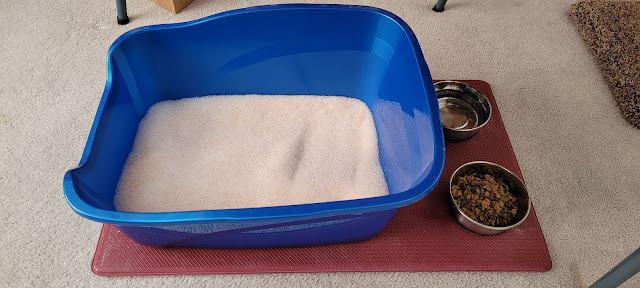
 Schroeder has been settled in for a few days now. I have taken the cage and a blanket I was loaned back to the animal shelter. I bought a pad to put under the litter box, water bowl, and food bowl. The litter pan I purchased for the cage in which Schroeder was originally confined was technically made for kittens. Schroeder is definitely not a kitten. (The vet pegged him as two years old and just over nine pounds.) I replaced the pan with a much more commodious litter box. There is now much less litter on the floor. (I had been vacuuming a lot.)

Litter, food & water for Schroeder
Updated facilities for Schroeder

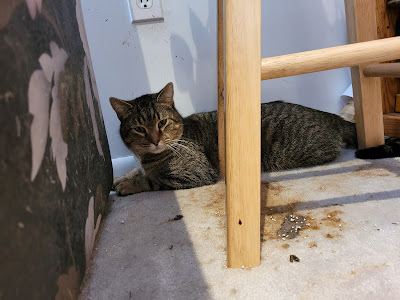
Schroeder continues to be a surprisingly laid-back cat. He spends much of his time in a cozy spot between the couch and a plant stand.

Schroeder’s favorite spot
Schroeder’s cozy spot. Stains on the carpet are from the flowerpot above.

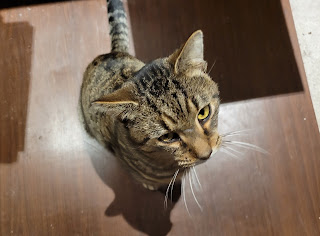
Schroeder comes out immediately when I enter the room and readily accepts my petting him. He has shown no interest in toys, whether or not they contain catnip. I can pick him up, but he immediately jumps down when I try to put him on my lap. Good photos of the cat are hard to get because he is either in his favorite spot (see above) or very close to me.

Schroeder at my feet
Schroeder at my feet.

Note: Schroeder’s story to date can be followed here.

January 25, 2022

Schroeder Update 10

 Yesterday was the day I was to take Schroeder to a neutering clinic to have him fixed, vaccinated, and given other veterinary care. I felt fortunate to have found out about this opportunity to give him all the immediate care he needs at an affordable price. The clinic is sponsored by Cat Aid Network.

Cats were to arrive at the clinic between 7:45 and 8:15 am. Since the drive was to take nearly half an hour, I set my alarm for 6 am, an hour later than usual. I ate breakfast and dressed in 45 minutes. The next step was to secure Schroeder in his carrier in preparation for our trip.

Since Schroeder had been spending nearly all his time in a carrier—see a photo of the arrangement I had created for him in my last post—I expected that corralling him for the trip to the clinic would be a snap. When I walked into the room, I saw that he wasn’t in the cage—good. Then I discovered that he wasn’t in the carrier either. He had somehow escaped confinement. This was troublesome but hardly not shocking, as the connection between cage and carrier was more psychological than physical. I quick look around the room found Schroeder hiding on a bookshelf just off the floor. With my leather gloves and heavy-duty Carhartt shirt, I grabbed the cat, thrust him into the carrier, and closed the carrier door.

I pulled out of the driveway at 7:14 am, a minute before my planned departure time. There was light snow, but the drive was uneventful. The address I was given was for an empty warehouse. I arrived a few minutes early and saw that four or five cars with cats were already in the parking lot. After a few minutes, a woman entered the warehouse and emerged with a sign that said SPAY CLINIC and waved the cat owners inside. The building looked like, well, an empty warehouse. There was a small room at the right, and this is where cats in their carriers were being collected. The place had the ambiance of a pre-Roe back-alley abortion clinic. (I later learned that procedures were not performed in the warehouse room but in a truck that arrive later with two actual veterinarians.) I left Schroeder after filling out a couple of forms and drove home in more light snow.

About 3:30 pm, got the call that Schroeder was ready to be picked up. By this time, the snow was a little heavier, but the retrieval went smoothly. I wrote a check for the veterinarian services. This was the first time I had written a check in a year or maybe two years. Only cash or checks were accepted. (Who writes checks anymore?) I picked up Schroeder in his carrier and headed home.

When I returned home about 4:30, I opened the door of the carrier and let Schroeder roam about. He was most interested in food and water and seemed none the worse for wear. (He had been given an injection for pain.) In the evening, he was walking about, nuzzling my leg, allowing me to pet him, and even letting me pick him up. Suddenly, he seemed very socialized. When left alone, he retreated to a cozy corner he found between the couch and a plant stand.

I am cautiously optimistic that Schroeder will be an adoptable cat, though I will have to find a home for him. I had thought him quite young, but the vets apparently concluded that he is about two years old.

For now, I am removing the cage and carrier and letting Schroeder range about the room. I’ll write more about him when there’s something interesting to say.

Schroeder Back Home
Schroeder back home before I removed the cage and carrier.

Note: Schroeder’s story to date can be followed here.

January 20, 2022

Schroeder Update 9

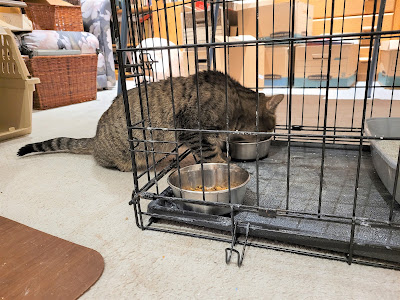
The enclosure I set up for Schroeder when I brought him home from the animal shelter—see details here—was frankly jury-rigged. Since I didn’t have a proper litter pan, I fashioned one from a cardboard box. I had some litter-box liners I could use, so this sort of worked. I almost immediately constructed another one from a smaller box to give the cat a bit more room in the enclosure, however. Schroeder seemed to be spending all his time sitting in the makeshift litter pan. The next day, there was litter everywhere, including in the food and water bowls. I removed the bowls for cleaning, and, when I filled the food bowl, the cat at voraciously. I gave him a second helping.

By this time, I had opened the enclosure door and placed an open carrier in front of it. This gave Schroeder a sort of second room to his temporary home. Today, I found a proper litter pan. It is designed for a kitten, but it should be serviceable, and it takes up less room than my cardboard pans.

The current setup for Schroeder looks like this:

Where you may ask, is the cat? Well, he is in the carrier on the left. He has been there all day and has hardly moved. As far as I can tell, he has neither drunk, nor eaten, nor used the litter pan. I have tried to coax him out of hiding, but he has been, shall I say, unmoved. I have—wisely, I hope—not tried to dislodge him. Assuming he is not suffering from depression or catatonia—note the clever use of the term there—he will have to show himself eventually.

The good news is that on Monday, four days from now, I will be taking Schroeder to a clinic sponsored by Cat Aid Network. He will be neutered, vaccinated, and otherwise cared for. Between now and then, I’m hoping that Schroeder and I will become friends.

Stay tuned for further updates.


Note: Schroeder’s story to date can be followed here.

January 18, 2022

Schroeder Update 8 (caught!)

It was very cold today, and there was about 9 inches of snow on the ground. I noticed that there were prints in the snow leading to the small shelter I had put outside in the hope that Schroeder would find it and use it as a refuge from the cold. (There is a picture of the shelter in yesterday’s post.) I had not put the trap out today thinking that it might not work well in the snow.

In the early afternoon, I saw Schroeder leaning against the glass surrounding the back door. I quickly got a food bowl for him. When I opened the door, he clearly wanted to come inside. I put out the bowl, closed the door, and took a moment to think. The cat was clearly hungry, so perhaps I could induce him to enter the trap. I removed the food bowl and put out the trap, which had more food already inside. Schroeder walked around the trap, eying the food. Eventually, he entered the trap, but, to my surprise, he didn’t trigger the door that would have trapped him inside. (The trigger for the trap is a metal plate just in front of the bait.) I tried to close the trap door, but the cat came out. I decided to go inside and see what would happen next.

A few minutes later, I saw that Schroeder was inside the trap, and the door had been triggered. I had caught my intended quarry!

I brought the trap inside and was surprised that the cat was not struggling, though he did protest verbally a little. I set the trap down so I could call the shelter. The photo below shows Schroeder just after I brought him inside. Note the snow still clinging to the trap.

The next step was to take trap and cat to the animal shelter to check for a chip. The trip took 10 minutes or so, and I heard not a sound from Schroeder. It took a few minutes to check if the cat was chipped, as he really didn’t seem to want to move. We finally succeeded in checking. As I expected, there was no chip. Schroeder seemed to be on his own.

It isn’t clear what the step after neutering should be. Is this cat adoptable or will he need to be returned to the wild? The shelter did not have room for him, but I was sent home with Schroeder in a cage. On the way home, I was deciding where to put the new boarder. For safety’s sake, I wanted to keep him away from my own cats.

When I got home, I put Schroeder in a room I could close off (though Linus seemed to sense that something was up). It took a few tries before I constructed an adequate litter box and found bowls that took up as little room as possible in the modest cage (approximately 24x17 inches). I took the photo below once the cage was equipped with litter, food, and water. After the photo was taken, I replaced all three containers with smaller ones to give Schroeder as much room as possible.

Schroeder has been very quiet and still. I have not tried to handle him at all. Tomorrow, we’ll see if we can be friends.


Note: Schroeder’s story to date can be followed here.

January 17, 2022

Terrorism? Really?

President Biden called the hostage incident in a Texas synagogue “an act of terror.” The FBI, which is now investigating the 11-hour standoff that resulted in no casualties other than the hostage-taker, is calling the event “terrorism-related.”

Given that the perpetrator, Malik Faisal Akram, apparently demanded the release of convicted terrorist Aafia Siddiqui, the “terrorism-related” description appears justified. But did Akram really commit “an act of terror,” as the president asserted? Was he himself a terrorist?

Not everyone agrees on just what terrorism is. Merriam-Webster offers a straightforward definition:

the systematic use of terror especially as a means of coercion

Merriam-Webster further provides multiple definitions of terror, including:

a state of intense or overwhelming fear
or
violence or the threat of violence used as a weapon of intimidation or coercion, especially violent or destructive acts (such as bombing) committed by groups in order to intimidate a population or government into granting their demands

The first definition captures the meaning of terror as a human emotion. For example, someone trapped in a burning building and facing a horrible death is surely experiencing terror. The second definition seems too broad, though the description following especially captures what most of us think of as terror or terrorism.

Malik Faisal Akram did indeed employ “violence or the threat of violence used as a weapon of intimidation or coercion.” But does not an armed bank robber do the same? Yet it would be viewed as odd to call the run-of-the-mill bank robber a terrorist.

Akram did not seek to intimidate the government or American citizens generally. As most of us understand terrorism, it necessarily involves inspiring fear (i.e., terror) in a wide audience. For example, flying airplanes into the World Trade Towers was a crime, but it was certainly also an act of terrorism. It scared the shit out of the entire country, which, no doubt, was the desired effect. Akram’s deeds not so much. He was a kidnapper and extortionist, and his crimes may have arisen in part from antisemitic animus. But I do not think him a terrorist.

President Biden, like many of us, was appalled by Akram’s actions. Rather than thinking deeply about the matter before speaking, he used the word “terror” because of the reaction that word elicits. He acted as many dictators do, labeling any violent act they dislike or fear as “terrorism.”

After 9/11, the words “terror” and “terrorism” themselves have become terrifying. They have become weapons in the hands of self-serving politicians because they call forth such visceral reactions and discourage further rational thought.

I do not believe that President Biden had ulterior motives in saying what he did. He is, after all, known for his less-than-precise declarations. This is not to excuse him, of course, and one could wish that, as President of the United States, he would edit his pronouncements more carefully. I think the president simply meant that Malik Faisal Akram did a really bad thing, something that was more reprehensible for having been committed inside a synagogue during a worship service. What he did was terrible, but it was not an act of terror.

Schroeder Update 7

My previous post about trying to capture Schroeder can be found here.

Yesterday was a frustrating day. I got up, went to the bathroom, and fed the cats. As I began fixing breakfast, I noticed that Charlie was staring out the back door. Sure enough, Schroeder was there, and I hadn’t put out the trap. It was a cold day (about 12 degrees), so I put out a bowl of food for the cat. Schroeder ate, though not all that much. After his snack, He sat for a time under the deck, a few yards from the back door. Since any water nearby would be frozen, I put out a bowl of water as well. Schroeder seemed uninterested.

After Schroeder went away, I put out the trap and a cat shelter that my own cats have never used. I thought the shelter might be attractive in the bitter cold. (See photo below,)

Cat Trap & Shelter

My visitor did not return. Snow began falling about 3 PM, and it was supposed to continue for 24 hours or so. Since I didn’t want to drive to the animal shelter in the snow should I trap Schroeder, I brought the trap inside.

This morning, there is at least six inches of snow on the ground, and it’s still snowing. Cat trapping will resume tomorrow.


Note: Schroeder’s story to date can be followed here.

January 14, 2022

Schroeder Update 6 (again, sort of)

Let me begin by saying that, despite deploying the trap again today, I did not capture Schroeder.

A neighbor reminded me that I had a list of e-mail addresses of people in the neighborhood. Hoping that someone knew something about the orange tabby I caught in the trap yesterday, I sent a message to all my neighbors. It didn’t take long to get a message back that an orange tabby had escaped his home and was missing. It seemed unlikely that there were two orange tabbies roaming about, but I was perplexed by having been told that the escaped cat was chipped. Nevertheless, I told my neighbor that the cat I had trapped was at a local shelter. The cat, Ozymandias (Ozzie for short), a neutered male, was retrieved from the shelter this afternoon. As it happens, the cat was inherited from a relative who said the cat was chipped, but that may have been a misrepresentation. (Ozymandias is a name I had never heard before. I doubt that many cats are given this name.)

Anyway, the orange tabby adventure has ended happily. The trap will be set out tomorrow in the hope of capturing Schroeder.

As I mentioned yesterday, I forgot to take a picture of the cat I trapped. His owners have kindly provided a couple of pictures of Ozzie at home:


Note: Schroeder’s story to date can be followed here.

January 13, 2022

Schroeder Update 5 (sort of)

As I reported yesterday, I put out a trap in hopes of capturing Schroeder. I brought the trap inside last night, as I did not want to capture any of the wildlife that sometimes shows up under my bird feeders at night. I returned the trap outdoors early this morning and gave it a look from time to time.

A little bit before noon, I saw that the trap held a cat. Alas, the cat was not Schroeder! Instead, I had caught an orange tabby I had seen a few times before. This cat was larger than Schroeder and, I assumed, older. When I went out to the trap, the cat was running about frantically and loudly protesting its confinement. I knew my next step was to check whether the cat had an identifying chip. I didn’t know what the next step was going to be after that.

I put the trap and cat into the car and drove to the animal shelter. The cat was calmer by the time we arrived, though it meowed constantly during the trip. It was not possible to check for a chip while the cat was in the trap, so the cat, Judy—a shelter employee, not her real name—and I went into a small bathroom where, if the cat eluded human control, it couldn’t get far. (I don’t yet know if the animal is male or female and didn’t make any attempt to find out.) We opened the trap, got the cat’s head and neck out, and scanned for a chip. The scan was negative.

At this point, I was afraid I would face an unpleasant choice: return the cat to where I found it or have it neutered at my expense and return it to where I found it. The former option seemed to miss an opportunity, but the latter one would be costly without advancing my original objective.

Judy was convinced that the cat was not feral; once out of the trap, he could be handled without the huge pair of gloves Judy brought into the bathroom. She left me with the cat and returned with a carrier. I was afraid this was being lent to me to take the animal away. But no. the cat was to stay at the shelter for now. I filled out a form identifying me and the place the cat was captured, and I was sent on my way with the now-empty trap.

When I got home, I decided not to put the trap outside again; the day had been too traumatic. Instead, I returned to folding underwear I had washed earlier. I did this with the help of a glass of brandy to calm my nerves. I’ll put out the trap in hopes of catching Schroeder tomorrow. Since I know the orange cat hangs around the neighborhood, I plan to ask around to learn if anyone admits to owning the cat or knows who does.

I did take away some lessons from today’s adventure. First, when you set a trap, you can’t guarantee what you’re going to catch. I had worried about catching a raccoon or (heaven forbid) a skunk. I hadn’t considered that I might catch another cat. Second, a trapped animal can seem pretty wild, and I found this unnerving. When I brought the trap inside, the cat stopped moving about frantically, though it was still very vocal. I tried talking to the cat in reassuring tones and assumed that, even caged, there was something to be said for being in a warm place on a cold January day. Finally, I learned that my choice of a stainless steel bowl to hold the bait (i.e., cat food) was a good choice. Both cat and bowl seemed to be flying about the trap when I went out to investigate what I had caught.

Well, we’ll see what we catch tomorrow.

P.S. I meant to take a picture of the orange tabby, but, amid all the excitement, I forgot to do it.

 Update, 1/14/2022. Rereading my post today, I found several errors resulting from my having written rather hurriedly yesterday. These have been corrected.


Note: Schroeder’s story to date can be followed here.

January 12, 2022

Schroeder Update 4

Schroeder came by again today. I had not yet eaten breakfast when I saw Linus looking intently out the glass near the bottom of the door. He then moved to look out the glass on the side of the door. I looked outside and there was Schroeder. I quickly filled a bowl for him with cat food and set it outside. A couple of hours later, I picked up a trap from a local animal shelter and placed it outside.

Here is a picture of the trap, filled with food and armed:

I don’t know if Schroeder is smart enough to notice the food but not smart enough to recognize the danger of being trapped. I also worry that I may trap other non-feline wildlife in the area.


Note: Schroeder’s story to date can be followed here.